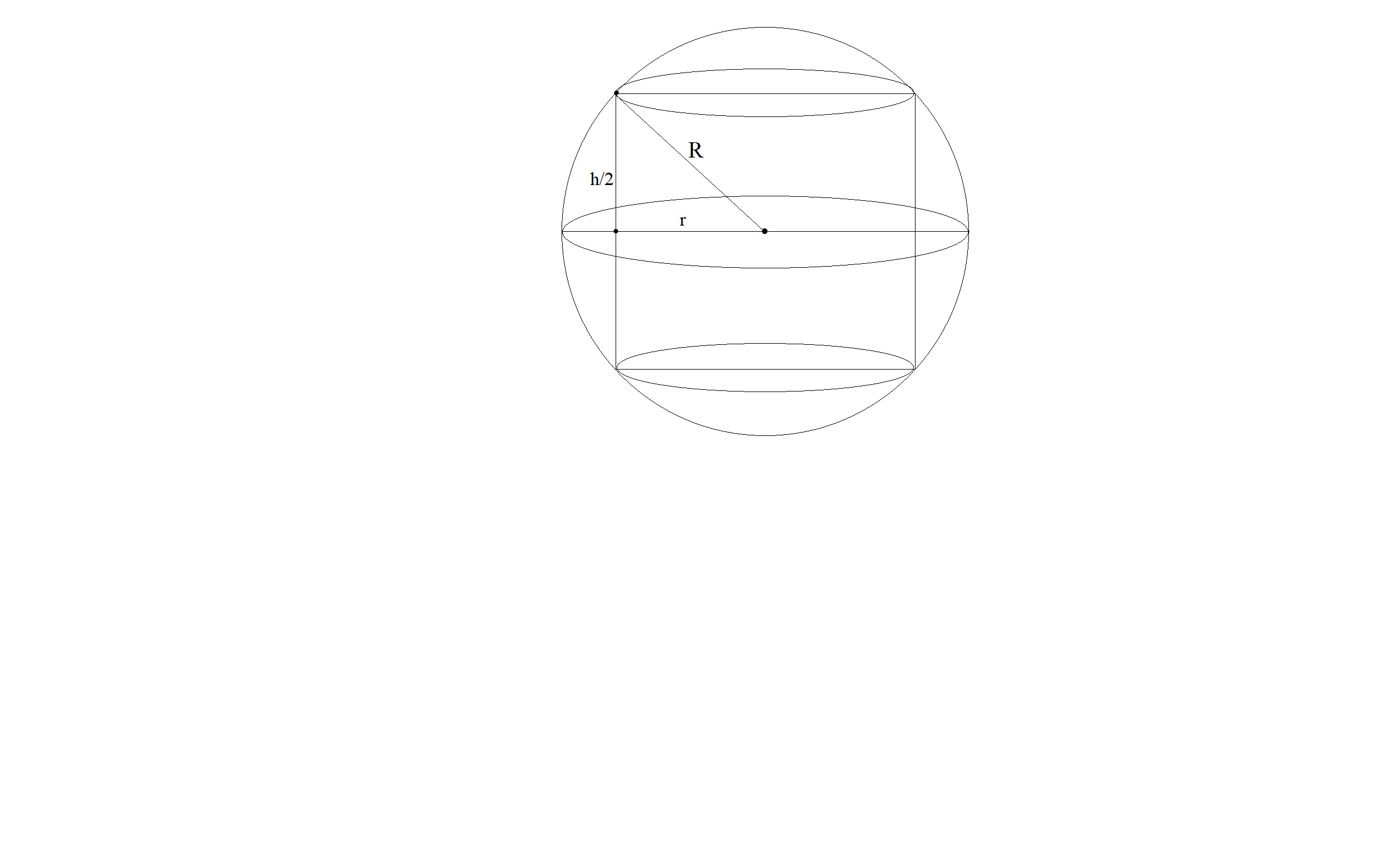
Let R = R= R = the radius of the sphere, r = r= r = the radius of a base of a inscribed cylinder, h = h= h = the height of a cylinder.
Then V c y l = π r 2 h . V_{cyl}=\pi r^2 h. V cy l = π r 2 h .
By the Pythagorean Theorem
R 2 = r 2 + ( h / 2 ) 2 c o n s t R^2=r^2+(h/2)^2\ \ const R 2 = r 2 + ( h /2 ) 2 co n s t
r 2 = R 2 − ( h / 2 ) 2 r^2=R^2-(h/2)^2 r 2 = R 2 − ( h /2 ) 2 Substitute
V c y l = V ( h ) = π ( R 2 − ( h / 2 ) 2 ) h V_{cyl}=V(h)=\pi (R^2-(h/2)^2) h V cy l = V ( h ) = π ( R 2 − ( h /2 ) 2 ) h
V ( h ) = π 4 ( 4 R 2 h − h 3 ) , 0 < h < 2 R V(h)=\dfrac{\pi}{4}(4R^2h-h^3) , 0<h<2R V ( h ) = 4 π ( 4 R 2 h − h 3 ) , 0 < h < 2 R Find the first derivative with respect to h h h
V ′ ( h ) = π 4 ( 4 R 2 − 3 h 2 ) V'(h)=\dfrac{\pi}{4}(4R^2-3h^2) V ′ ( h ) = 4 π ( 4 R 2 − 3 h 2 ) Find the critical number(s)
V ′ ( h ) = 0 = > π 4 ( 4 R 2 − 3 h 2 ) = 0 V'(h)=0=>\dfrac{\pi}{4}(4R^2-3h^2)=0 V ′ ( h ) = 0 => 4 π ( 4 R 2 − 3 h 2 ) = 0
h 1 = − 2 3 R , h 2 = 2 3 R h_1=-\dfrac{2}{\sqrt{3}}R, h_2=\dfrac{2}{\sqrt{3}}R h 1 = − 3 2 R , h 2 = 3 2 R If 0 < h < 2 3 R , V ′ ( h ) > 0 , V ( h ) 0<h<\dfrac{2}{\sqrt{3}}R, V'(h)>0, V(h) 0 < h < 3 2 R , V ′ ( h ) > 0 , V ( h ) increases.
If 2 3 R < h < 2 R , V ′ ( h ) < 0 , V ( h ) \dfrac{2}{\sqrt{3}}R<h<2R, V'(h)<0, V(h) 3 2 R < h < 2 R , V ′ ( h ) < 0 , V ( h ) decreases.
The function V ( h ) V(h) V ( h ) has the absolute maximum on [ 0 , 2 R ] [0, 2R] [ 0 , 2 R ] at h = 2 3 R . h=\dfrac{2}{\sqrt{3}}R. h = 3 2 R .
r 2 = R 2 − ( 2 2 3 R ) 2 = 2 3 R 2 r^2=R^2-(\dfrac{2}{2\sqrt{3}}R)^2=\dfrac{2}{3}R^2 r 2 = R 2 − ( 2 3 2 R ) 2 = 3 2 R 2
r = 2 3 R r=\dfrac{\sqrt{2}}{\sqrt{3}}R r = 3 2 R
V c y l m a x = π ( 2 3 R 2 ) ( 2 3 R ) V_{cyl\ max}=\pi(\dfrac{2}{3}R^2)(\dfrac{2}{\sqrt{3}}R) V cy l ma x = π ( 3 2 R 2 ) ( 3 2 R )
= 4 3 π 9 R 3 ( u n i t s 3 ) =\dfrac{4\sqrt{3}\pi}{9}R^3({units}^3) = 9 4 3 π R 3 ( u ni t s 3 )
If R = 1 , R=1, R = 1 , then V c y l m a x = 4 3 π 9 u n i t s 3 . V_{cyl\ max}=\dfrac{4\sqrt{3}\pi}{9}{units}^3. V cy l ma x = 9 4 3 π u ni t s 3 .
Comments