
Search & Filtering
Three particles of equal masses m are placed at the vertices of an equilateral triangle of
side 2.0 m. Determine the centre of mass of this system.
A particle is being rotated in a centrifuge which has a radius of 5.0 m. If the
particle’s centripetal acceleration is 4 g, determine its speed. What is the time period
of its motion?
A satellite of mass 2500 kg is orbiting the Earth in an elliptical orbit. At the apagee, the
altitude of the satellite is 3000 km, while at the perigee its altitude is 1000 km. Calculate
the energy and angular momentum of the satellite and its speed at the apagee and perigee.
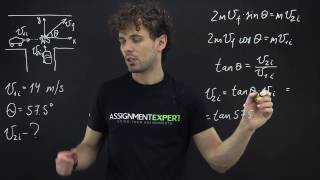
A particle of mass 3m initially moving with a speed u in the positive x-direction
collides with a second particle of mass m moving in the opposite direction with an
unknown speed v. After collision the mass 3m moves along the negative y-direction
with a speed u/2 and the mass m moves with a speed v in a direction making an angle
of 45˚ with the positive x-direction. Determine v and v in units of u. Is the collision
elastic?
A disc rotates with a period of 0.50s. Its moment of inertia about its axis of rotation is 0.08 Kg m²
. A small mass is dropped onto the disc and rotates with it. The moment of
inertia of the mass about the axis of rotation is 0.02 kg m²
. Determine the final period
of the rotating disc and mass system.
A merry-go-round is initially at rest. On being given a constant angular acceleration it
reaches an angular speed of
1 0.50 rad/sin 10.0 s. At t = 10.0 s, determine the
magnitude of: (i) the angular acceleration of the merry-go-round ; (ii) the linear velocity
of a child sitting on the merry-go-round at a distance of 3.0 m from its centre; (iii) the
tangential acceleration of the child; (iv) the centripetal acceleration of the child; and
(v) the net acceleration of the child.
Find the ground-state electron energy by substituting the radial wave function, 𝑅(𝑟)= 2𝑎𝑜3/2𝑒−𝑟𝑎𝑜⁄ that corresponds to 𝑛 = 1,𝑙 = 0, into radial equation for hydrogen atom.
Calculate the critical frequency for the E layer if maximum ionic densities are 3 x 10⁶
A.15.58 x 106
B.15.58 kHz
C.1.58 x 103
D.None of the above
. Derive Schrodinger wave equation from Cartesian coordinates into Spherical polar coordinates. 1 𝑟 2 𝜕 𝜕𝑟 (𝑟 2 𝜕𝜓 𝜕𝑟 ) + 1 𝑟 2𝑠𝑖𝑛𝜃 𝜕 𝜕𝜃 (𝑠𝑖𝑛𝜃 𝜕𝜓 𝜕𝜃) + 1 𝑟 2𝑠𝑖𝑛2𝜃 𝜕 2𝜓 𝜕𝜙2 + 2𝑚 ℏ 2 (𝐸 − 𝑈)𝜓 = 0
In Stern-Gerlach experiment, calculate the force being exerted on the silver atoms due to the inhomogeneous magnetic field and hence calculate the maximum displacement occurs between the traces.

 #339914 on Dec 2023