Answer on Question #67025, Physics / Optics
Light from a mercury lamp falls on two slits separated by 0.6mm , and the resulting interference pattern is observed on a screen 2.5m away from the slits. If the adjacent bright fringes are separated by 2.27mm , what is the wavelength of the light?
Find: λ−?
Given:
d=0.6×10⁻³ m
L=2.5 m
Δx=2.27×10⁻³ m
n=1.0
Solution:
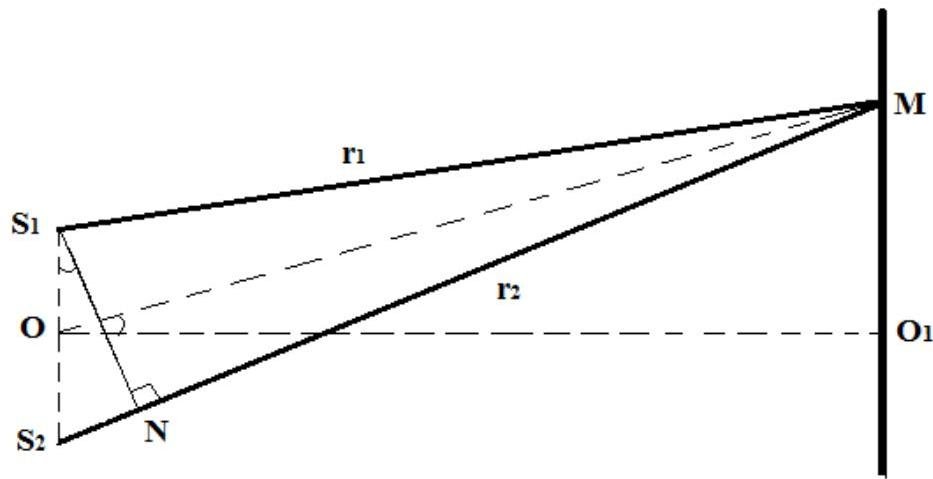
S1 and S2 are the point sources
d is the distance between S1 and S2
Zero interference maximum is in point O1 .
L is the distance between the point sources and screen
Choose on screen the point M , where there is a dark line.
Dark line responsible the interference minimum.
Condition of interference maximum:
nΔr=kλ(1),
where Δr is the geometric difference at which the waves come to the point M from S1 and S2 , n is the absolute index of refraction, λ is the wavelength of light, k=0,±1,±2,… (the number of minimum)
From Figure ⇒ the similarity of triangles (by two angles):
ΔOO1M∼ΔS1NS2
MOS1S2=O1MS2N
Of (2) and Figure ⇒MOd=xΔr (3)
Since d<<L , then MO≈L (4)
(4) in (3): Ld=xΔr (5)
Of (5) ⇒Δr=Ldx (6)
(6) in (1): nLdxk=kλ (7)
Of (7) ⇒xk=ndkλL (8)
Of (7) ⇒xk+1=nd(k+1)λL (9)
Δx=xk+1−xk (10)
(8) and (9) in (10): Δx=ndλL (11)
Of (11) ⇒λ=LndΔx (12)
Of (12) ⇒λ=544.8×10⁻⁹ m
**Answer:**
544.8×10⁻⁹ m
Answer provided by https://www.AssignmentExpert.com



 #339914 on Dec 2023