Question #66908

Two slits are spaced 0.3 mm apart and are placed 50cm from a screen. Suppose the entire apparatus is immersed in water. What is the distance between the second and third dark lines of the interference pattern when the slits are illuminated with the light of 600 nm wavelength?

Expert's answer

Answer on Question #66908, Physics / Optics

Two slits are spaced 0.3mm0.3\mathrm{mm} apart and are placed 50cm50\mathrm{cm} from a screen. Suppose the entire apparatus is immersed in water. What is the distance between the second and third dark lines of the interference pattern when the slits are illuminated with the light of 600nm600\mathrm{nm} wavelength?

Find: Δx?\Delta x - ?

Given:

d=0.3×10³ md = 0.3 \times 10^{-3} \mathrm{~m}

L=0.5 mL = 0.5 \mathrm{~m}

n=1.33n = 1.33

λ=600×109 m\lambda = 600 \times 10^{-9} \mathrm{~m}

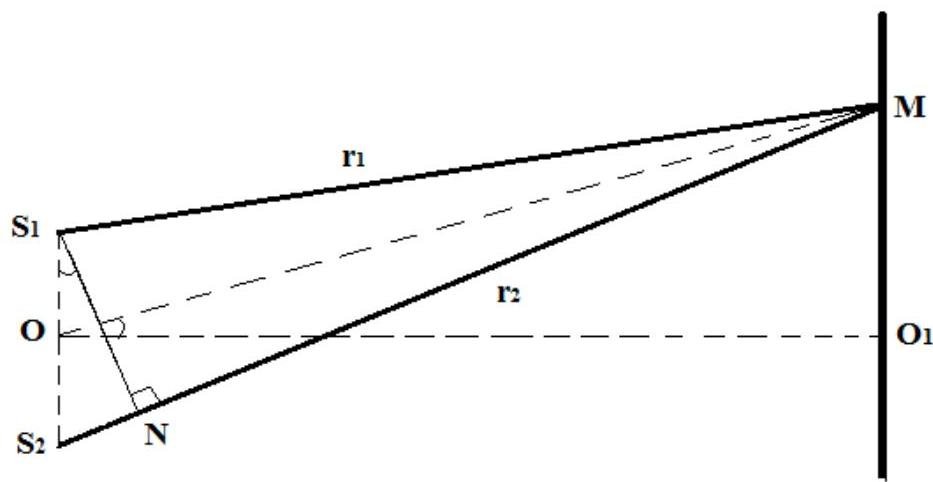
S1S_{1} and S2S_{2} are the point sources

d is the distance between S1S_{1} and S2S_{2}

Zero interference maximum is in point O1O_1 .

L is the distance between the point sources and screen

Choose on screen the point MM , where there is a dark line.

Dark line responsible the interference minimum.

Condition of interference minimum:

nΔr=(2k+1)λ2(1),\mathrm{n}\Delta \mathrm{r} = (2\mathrm{k} + 1)\frac{\lambda}{2} (1),

where Δr\Delta r is the geometric difference at which the waves come to the point MM from S1S_{1} and S2S_{2} , nn is the absolute index of refraction, λ\lambda is the wavelength of light, k=0,±1,±2,k = 0, \pm 1, \pm 2, \ldots (the number of minimum)

From Figure \Rightarrow the similarity of triangles (by two angles):

ΔOO1MΔS1NS2\Delta \mathrm{OO}_1\mathrm{M}\sim \Delta \mathrm{S}_1\mathrm{NS}_2

S1S2MO=S2NO1M\frac {S _ {1} S _ {2}}{M O} = \frac {S _ {2} N}{O _ {1} M}


Of (2) and Figure dMO=Δrx\Rightarrow \frac{d}{MO} = \frac{\Delta r}{x} (3)

Since d<<Ld << L , then MOLMO \approx L (4)

(4) in (3): dL=Δrx\frac{d}{L} = \frac{\Delta r}{x} (5)

Of (5) Δr=dLx\Rightarrow \Delta r = \frac{d}{L} x (6)

(6) in (1): ndLxk=(2k+1)λ2n \frac{d}{L} x_k = (2k + 1) \frac{\lambda}{2} (7)

Of (7) xk=(2k+1)λ2nLd\Rightarrow x_{k} = \frac{(2k + 1)\frac{\lambda}{2}}{n_{L}^{d}} (8)

Of (8) xk=(2k+1)λL2nd\Rightarrow x_{k} = \frac{(2k + 1)\lambda L}{2nd} (9)

Of (9) xk+1=(2(k+1)+1)λL2nd\Rightarrow x_{k + 1} = \frac{(2(k + 1) + 1)\lambda L}{2nd} (10)

Δx=xk+1xk\Delta x = x_{k + 1} - x_{k} (11)

(9) and (10) in (11): Δx=λLnd\Delta x = \frac{\lambda L}{nd} (12)

Of (12) Δx=0.752×10³m\Rightarrow \Delta x = 0.752 \times 10^{-3} \, \text{m}

**Answer:**

0.752×10³m0.752 \times 10^{-3} \, \text{m}

Answer provided by https://www.AssignmentExpert.com

Need a fast expert's response?

Submit order

and get a quick answer at the best price

for any assignment or question with DETAILED EXPLANATIONS!

LATEST TUTORIALS
APPROVED BY CLIENTS