Question #109586

Use the graph to determine the limit. (If an answer does not exist, enter DNE.)

WebAssign Plot

(a)

lim

x→c+

f(x) =


(b)

lim

x→c−

f(x) =


(c)

lim

x→c

f(x) =


Is the function continuous at

x = −5?


Yes

No

Expert's answer

Since you did not provide a picture with a graph, then I can show the possible options.
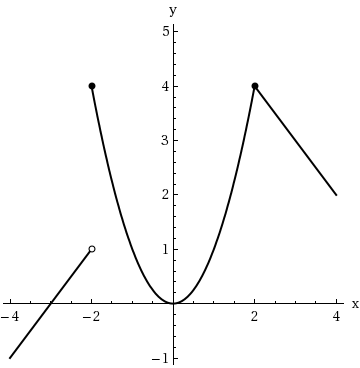


In this case,


limx2f(x)=1limx2+f(x)=4limx2f(x)limx2+f(x)limx2f(x)f(x) is discontinuous at the pointx=2limx2f(x)=4limx2+f(x)=4limx2f(x)=limx2+f(x)limx2f(x)=4f(x) is continuous at the pointx=2\lim\limits_{x\to -2^{-}}f(x)=1\\[0.3cm] \lim\limits_{x\to -2^{+}}f(x)=4\\[0.3cm] \lim\limits_{x\to -2^{-}}f(x)\neq\lim\limits_{x\to -2^{+}}f(x)\longrightarrow\nexists\lim\limits_{x\to -2}f(x)\\[0.3cm] \boxed{f (x)\text{ is discontinuous at the point}\quad x = -2}\\[0.3cm] \lim\limits_{x\to 2^{-}}f(x)=4\\[0.3cm] \lim\limits_{x\to 2^{+}}f(x)=4\\[0.3cm] \lim\limits_{x\to 2^{-}}f(x)=\lim\limits_{x\to 2^{+}}f(x)\longrightarrow\lim\limits_{x\to 2}f(x)=4\\[0.3cm] \boxed{f (x)\text{ is continuous at the point}\quad x = 2}

Another situation


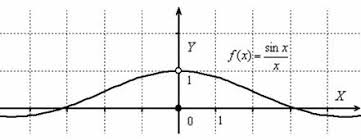
limx0f(x)=1limx0+f(x)=1limx0f(x)=limx0+f(x)limx0f(x)=1f(0)=0limx0f(x)=1f(x) is discontinuous at the pointx=0\lim\limits_{x\to 0^{-}}f(x)=1\\[0.3cm] \lim\limits_{x\to 0^{+}}f(x)=1\\[0.3cm] \lim\limits_{x\to 0^{-}}f(x)=\lim\limits_{x\to 0^{+}}f(x)\longrightarrow\lim\limits_{x\to 0}f(x)=1\\[0.3cm] f(0)=0\neq\lim\limits_{x\to 0}f(x)=1\\[0.3cm] \boxed{f (x)\text{ is discontinuous at the point}\quad x = 0}\\[0.3cm]

Another situation


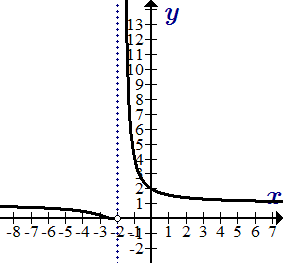
limx2f(x)=0limx2+f(x)=+limx2f(x)limx2+f(x)limx2f(x)f(x) is discontinuous at the pointx=2\lim\limits_{x\to -2^{-}}f(x)=0\\[0.3cm] \lim\limits_{x\to -2^{+}}f(x)=+\infty\\[0.3cm] \lim\limits_{x\to -2^{-}}f(x)\neq\lim\limits_{x\to -2^{+}}f(x)\longrightarrow\nexists\lim\limits_{x\to -2}f(x)\\[0.3cm] \boxed{f (x)\text{ is discontinuous at the point}\quad x = -2}\\[0.3cm]


LATEST TUTORIALS
APPROVED BY CLIENTS