
Search
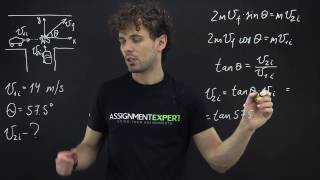
A nucleus, initially at rest, decays radioactively. In the process, it emits an electron horizontally to the east, with momentum 9.0 X 10⁻²¹ kg·m/s and a neutrino horizontally to the south, with momentum 4.8 X 10⁻²¹ kg·m/s.
(a) In what direction does the residual nucleus move? (3 marks)
(b) What is the magnitude of its momentum? (3 marks)
(c) If the mass of the residual nucleus is 3.6 X 10⁻²⁵ kg, what is its recoil velocity? (3 marks)
A frictionless disc of mass 0.50 kg is moving in a straight line across an air table at a speed of 2.4 m/s when it bumps into an elastic band stretched between two fixed posts. If the elastic band exerts an average opposing force of 1.4 N on the disc for 1.5 s, what will be the final velocity of the disc?
Calculate the increase in volume of 0.1L of mercury when its temperature changes from 100C to 350C?
A copper bar is 2.5 m long at 150C. What is the change in the length of the bar when it is heated to 350C?
(a) Outline problems involved in the large-scale use of photo-voltaic electricity in terms of availability of solar energy and that a large area is required to capture adequate amounts of solar energy. (b) It is planned to replace a 20 MW output fossil fuel power station with a 20 MW output solar-voltaic power station. If the average solar insolation (power incident normally per square meter on the surface of the Earth) at a given location is 350 W m-2 and the efficiency of the solar-voltaic cells is 20%, estimate the area of land surface required for generating the 20 MW of electrical power using solar-voltaic panels.
Two identical balls, A and B, are released from rest from the same height, 2.8 m, along two smooth inclined planes that touch the horizontal ground. Ball A is released on a plane inclined at 30° to the horizontal. The plane on which ball B is released is inclined at 60° to the horizontal. Ignore energy due to rotation of the balls. (a) What is the speed of each ball at the bottom of their respective inclined planes? (b) Which ball would reach the bottom first? Explain your answer.
Lesson Thermodynamics Processes
1. An engine bought by an engineer rated a transfer of 5,000 J of energy from a hot reservoir during one cycle and dissipated 3x10³J. Find the efficiency of the engine.
2. A particular heat engine has a mechanical power output of 5.00 kW and an efficiency of 25.0%. The engine expels 8.00x10³ J of exhaust energy in each cycle. Find (a) the energy taken in during each cycle and (b) the time interval for each cycle
Two point charge Q1 and Q2 are 3m apart, and their combined charge is 20micro coulumb.
(a) if one repels the other with a force of 0.075N, what are the two charges?
(b) if one attract the other with a force of 0.525N, what are the magnitude of the charges?
2. An object of mass 10 kg is whirled round a horizontal circle of radius 4 m by a revolving string inclined to the vertical. If the uniform speed of the object is 5 m/s, calculate:
(i) the tension in the string
(ii) the angle of inclination of the string to the vertical.
Two charges q = 6 µC and q2 = +10 µC are placed 12 cm apart. Another charge, q=2 μC is placed in the middle. Determine the magnitude and direction of the force acting on qs by the charge qi and 92.

 #339914 on Dec 2023