
Search
Two charges q1 = -6 µC and q2 = +10 µC are placed 12 cm apart. Another charge, q=-2 μC is placed in the middle. Determine the magnitude and direction of the force acting on q3 by the charge q1 and 92.
A coin is placed at the top of a two-story building, having a potential energy of 20 J. If it has a mass of 2.50 grams, what would be its velocity upon hitting the ground?
A 20 kg block (m1) and a bucket with mass m2 are connected by a light string that passes over a frictionless pulley as shown in Figure 2. The block lies on an incline plane of angle, α = 53.1° and the coefficient of kinetic friction between the block and the plane is 0.40. Calculate the mass of the hanging bucket, m2 if it is moving downward with the acceleration of 2.67 m/s 2
- The baton of a majorette is a uniform rod mass of 250g and length of 64cm. What is the moment of inertia of the baton about an axis passing through (a) its center? (b) at a point 20 cm from one end.
- What is the angular momentum of each hand of a clock? Treat the hands like a thin rod with an axis of rotation about one end. The minute hand is 25 cm long and has a mass of 46g. The hour hand is 15 cm long and has a mass of 32g.
Boston Red Sox pitcher Roger Clemens could routinely throw a fast ball at a horizontal speed of 160 km. How long did the ball take to reach home plate 18.4m away?
(a) Derive the formula for elastic potential energy, PEE, in terms of applied force F, stiffness constant k, and extension ΔL of a wire. State any assumptions made. (b) Figure 4.6a shows a F versus ΔL graph for a wire of length 2.0 m and diameter 1.2 mm. (i) Determine the stiffness constant of the wire from the graph. (ii) Determine the Young’s modulus for the material of the wire. (iii)What is a practical advantage of knowing the Young’s modulus as compared with the stiffness constant of the wire?
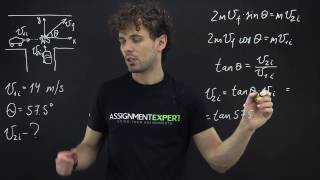
A steel ball of mass 0.50 kg, moving with a velocity 2.0 m/s, strikes a second ball of mass 0.30 kg, initially at rest. The collision is a glancing one, causing the first ball to be deflected by an angle of 30°, with a speed of 1.50 m/s. Determine the velocity of the second ball after the collision, giving both its speed and direction. (6 marks)
A 34-g bullet travelling at 120 m/s embeds itself in a wooden block on a smooth surface. The block then slides toward a spring and collides with it. The block compresses the spring (k = 99 N/m) a maximum of 1.2 cm. Calculate the mass of the block of wood. (6 marks)
An 80 kg man standing at rest on a smooth, level ice surface throws a 200 g ball horizontally with a speed of 25 m/s, relative to Earth.
(a) With what speed and in what direction does the man move? (3 marks)
(b) If the man throws six such balls every 5.0 s, what is the average force acting on him? (3 marks)
Two men, of mass 100 kg each, stand on a cart of mass 300 kg. The cart can roll with negligible friction along a north-south track, and everything is initially at rest. One man runs towards the north and jumps off the cart at a speed of 5.0 m/s, relative to the cart. After he has jumped, the second man runs towards the south and jumps off the cart, again with a speed of 5.0 m/s relative to the cart. Calculate the speed and direction of the cart after both men have jumped off. (6 marks)

 #340153 on Dec 2023