Question #79236

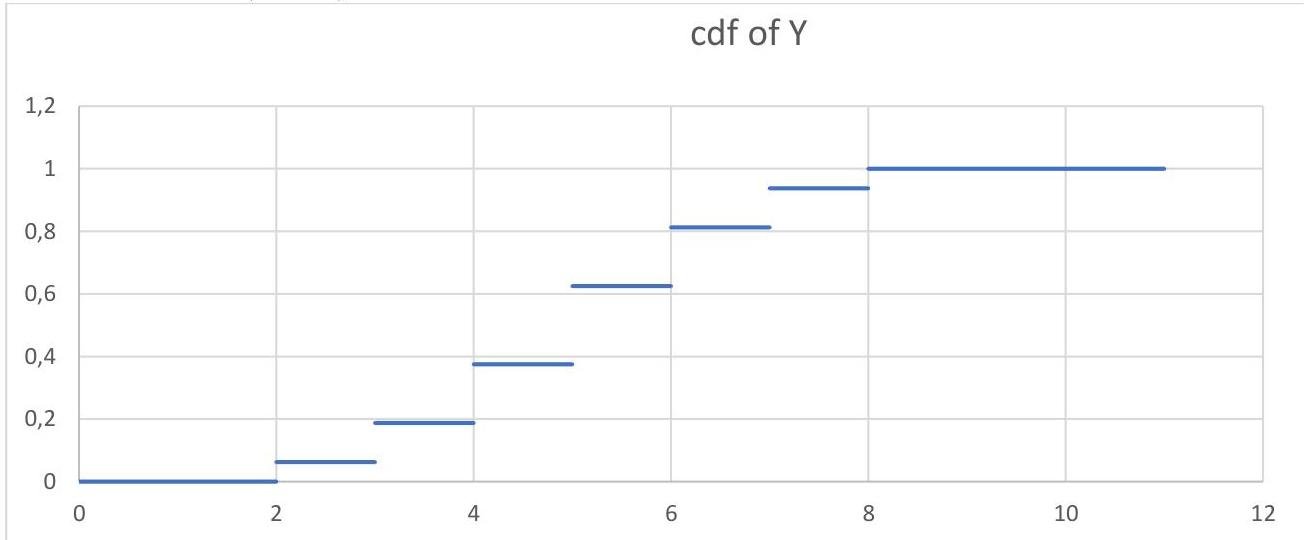
Let e=(i,j) represent an arbitrary resulting from two rolls of the four-sided die of example 2.1.1. Tabulate the discrete pdf and sketch the graph of the CDF for the (a) Y(e) = i + j
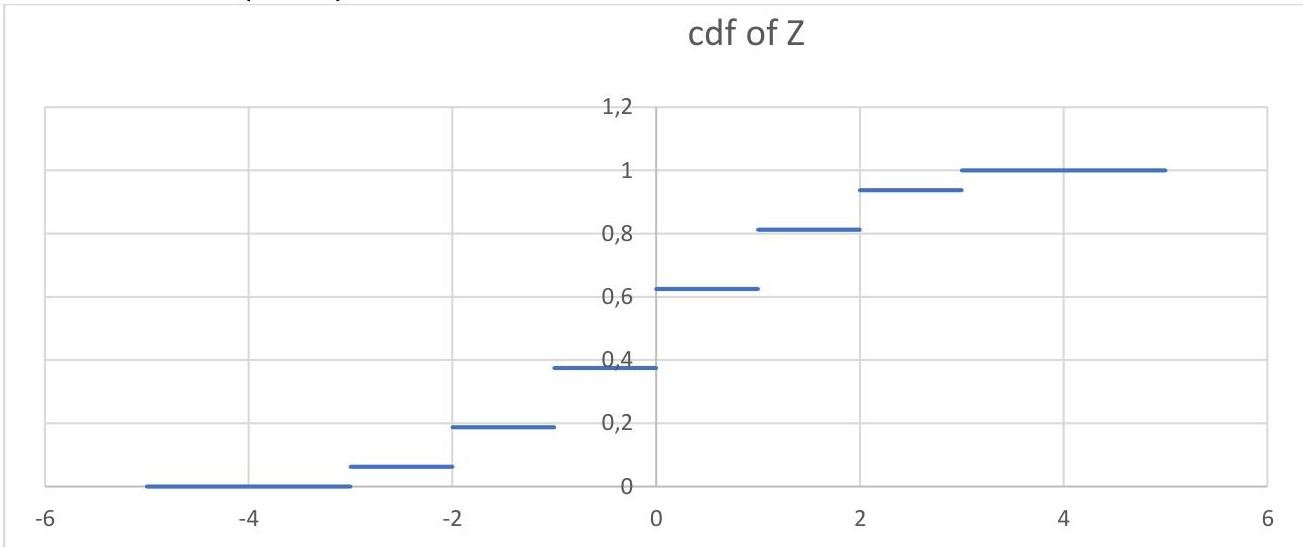
(b) Z(e) = i - j
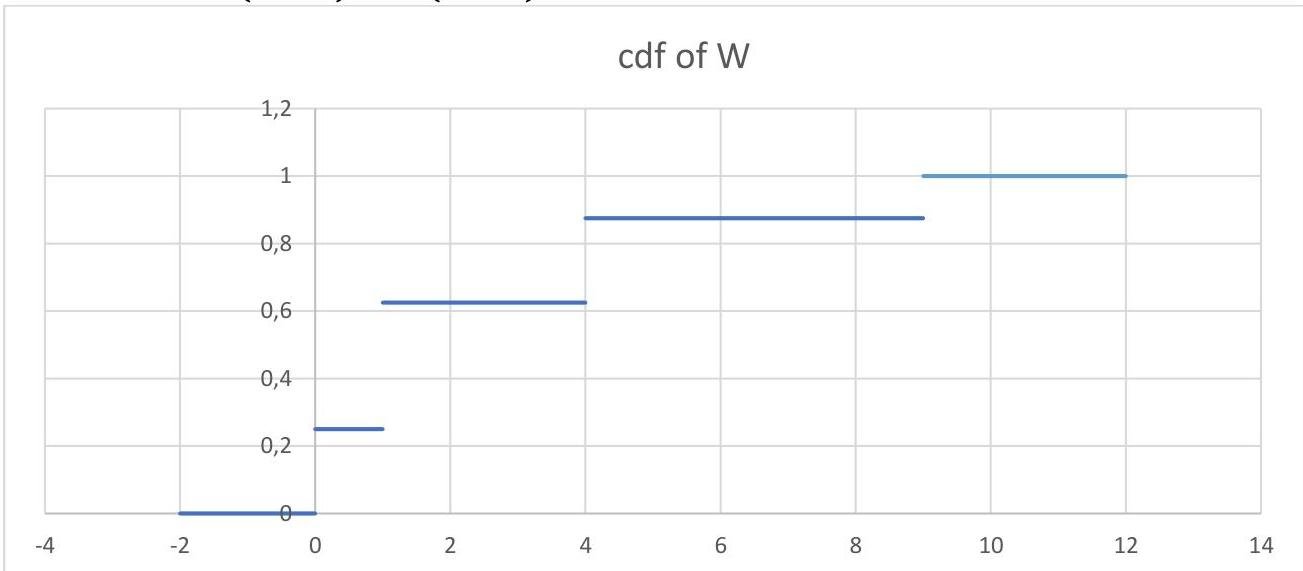
(c) W(e) = (i - j)^2
1

Expert's answer

2018-07-23T10:32:08-0400

Answer on Question #79236 – Math – Statistics and Probability

Question

Let e=(i,j)e = (i,j) represent an arbitrary resulting from two rolls of the four-sided die of example 2.1.1. Tabulate the discrete pdf and sketch the graph of the CDF for the

(a) Y(e)=i+jY(e) = i + j

(b) Z(e)=ijZ(e) = i - j

(c) W(e)=(ij)2W(e) = (i - j)^2

Solution

The set of all possible outcomes is


(1,1),(1,2),(1,3),(1,4),(2,1),(2,2),(2,3),(2,4),(3,1),(3,2),(3,3),(3,4),(4,1),(4,2),(1, 1), (1, 2), (1, 3), (1, 4), (2, 1), (2, 2), (2, 3), (2, 4), (3, 1), (3, 2), (3, 3), (3, 4), (4, 1), (4, 2),


(4,3), (4,4). Each of the outcomes has probability 1/16.

a) Y(e)=i+jY(e) = i + j

The set of possible values is {2,3,4,5,6,7,8}\{2,3,4,5,6,7,8\}. The probabilities are:


P(Y=2)=P((1,1))=1/16P(Y = 2) = P((1,1)) = 1/16P(Y=3)=P((1,2))+P((2,1))=2/16P(Y = 3) = P((1,2)) + P((2,1)) = 2/16P(Y=4)=P((1,3))+P((2,2))+P((3,1))=3/16P(Y = 4) = P((1,3)) + P((2,2)) + P((3,1)) = 3/16P(Y=5)=P((1,4))+P((2,3))+P((3,2))+P((4,1))=4/16P(Y = 5) = P((1,4)) + P((2,3)) + P((3,2)) + P((4,1)) = 4/16P(Y=6)=P((2,4))+P((3,3))+P((4,2))=3/16P(Y = 6) = P((2,4)) + P((3,3)) + P((4,2)) = 3/16P(Y=7)=P((3,4))+P((4,3))=2/16P(Y = 7) = P((3,4)) + P((4,3)) = 2/16P(Y=8)=P((4,4))=1/16P(Y = 8) = P((4,4)) = 1/16


b) Z(e)=ijZ(e) = i - j

The set of possible values is {3,2,1,0,1,2,3}\{-3, -2, -1, 0, 1, 2, 3\}

P(Z=3)=P((1,4))=1/16P(Z = -3) = P((1,4)) = 1/16P(Z=2)=P((1,3))+P((2,4))=2/16P(Z = -2) = P((1,3)) + P((2,4)) = 2/16P(Z=1)=P((1,2))+P((2,3))+P((3,4))=3/16P(Z = -1) = P((1,2)) + P((2,3)) + P((3,4)) = 3/16P(Z=0)=P((1,1))+P((2,2))+P((3,3))+P((4,4))=4/16P(Z = 0) = P((1,1)) + P((2,2)) + P((3,3)) + P((4,4)) = 4/16P(Z=1)=P((2,1))+P((3,2))+P((4,3))=3/16P(Z = 1) = P((2,1)) + P((3,2)) + P((4,3)) = 3/16P(Z=2)=P((3,1))+P((4,2))=2/16P(Z = 2) = P((3,1)) + P((4,2)) = 2/16P(Z=3)=P((4,1))=1/16P(Z = 3) = P((4,1)) = 1/16


c) W(e)=(ij)2W(e) = (i - j)^2

The set of possible values is {0,1,4,9}\{0,1,4,9\}

P(Z=0)=P((1,1))+P((2,2))+P((3,3))+P((4,4))=4/16P(Z = 0) = P((1,1)) + P((2,2)) + P((3,3)) + P((4,4)) = 4/16P(Z=1)=P((1,2))+P((2,3))+P((3,4))+P((2,1))+P((3,2))+P(Z = 1) = P((1,2)) + P((2,3)) + P((3,4)) + P((2,1)) + P((3,2)) +P((4,3))=6/16P((4,3)) = 6/16P(Z=4)=P((1,3))+P((2,4))+P((3,1))+P((4,2))=4/16P(Z = 4) = P((1,3)) + P((2,4)) + P((3,1)) + P((4,2)) = 4/16P(Z=9)=P((1,4))+P((4,1))=2/16P(Z = 9) = P((1,4)) + P((4,1)) = 2/16


Answer provided by https://www.AssignmentExpert.com

Need a fast expert's response?

Submit order

and get a quick answer at the best price

for any assignment or question with DETAILED EXPLANATIONS!

Comments

No comments. Be the first!
LATEST TUTORIALS
APPROVED BY CLIENTS