Question #68542

The manufacturer of a popular brand of TV knows from his past experience that the
probability of his TV set failing to work properly during the warranty period is 0.04. Find the
probability that in a sample of 25 sold TV sets selected at random, 6 or less TV sets will be
failing to work properly during the warranty period. Use both the binomial and Poisson rule
and compare the results.
1

Expert's answer

2017-05-30T02:05:10-0400

Answer on Question#68542 – Math – Statistics and Probability

Question. The manufacturer of a popular brand of TV knows from his past experience that the probability of his TV set failing to work properly during the warranty period is 0.04. Find the probability that in a sample of 25 sold TV sets selected at random, 6 or less TV sets will be failing to work properly during the warranty period. Use both the binomial and Poisson rule and compare the results.

Solution. Let us start from the finding of exact probability using the binomial rule. See https://en.wikipedia.org/wiki/Binomial_distribution. In our case n=25,p=0.04,q=0.96n = 25, p = 0.04, q = 0.96. Then the required probability is:


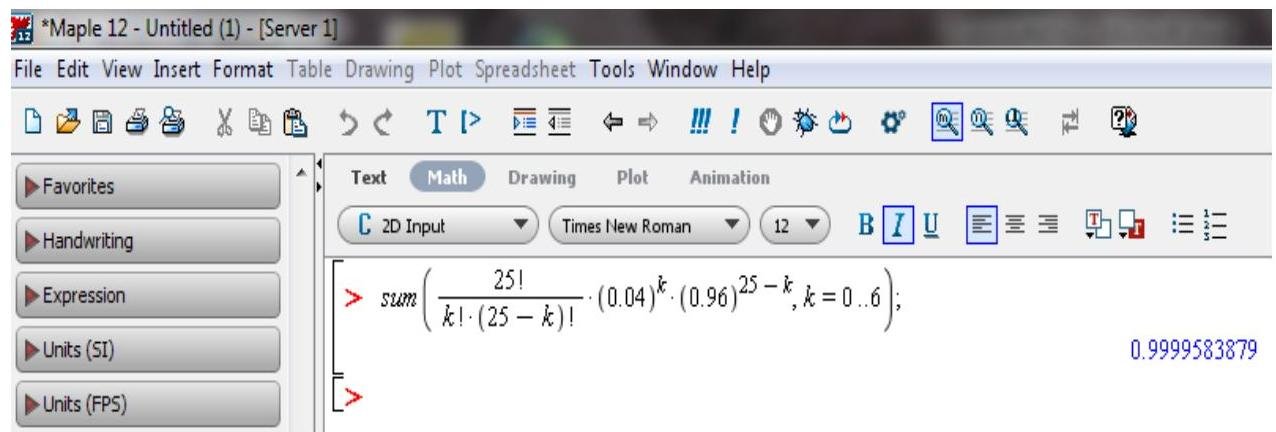
P{6 or less}=P{0}+P{1}+P{2}+P{3}+P{4}+P{5}+P{6}==(250)0.0400.9625+(251)0.0410.9624+(252)0.0420.9623+(253)0.0430.9622++(254)0.0440.9621+(255)0.0450.9620+(256)0.0460.9619==25!0!25!0.0400.9625+25!1!24!0.0410.9624+25!2!23!0.0420.9623+25!3!22!0.0430.9622++25!4!21!0.0440.9621+25!5!20!0.0450.9620+25!6!19!0.0460.96190.99996\begin{array}{l} P \{6 \text{ or less} \} = P \{0\} + P \{1\} + P \{2\} + P \{3\} + P \{4\} + P \{5\} + P \{6\} = \\ = \binom{25}{0} \cdot 0.04^{0} \cdot 0.96^{25} + \binom{25}{1} \cdot 0.04^{1} \cdot 0.96^{24} + \binom{25}{2} \cdot 0.04^{2} \cdot 0.96^{23} + \binom{25}{3} \cdot 0.04^{3} \cdot 0.96^{22} + \\ + \binom{25}{4} \cdot 0.04^{4} \cdot 0.96^{21} + \binom{25}{5} \cdot 0.04^{5} \cdot 0.96^{20} + \binom{25}{6} \cdot 0.04^{6} \cdot 0.96^{19} = \\ = \frac{25!}{0! \cdot 25!} \cdot 0.04^{0} \cdot 0.96^{25} + \frac{25!}{1! \cdot 24!} \cdot 0.04^{1} \cdot 0.96^{24} + \frac{25!}{2! \cdot 23!} \cdot 0.04^{2} \cdot 0.96^{23} + \frac{25!}{3! \cdot 22!} \cdot 0.04^{3} \cdot 0.96^{22} + \\ + \frac{25!}{4! \cdot 21!} \cdot 0.04^{4} \cdot 0.96^{21} + \frac{25!}{5! \cdot 20!} \cdot 0.04^{5} \cdot 0.96^{20} + \frac{25!}{6! \cdot 19!} \cdot 0.04^{6} \cdot 0.96^{19} \approx 0.99996 \\ \end{array}


(see Appendix).

Now let us compute the required probability approximately with using the rule of Poisson (see http://faculty.vassar.edu/lowry/poisson.html). We have: np=250.04=1np = 25 \cdot 0.04 = 1. Then


P{6 or less}=P{0}+P{1}+P{2}+P{3}+P{4}+P{5}+P{6}100!e1+111!e1+122!e1+133!e1+144!e1+155!e1+166!e1==1e(1+1+12+16+124+1120+1720)=1957720e0.99992.\begin{array}{l} P \{6 \text{ or less} \} = P \{0\} + P \{1\} + P \{2\} + P \{3\} + P \{4\} + P \{5\} + P \{6\} \approx \\ \approx \frac{1^{0}}{0!} e^{-1} + \frac{1^{1}}{1!} e^{-1} + \frac{1^{2}}{2!} e^{-1} + \frac{1^{3}}{3!} e^{-1} + \frac{1^{4}}{4!} e^{-1} + \frac{1^{5}}{5!} e^{-1} + \frac{1^{6}}{6!} e^{-1} = \\ = \frac{1}{e} \cdot \left(1 + 1 + \frac{1}{2} + \frac{1}{6} + \frac{1}{24} + \frac{1}{120} + \frac{1}{720}\right) = \frac{1957}{720e} \approx 0.99992. \\ \end{array}


We see that the computational error is 0.999960.99992=0.00004|0.99996 - 0.99992| = 0.00004 i.e. very small. But it is much easier to compute the required probability approximately using the rule of Poisson.

Answer. 0.99996.

Answer provided by www.AssignmentExpert.com

Appendix
Need a fast expert's response?

Submit order

and get a quick answer at the best price

for any assignment or question with DETAILED EXPLANATIONS!

Comments

Assignment Expert
30.05.17, 11:40

Dear Simanchal, You're welcome. We are glad to be helpful. If you liked our service please press like-button beside answer field. Thank you!

Simanchal Sahoo
30.05.17, 10:02

Thanks a lot for the answer

LATEST TUTORIALS
APPROVED BY CLIENTS

