Find all the third roots of i and plot them on a Argand diagram. (please also state which theorems was used) .
Given complex number -
z=i
Real(z)=x=0Img(z)=y=1Real(z)=x=0\\ Img(z)=y=1Real(z)=x=0Img(z)=y=1
ϕ=arg(z)=tan−1(10)=tan−1(∞)=π2\phi=arg(z)=tan^{-1}(\dfrac{1}{0})=tan^{-1}(\infty)=\dfrac{\pi}{2}ϕ=arg(z)=tan−1(01)=tan−1(∞)=2π
The above complex number in polar form is-
z=cosπ2+isinπ2=cos\dfrac{\pi}{2}+isin\dfrac{\pi}{2}=cos2π+isin2π
To find its cube root we take-
zk=z3=∣z∣3(cosϕ+2πk3+isinϕ+2πk3),k=0,1,2.z_k=\sqrt[3]{z}=\sqrt[3]{|z|}(cos {\frac {\phi+2\pi k} 3}+isin{\frac {\phi+2\pi k} 3}), k=0,1,2.zk=3z=3∣z∣(cos3ϕ+2πk+isin3ϕ+2πk),k=0,1,2.
So, let's find all zkz_kzk
z0=(cosπ6+isinπ6)z_0=(cos {\frac {\pi} 6}+isin{\frac {\pi} 6})z0=(cos6π+isin6π)
z1=(cos5π6+isin5π6)z_1=(cos {\frac {5\pi} 6}+isin{\frac {5\pi} 6})z1=(cos65π+isin65π)
z2=(cos3π2+isin3π2)z_2=(cos {\frac {3\pi} 2}+isin{\frac {3\pi} 2})z2=(cos23π+isin23π)
Here Demovier's theorem is used.
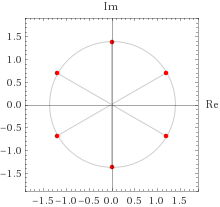
Argand diagram is-
Need a fast expert's response?
and get a quick answer at the best price
for any assignment or question with DETAILED EXPLANATIONS!
Comments

