Answer on Question #49307, Engineering, Other
In a single slit Fraunhofer diffraction experiment, a light source of wavelength 600nm is used. Calculate the angular spread of the central maxima and angular positions of second and third minima if the widths of the slit are following:
1 mm
2.2 μ m
Solution:
The Fraunhofer diffraction equation is used to model the diffraction of waves when the diffraction pattern is viewed at a long distance from the diffracting object.
The diffraction at a single slit of width d is shown in Figure 1. Diffraction occurs in all directions to the right of the slit.
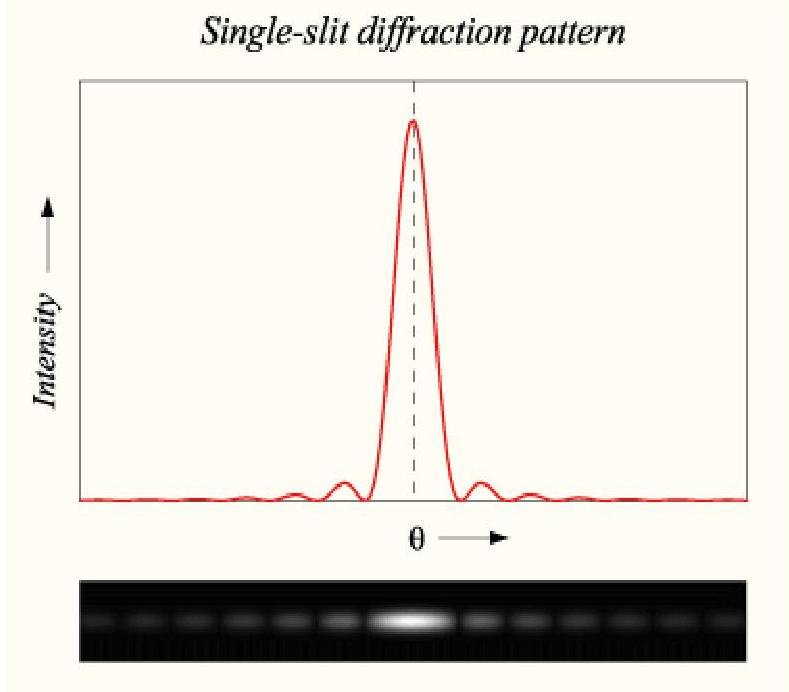
Fig.1. Graph and image of single-slit diffraction
The pattern consists of a central bright fringe (band) flanked by much weaker maxima alternating with dark fringes.
The general condition for a minimum for a single slit is:
mλ=dsinθ
where m=1,2,3,4 and so on
- d is the width of the slit,
- θ is the angle at which the minimum intensity occurs, and
- λ is the wavelength of the light
1. d=1 mm
The angular spread of the central maximum is the angular fringe width of the central maximum.
Thus,
sinθ0=d2λ=1∗10−32∗600∗10−9=12∗10−4
As the angle is very small we can use the relation, sinθ=θ.
Hence,
θ0=0.0012rad=0.069∘
The positions of second and third minima are:
sinθ2=d2λ=1×10−3600×10−9=12×10−4θ2=0.0012rad=0.069∘sinθ3=d3λ=1×10−33×600×10−9=18×10−4θ3=0.0018rad=0.1∘
2. d=2 μm
The angular spread of the central maximum is the angular fringe width of the central maximum.
Thus,
sinθ0=d2λ=2×10−62×600×10−9=0.6
Hence,
θ0=sin−10.6=0.644rad=36.9∘
The positions of second and third minima are:
sinθ2=d2λ=2×10−62×600×10−9=0.6θ2=sin−10.6=0.644rad=36.9∘sinθ3=d3λ=2×10−63×600×10−9=0.9θ3=sin−10.9=1.12rad=64.2∘
http://www.AssignmentExpert.com/



 #340153 on Dec 2023