Question #49848

2 blocks of mass m and M are connected by a string of constant k. the blocks are kept on a constant horizontal plane and are at rest. the spring is unstretched when a constant force F starts acting on the block of mass M ti pull it. Find the maximum extension of the spring
1

Expert's answer

2014-12-08T12:49:19-0500

Answer on Question#49848 - Physics - Mechanics - Kinematics - Dynamics

2 blocks of mass mm and MM are connected by a string of constant kk . The blocks are kept on a constant horizontal plane and are at rest. The spring is unstretched when a constant force FF starts acting on the block of mass MM to pull it. Find the maximum extension of the spring.

Solution:
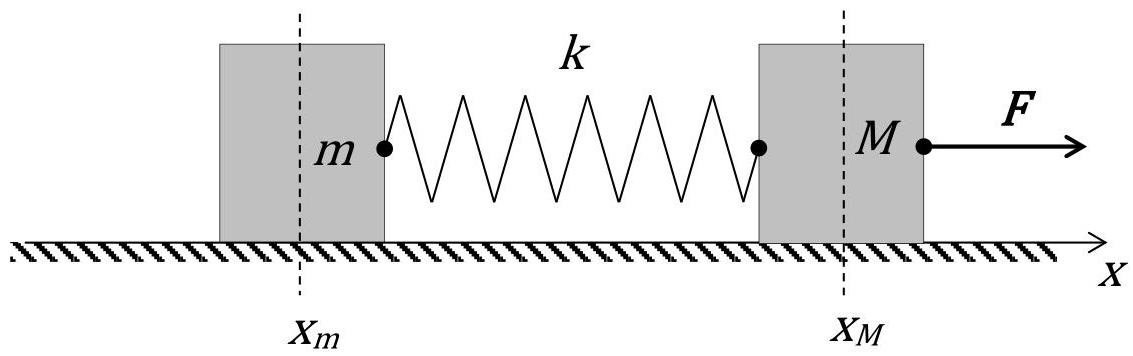


Let xmx_{m} be the displacement of mass mm and xMx_{M} be the displacement of mass MM , then the extension of the spring is xMxmx_{M} - x_{m} . According to the 2 Newton's law the equation of motion of the mass MM can be written as follows


Mx¨M=Fk(xMxm)M \ddot {x} _ {M} = F - k \left(x _ {M} - x _ {m}\right)


And for the mass mm :


mx¨m=k(xMxm)m \ddot {x} _ {m} = k \left(x _ {M} - x _ {m}\right)


Dividing equation (1) by MM and equation (2) by mm we obtain


{x¨M=FMkM(xMxm)x¨m=km(xMxm)\left\{ \begin{array}{c} \ddot {x} _ {M} = \frac {F}{M} - \frac {k}{M} (x _ {M} - x _ {m}) \\ \ddot {x} _ {m} = \frac {k}{m} (x _ {M} - x _ {m}) \end{array} \right.


Subtracting the second equation of this system from the first we obtain


d2(xMxm)dt2=FMk(1M+1m)(xMxm)=FMkmMm+M(xMxm)\frac {d ^ {2} (x _ {M} - x _ {m})}{d t ^ {2}} = \frac {F}{M} - k \left(\frac {1}{M} + \frac {1}{m}\right) (x _ {M} - x _ {m}) = \frac {F}{M} - \frac {k}{\frac {m M}{m + M}} (x _ {M} - x _ {m})


Denoting (xMxm)(x_{M} - x_{m}) by Δx\Delta x and mMm+M\frac{mM}{m + M} by μ\mu we obtain


Δx¨=FMkμΔx\Delta \ddot {x} = \frac {F}{M} - \frac {k}{\mu} \Delta x


This equation has the following solution


Δx=Asinkμt+Bcoskμt+FμMk\Delta x = A \sin \frac {k}{\mu} t + B \cos \frac {k}{\mu} t + \frac {F \mu}{M k}


where AA and BB are some constants. We can determine them from the initial conditions, which are


Δx(0)=0,Δx(0)=0\Delta x (0) = 0, \quad \Delta x (0) = 0


Using the first condition we obtain


0=B+FμMk0 = B + \frac {F \mu}{M k}


It gives us the value of BB:


B=FμMkB = - \frac {F \mu}{M k}


Taking the derivative of (3) we obtain


x˙=AkμcoskμtBkμsinkμt\dot {x} = A \frac {k}{\mu} \cos \frac {k}{\mu} t - B \frac {k}{\mu} \sin \frac {k}{\mu} t


Using second condition we obtain


x˙(0)=AkM=0\dot {x} (0) = A \frac {k}{M} = 0


It gives us the value of AA:


A=0A = 0


Therefore, the extension of the spring at any time is given by


Δx=FμMk(1coskμt)\Delta x = \frac {F \mu}{M k} \left(1 - \cos \frac {k}{\mu} t\right)


It is easy to see that extension reaches its maximum when cosine equals -1. Therefore, the maximum extension of the spring has the following value


Δxmax=2FμMk\Delta x _ {m a x} = 2 \frac {F \mu}{M k}


Answer: 2FμMk2\frac{F\mu}{Mk}

http://www.AssignmentExpert.com/


Need a fast expert's response?

Submit order

and get a quick answer at the best price

for any assignment or question with DETAILED EXPLANATIONS!

Comments

No comments. Be the first!
LATEST TUTORIALS
APPROVED BY CLIENTS

