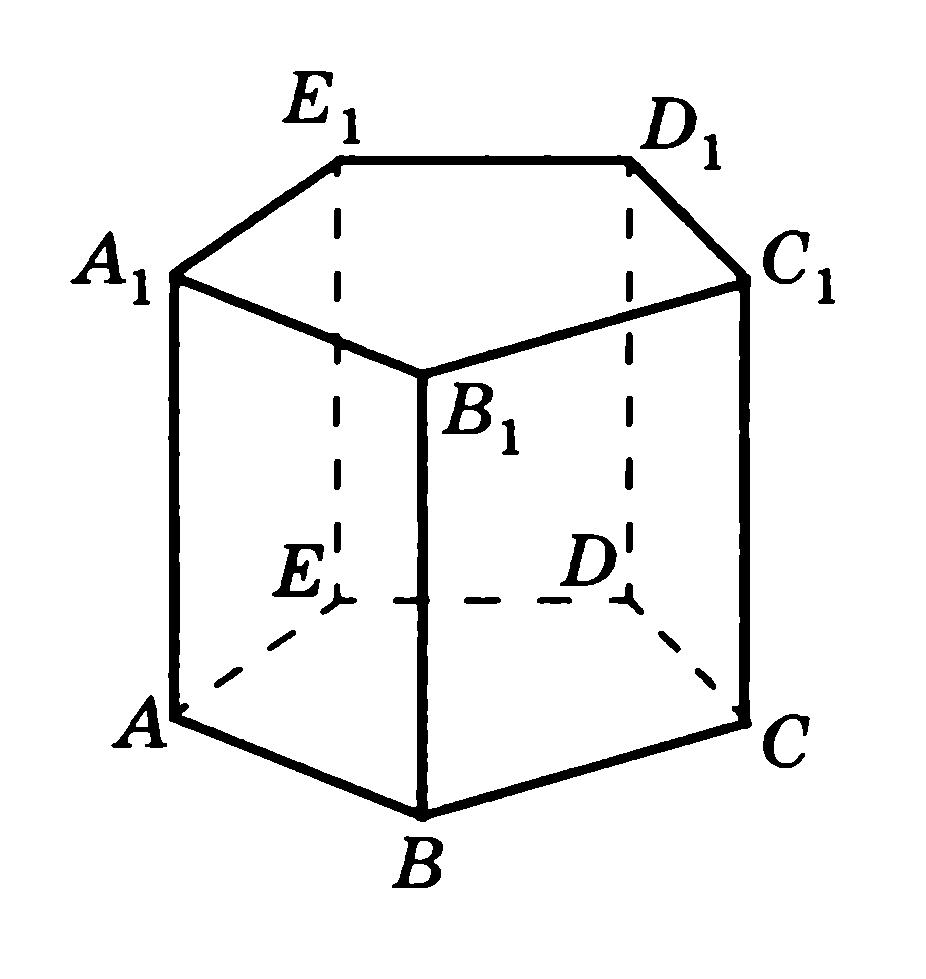
Let A B = B C = C D = D E = A E AB=BC=CD=DE=AE A B = BC = C D = D E = A E then A A A 1 B B B 1 = B =B = B 1 C C C 1 = C =C = C 1 D D D 1 = D =D = D 1 E E E 1 = E =E = E 1 A A A 1
Then the area of the upper and lower bases of the prism: S b a s e = A B 2 25 + 10 5 4 = 225 25 + 10 5 4 S\scriptsize{base} \normalsize =\frac{AB^2\sqrt{25+10\sqrt{5}}}4=\frac{225\sqrt{25+10\sqrt{5}}}4 S ba se = 4 A B 2 25 + 10 5 = 4 225 25 + 10 5 ,
both bases: S ∗ = 2 S = 225 25 + 10 5 2 S^*=2S=\frac{225\sqrt{25+10\sqrt{5}}}2 S ∗ = 2 S = 2 225 25 + 10 5
1.
A side face has the area S = A B ⋅ A A S=AB\cdot AA S = A B ⋅ AA 1 , all five side faces have the area S ∗ ∗ = 5 S = 5 ⋅ 15 ⋅ 32 = 2400 S^{**}=5S=5\cdot15\cdot32=2400 S ∗∗ = 5 S = 5 ⋅ 15 ⋅ 32 = 2400 cm2
2.
The total surface area: S = S ∗ + S ∗ ∗ = 225 25 + 10 5 2 + 2400 ≈ 3175 , 2148 S=S^*+S^{**}=\frac{225\sqrt{25+10\sqrt{5}}}2+2400\thickapprox3175,2148 S = S ∗ + S ∗∗ = 2 225 25 + 10 5 + 2400 ≈ 3175 , 2148 cm2
3.
The volume of the prism: V = S b a s e ⋅ A A V=S\scriptsize{base}\normalsize \cdot AA V = S ba se ⋅ AA 1 = 225 25 + 10 5 4 ⋅ 32 = 1800 25 + 10 5 =\frac{225\sqrt{25+10\sqrt{5}}}4\cdot32=1800\sqrt{25+10\sqrt{5}} = 4 225 25 + 10 5 ⋅ 32 = 1800 25 + 10 5 ≈ 12387 , 4373 \thickapprox12387,4373 ≈ 12387 , 4373 cm3
Comments

