Answer on Question #55823 – Math – Calculus
4. A tennis ball machine serves a ball vertically into the air from a height of 2 feet, with an initial speed of 120 feet per second. What is the maximum height, in feet, the ball will attain? Round to the nearest whole foot.
Solution
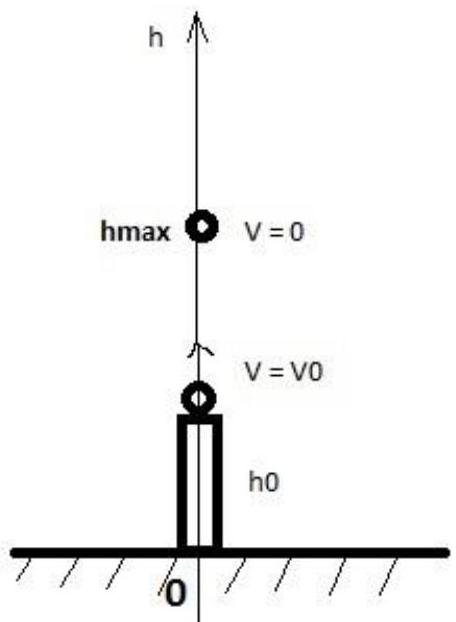
h(t) is height, v(t)=h(t) is velocity, a(t)=v(t)=h¨(t) is acceleration
v0=120sfeet,g=9,8s2m=9,8⋅3,28(s2feet)=32,14s2feet
As we know a(t)=const=−g, so v(t)=∫a(t)dt=v0−gt (v0 is the initial velocity)
Also h(t)=∫v(t)dt=∫(v0−gt)dt=h0+v0t−2gt2 (h0 is the initial height)
h(tmax)=hmax when h˙(tmax)=v(tmax)=0, so 0=v0−gtmax,tmax=gv0,
hmax=h(tmax)=h0+v0t−(2g)(gv0)2=h0+2gv02 (you can get this much easier, if you know The Law of Conservation of Energy: mv2+mgΔh=const, so in this case mv2=mgΔh,Δh=2gv2)
hmax=2+2⋅32,141202=226,02 (feet)Answer: 226 feet
5. A tennis ball machine serves a ball vertically into the air from a height of 2 feet, with an initial speed of 110 feet per second. After how many seconds does the ball attain its maximum height? Round to the nearest hundredth.
Solution:
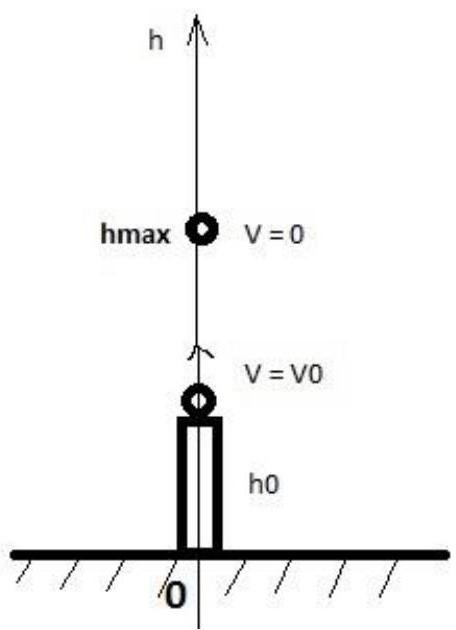
h(t) is height, v(t)=h˙(t) is velocity, a(t)=v˙(t)=h¨(t) is acceleration
v0=110sf e e t,g=9,8s2m=9,8∗3,28(s2f e e t)=32,14s2f e e t
As we know a(t)=const=−g , so v(t)=∫a(t)dt=v0−gt ( v0 is the initial condition)
Also h(t)=∫v(t)dt=∫(v0−gt)dt=h0+v0t−2gt2
h(tmax)=hmax when h˙(tmax)=v(tmax)=0,so0=v0−gtmax,tmax=gv0,
tmax=32,14110=3,4225(s)
Answer: 3,42 s.
6. The finishing time for a runner completing the 200-meter dash is affected by the tail-wind speed, s. The change, t, in a runner's performance is modeled by the function shown below:
t=0.0119s2−0.308s−0.0003
Predict the change in a runner's finishing time with a wind speed of 5 meters/second. Note: A negative answer means the runner finishes with a lower time. Round to the nearest hundredths.
Solution:
t(s)=0.0119s2−0.308s−0.0003t(5)=0.0119∗(52)−0.308∗(5)−0.0003=−1,2428(s)
Answer: -1,24 s, the runner finishes with a lower time.
www.AssignmentExpert.com



