Question #39754

Olive oil with a density of 830 kg/m^3 ,in a food factory needs to be pumped in a 30mm diameter pipe to a tank 10m above the pump with a rate of 18m^3/hr. The depth of fluid in the tank is 2.75m, what pressure must be added to lift the oil to the upper tank. Friction losses as 5kpa using this equation
P1+p v1^2 + h1 pg + trianglePe = P2+p v2^2 + h2 pg + trianglePf
2 2
trianglePe= pumping energy trianglePf=frictional losses
given that Power= pressure=volume flow
1

Expert's answer

2014-03-07T02:52:38-0500

Answer on Question #39754, Engineering, Other

Question

Olive oil with a density of 830 kg/m3830\ \mathrm{kg/m^3}, in a food factory needs to be pumped in a 30 mm diameter pipe to a tank 10 m above the pump with a rate of 18 m3/hr18\ \mathrm{m^3/hr}. The depth of fluid in the tank is 2.75 m, what pressure must be added to lift the oil to the upper tank.

Friction losses as 5kpa using this equation


P1+ρv122+ρgh1+ΔPe=P2+ρv222+ρgh2+ΔPfP_1 + \frac{\rho v_1^2}{2} + \rho g h_1 + \Delta P_e = P_2 + \frac{\rho v_2^2}{2} + \rho g h_2 + \Delta P_f

Solution

The Bernoulli equation states that,


P+ρv22+ρgh=constantP + \frac{\rho v^2}{2} + \rho g h = \text{constant}


In the above equation, PP is pressure, which can be either absolute or gage, but should be in the same basis on both sides, ρ\rho represents the density of the fluid, assumed constant, vv is the velocity of the fluid at the inlet/outlet, and hh is the elevation about a datum that is specified.
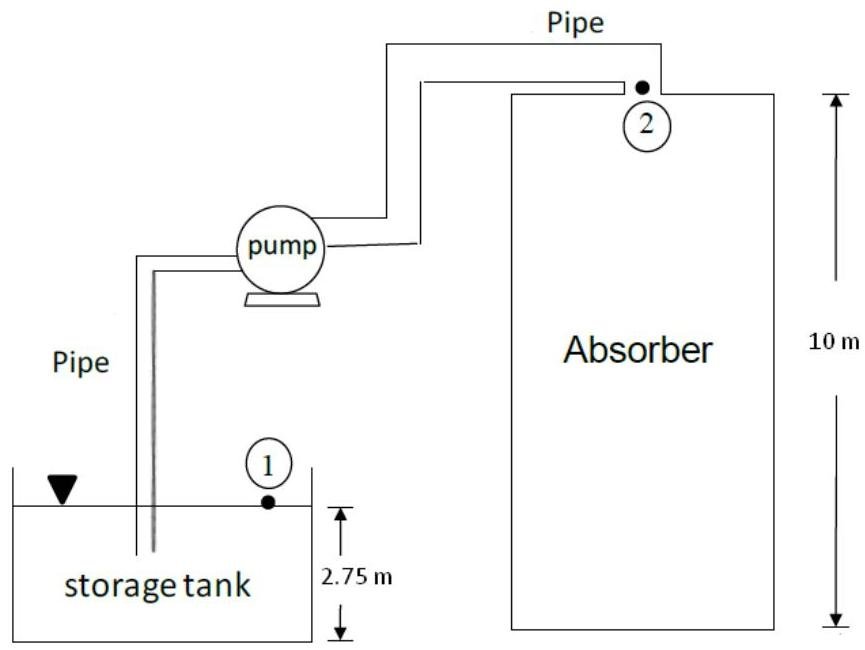


We use location 1 for "in" and location 2 for "out."

We have Bernoulli equation


P1+ρv122+ρgh1+ΔPe=P2+ρv222+ρgh2+ΔPfP_1 + \frac{\rho v_1^2}{2} + \rho g h_1 + \Delta P_e = P_2 + \frac{\rho v_2^2}{2} + \rho g h_2 + \Delta P_f


Now list all the known information at the two locations.

P1=0P_1 = 0 gage (Open to atmosphere)

v1=0v_1 = 0 (Large cross-sectional area)

h1=0h_1 = 0 (By choice of datum)

From the given discharge rate Q=18 m3/hr=18/3600 m3/sQ = 18\ \mathrm{m^3/hr} = 18/3600\ \mathrm{m^3/s} and the diameter of the pipe d=30 mmd = 30\ \mathrm{mm} at the upper tank inlet, we can calculate v2v_2.


Q=v2A=v2πd24Q = v _ {2} A = v _ {2} \frac {\pi d ^ {2}}{4}v2=4Qπd2v _ {2} = \frac {4 Q}{\pi d ^ {2}}


where A is cross sectional area of a pipe


v2=4Qπd2=4183.14(30103)23600=7.08m/sv _ {2} = \frac {4 Q}{\pi d ^ {2}} = \frac {4 \cdot 1 8}{3 . 1 4 \cdot (3 0 \cdot 1 0 ^ {- 3}) ^ {2} \cdot 3 6 0 0} = 7. 0 8 \mathrm {m / s}


p = 0 gage (Absorber is at atmospheric pressure)

v2=7.08m/sv_{2} = 7.08 \, \text{m/s} (from specified data)

h2=102.75=7.25mh_2 = 10 - 2.75 = 7.25 \, \text{m} (specified)

Substituting some of the known information into the above equation, we obtain


0+ρ02+ρg0+ΔPe=0+ρv222+ρgh2+ΔPf0 + \frac {\rho \cdot 0}{2} + \rho g \cdot 0 + \Delta P _ {e} = 0 + \frac {\rho v _ {2} ^ {2}}{2} + \rho g h _ {2} + \Delta P _ {f}ΔPe=ρv222+ρgh2+ΔPf\Delta P _ {e} = \frac {\rho v _ {2} ^ {2}}{2} + \rho g h _ {2} + \Delta P _ {f}ΔPe=8307.0822+8309.817.25+5103=84834.1Pa=84.8kPa\Delta P _ {e} = \frac {8 3 0 \cdot 7 . 0 8 ^ {2}}{2} + 8 3 0 \cdot 9. 8 1 \cdot 7. 2 5 + 5 \cdot 1 0 ^ {3} = 8 4 8 3 4. 1 \mathrm {P a} = 8 4. 8 \mathrm {k P a}


Answer. ΔPe=84.8kPa\Delta P_{e} = 84.8\mathrm{kPa}

Need a fast expert's response?

Submit order

and get a quick answer at the best price

for any assignment or question with DETAILED EXPLANATIONS!

Comments

No comments. Be the first!
LATEST TUTORIALS
APPROVED BY CLIENTS

