Answer on Question #48063-Engineering-SolidWorks-CosmoWorks-Ansys
Figure shows a block of mass m resting on a 20∘ slope. The block has coefficients of friction μs=0.81 and μk=0.45 with the surface. It is connected via a massless string over a massless, frictionless pulley to a hanging block of mass m2=2.0kg.
If this minimum mass is nudged ever so slightly, it will start being pulled up the incline. What acceleration will it have?
Solution
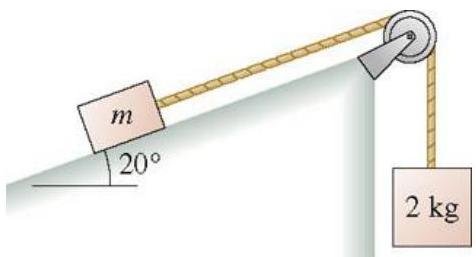
On a 20∘ slope, the force parallel causes acceleration down the incline
Fp=m⋅g⋅sinθ=m⋅9.8⋅sin20∘.
The friction force is caused by the force perpendicular m⋅g⋅cosθ is
Ffr=μsm⋅g⋅cosθ=0.81⋅m⋅9.8⋅cos20∘.
Since you are trying to move the block up the slope, both of these forces are opposing motion:
Fp+Ffr=m⋅9.8⋅sin20∘+0.81⋅m⋅9.8⋅cos20∘=m⋅9.8(sin20∘+0.81⋅cos20∘).
The force caused by the 2kg is F=2⋅9.8=19.6N pulling the block up the slope.
The block will stick and not slip, if the sum of the down forces is less than 19.6 N.
m⋅9.8(sin20∘+0.81⋅cos20∘)<19.6.m<9.8(sin20∘+0.81⋅cos20∘)19.6.m<1.81kg.
If this minimum mass is nudged ever so slightly, it will start being pulled up the incline. What acceleration will it have?
We need this kinetic friction force:
Fk=μsμkFfr=μsμkμsm⋅g⋅cosθ=μkm⋅g⋅cosθ=0.45⋅1.81⋅9.8⋅cos20∘.
So,
19.6−1.81⋅9.8(sin20∘+0.45⋅cos20∘)=1.81⋅a.a=3.3s2m.
Answer: 3.3s2m.
http://www.AssignmentExpert.com/



 #339914 on Dec 2023