Answer on Question#59876 - Chemistry | General Chemistry
A) calculate the missing ΔH values (using Hess's Law) in the table below: use ΔHfCO2(g)=−394 kj mol−1 AND ΔHfH2O(I)=−286 kj mol−1
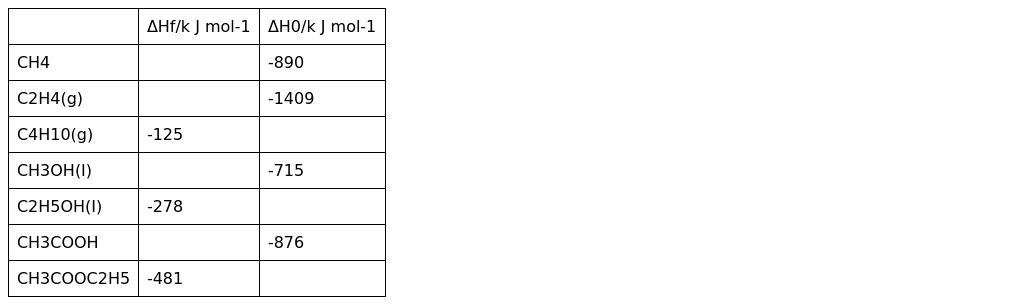
B) use the data to calculate ΔH for the reaction
CH3COOH(I)+C2H5OH(I)⟶CH3COOC2H5(I)+H2O(I)Answers:
A) The equation we want for the formation of methane from its elements would be the following:
C(s)+2H2(g)→CH4(g)→CH3COOH=?
You are given the three equations:
1. C(s)+O2(g)→CO2(g). ΔH1=−394 kJmol−1
2. H2(g)+1/2O2(g)→H2O(g). ΔH2=−286 kJmol−1
3. CH4(g)+2O2(g)→CO2(g)+2H2O(g). ΔH3=−890 kJmol−1
Equation 1 already has carbon on the left side. Equation 2 already has hydrogen on the left side, but we need two hydrogen molecules, so we can double the second equation. Equation 3 has methane on the left side instead of on the right side, so we need to reverse it.
1. C(s)+O2(g)→CO2(g). ΔH1=−394 kJmol−1
2. 2H2(g)+O2(g)→2H2O(g). ΔH2=−572 kJmol−1
3. CO2(g)+2H2O(g)→CH4(g)+2O2(g). ΔH3=+890 kJmol−1
Eliminating oxygen, carbon dioxide, and water on both sides in all the three equations, we end up with:
Total: C(s)+2H2(g)→CH4(g). ΔH=−76 kJmol−1
The standard heat of formation for methane is −76 kJmol−1.
Answer: ΔHf(CH4)=−76 kJmol−1
B) The combustion reaction is
C2H4(g)+3O2(g)→2CO2(g)+2H2O(g)
On the right hand side of the above expression we know the enthalpy of formation of the CO2 and the H2O from their atoms.
It is 2(−394)+2(−286)=−(788+572)=−1360kJ. This means that in forming 2 moles of CO2(g) and two moles of H2O(l) from their atoms, 1360kJ are released.
To get there from the left hand side of the equation, we must first form one mole of C2H4 from its atoms and then burn it with 3 moles of O2. ΔHc is the heat of combustion.
ΔHf[C2H4(g)]+ΔHc[C2H4(g)]=2ΔH∘f[CO2(g)]+2ΔH∘f[H2O(l)]ΔHf[C2H4(g)]−1411kJ=−1358.6kJ.ΔHf[C2H4(g)]=52.4kJ...and since we were talking about one mole of ethylene, that's 52.4 kJ/mole.
Answer: ΔHf(C2H4)=52.4kJmol−1
C) Complete combustion of butane:
2C4H10+13O2→8CO2+10H2O
Using standard enthalpies of formation, we imagine the reaction takes place by one mole of each starting molecule breaking apart into their elements in their standard states, and then reforming into the products. Obviously this is not really what happens but thermodynamically it is equivalent.
Here's some data:
ΔHf butane(g)=−125kJ/mol4C(s)+5H2(g)→C4H10(g)ΔHfCO2(g)=−394kJ/molC(s)+O2(g)→CO2(g)ΔHfH2O(g)=−286.0kJ/molH2(g)+0.5O2(g)→H2O(l)
We can simply reverse the sign of the ΔHf for the breaking apart of the molecule, as opposed to its formation.
So our reaction comprises:
2C4H10(g)→8C(s)+10H2(g)+125kJ/mol×2=+250.0kJ/mol8O2(g)+8C(s)→8CO2(g)−394kJ/mol×8=−3152kJ/mol10H2(g)+5O2(g)→10H2O(l)−286kJ/mol×10=−2860.0kJ/mol
Adding these values together:
+250.0kJ/mol+−3152.0kJ/mol+−2860.0kJ/mol=−5762.0kJ/mol
We then half this to calculate the standard enthalpy of combustion, since in the above equation we used 2 moles of butane to keep whole numbers:
−5762kJ/mol/2=−2881kJ/mol
Answer: ΔHc(C4H10)=−2881kJmol−1
D) CH3OH+3/2O2→CO2+2H2O ΔH=−726.4kJ/mol
C(graphite)+O2→CO2ΔH=−393.5kJ/molH2+1/2O2→H2OΔH=−285.8kJ/mol
Calculate the enthalpy of formation of methanol (CH3OH) from its elements:
C(graphite)+2H2+1/2O2→CH3OH
As for Hess's law:
−715kJ/mol−1=2x(−286kJ/mol−1)+−394kJ/mol−1−ΔH(CH3OH)ΔH(CH3OH)=−251kJ/mol−1
Answer: ΔHf(CH3OH)=−251kJmol−1
E) The balanced equation I we for ethanol is: C2H5OH(l)+3O2(g)→2CO2(g)+3H2O(g)
And from that, the three equations we have are:
C+O2→CO2…ΔH=−394kJ/molH2+0.5OH→H2O…ΔH=−286kJ/mol
2C+3H2+0.5O2→C2H5OH…ΔH=−278kJ/mol
Then we got:
(278) - (2 x 394) - (3 x 286) = -1368 kJ/mol
Answer: ΔHc (C₂H₅OH) = -1368 kJ mol⁻¹
J) C+O2→CO2ΔH1=−394kJ/mol
H2+1/2O2→H2OΔH2=−286kJ/mol
CH3COOH+2O2→2CO2+2H2OΔH3=876kJ/mol
2C+O2+2H2→CH3COOHΔH4−?
Therefore H4=2∗H1+2∗H2−H3=−394−286+876=196kJ/mol
Answer: ΔHf (CH₃COOH) = 196 kJ mol⁻¹
F) The balanced equation I we for ethyl acetate is:
CH3COOC2H5(l)+3O2(g)→4CO2(g)+4H2O(g)
And from that, the three equations we have are:
C+O2→CO2ΔH1=−394kJ/mol
H2+1/2O2→H2OΔH2=−286kJ/mol
CH3COOC2H5+2O2→4CO2(g)+4H2O(g)ΔH3=−481kJ/mol
CH3COOC2H5→4C+O2+4H2ΔH4−?
Therefore H4=2∗H1+2∗H2−H3=(−4.394)+(4.286)+481=−2239kJ/mol
Answer: ΔHc (CH₃COOC₂H₅) = -2239 kJ mol⁻¹
B) CH3COOH(l)+C2H5OH(l)→CH3COOC2H5(l)+4H2O(l)ΔH1−?
This could be thought of as the result of two hypothetical reactions, going via the elements:
CH3COOH(l)+C2H5OH(l)→4C(s)+5H2(g)+1.5O2(g)ΔH2
followed by 4C(s)+5H2(g)+1.5O2(g)→CH3COOC2H5(l)+4H2OΔH3
ΔH2 is −[ΔHfC2H5OH(l)+ΔHfCH3COOH(l)] as it is the reverse of the formation of the compounds from the element, and ΔH3 is even more obviously ΔHf(CH3COOC2H5(l))+ΔHf(H2O(l)) as it is the formation of the elements from their compounds. Applying Hess's Law:
ΔH1=ΔH2+ΔH3=−[ΔHfC2H5OH(l)+ΔHfCH3COOH(l)]+[ΔHf(CH3COOC2H5(l))+ΔHf(H2O(l))]
Substituting in appropriate values ΔHf (C₂H₅OH (l)) = -1367 kJ/mol; ΔHf CH₃COOH (l) = -874 kJ/mol; ΔHf (CH₃COOC₂H₅ (l)) = -2239 kJ/mol; ΔHf (H₂O (l)) = -286 kJ/mol:
ΔH1=−[(−1367)+(−874)]+[(−2239)+(−286)]=2241−2525=−284kJ/mol
Answer: -284 kJ/mol



 #340153 on Dec 2023