Answer on Question 58599, Physics, Quantum Mechanics
Question:
1. The X-rays with λ=100 pm are scattered from a carbon target. The scattered radiation is viewed at 90∘ . What KE is imparted to recoiling electron?
2. A particular X-ray photon has wavelength of λ=41.5 pm. Calculate photon:
a) energy
b) frequency
c) momentum
Solution:
1. In this question, we are dealing with the famous Compton effect. Here's the explanation of the Compton effect:
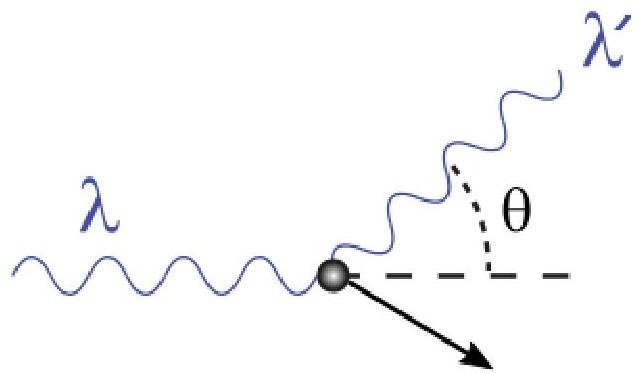
A photon of wavelength λ comes in from left, collides with a carbon target at rest, and a new photon of wavelength λ′ emerges at an angle θ (in our case, θ=90∘ ). Part of the energy of the photon is transferred to the recoiling electron (the arrow in the picture indicates the direction of motion of the electron).
Let's apply the Law of Conservation of Energy:
E=E′+KEe,
here, E is the energy of the photon before the collision with the carbon target, E′ is the energy of the photon after the collision with the carbon target and KEe is the kinetic energy imparted to recoiling electron.
Taking into account the inverse relationship between the energy of the photon and the wavelength of the light, we get:
λhc=λ′hc+KEe.
From this formula, we can find the kinetic energy imparted to recoiling electron:
KEe=λhc−λ′hc=hc(λ1−λ′1).
We can find λ′ from the Compton Scattering equation:
λ′−λ=mech(1−cosθ),
here, λ the initial wavelength of the photon, λ′ is the wavelength after scattering, mech is the Compton wavelength, and it is equal to 2.43⋅10−12m , h is the Planck's constant, me is the electron rest mass, c is the speed of light, θ is the scattering angle.
Therefore, from this formula we can calculate λ′ :
λ′=λ+mech(1−cosθ)=100⋅10−12m+2.43⋅10−12m⋅(1−cos90∘)=100⋅10−12m+2.43⋅10−12m=102.43⋅10−12m.
Finally, we can calculate the kinetic energy imparted to recoiling electron:
KEe=4.135⋅10−15eV⋅s⋅3⋅108sm⋅(100⋅10−12m1−102.43⋅10−12m1)==294.3eV.
**Answer:**
KEe=294.3eV.
2. a) There is an inverse relationship between the energy of the photon and the wavelength of the light given by the equation:
E=λhc,
here, h=6.626⋅10−34J⋅s is Planck's constant, c is the speed of light, λ is the wavelength of the light.
Then, from this formula we can calculate the energy of the photon:
E=λhc=41.5⋅10−12m6.626⋅10−34J⋅s⋅3⋅108sm=4.79⋅10−15J.
We can also calculate the energy of the photon in electronvolts (eV)
(in this case h=4.135⋅10−15eV⋅s):
E=λhc=41.5⋅10−12m4.135⋅10−15eV⋅s⋅3⋅108sm=29891eV
b) Let's look on our relationship between the energy of the photon and the wavelength of the light:
E=λhc.
Since the frequency f, wavelength λ and speed of light c are related by f=c/λ, we can rewrite this relation as follows:
E=λhc=hf.
From this formula, we can find the frequency of the photon:
f=hE=6.626⋅10−34J⋅s4.79⋅10−15J=7.23⋅1018Hz.
c) We can calculate the momentum of the photon using the famous De Broglie wavelength formula:
λ=ph,
here, λ is the wavelength of the particular X-ray photon, h is the Planck's constant, p is the momentum of the photon.
Then, from this formula we can calculate p:
p=λh=41.5⋅10−12m6.626⋅10−34J⋅s=1.596⋅10−23kg⋅sm.
**Answer:**
a) E=4.79⋅10−15J or in electronvolts E=29891eV.
b) f=7.23⋅1018Hz.
c) p=1.596⋅10−23kg⋅sm.
https://www.AssignmentExpert.com



 #339914 on Dec 2023