Question #39833

THE MAGNIFYING POWER OF GALILEAN TELESCOPE IN THE NORMAL ADJUSTMENT IS 20.THE DIFFERENCE BETWEEN THE MAGNIFYING POWER AND LENGTH OF THE TELESCOPE IS 19.05.THE FOCAL LENGTH OF OBJECTIVE AND EYE PIECE ARE : (inmeters)

1. 1 and -0.05

2. 0.05 and 2

3. 1 and 0.05

4. 2 and 0.05

Expert's answer

Answer on Question#39833 - Physics - Optics

Solve. THE MAGNIFYING POWER OF GALILEAN TELESCOPE IN THE NORMAL ADJUSTMENT IS 20. THE DIFFERENCE BETWEEN THE MAGNIFYING POWER AND LENGTH OF THE TELESCOPE IS 19.05. THE FOCAL LENGTH OF OBJECTIVE AND EYE PIECE ARE: (inmeters)

1. 1 and -0.05

2. 0.05 and 2

3. 1 and 0.05

4. 2 and 0.05

Solution.

GALILEAN TELESCOPE
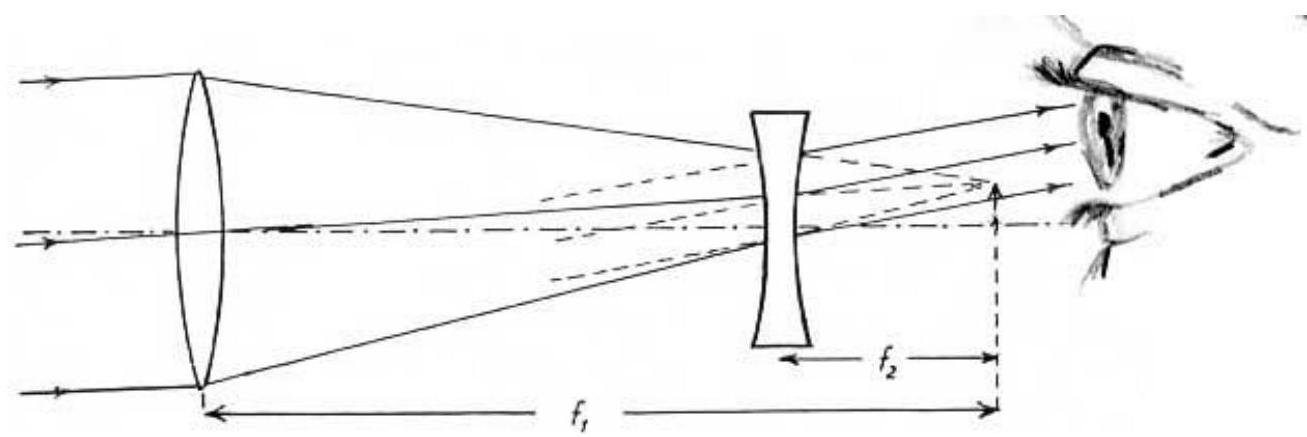


Objective is a convex lens of large focal length f1f_{1} ;

Eye piece is a divergent (concave) lens of short focal length f2f_{2} . Eye piece forms an erect and virtual image at the focus of objective on when adjustment is correct.

Magnifying power is the ratio of visual angle subtended by the image to the visual angle subtended by the object.


M=a n g l e s u b t e n d e d b y t h e f i n a l i m a g e o f e y ea n g l e s u b t e n d e d b y t h e o b j e c t a t t h e o b j e c t i v eM = \frac {\text {a n g l e s u b t e n d e d b y t h e f i n a l i m a g e o f e y e}}{\text {a n g l e s u b t e n d e d b y t h e o b j e c t a t t h e o b j e c t i v e}}M=βαM = \frac {\beta}{\alpha}


Since α\alpha and β\beta are small angle, therefore we can assume α=tanα\alpha = \tan \alpha , β=tanβ\beta = \tan \beta

M=tanαtanβM = \frac {\tan \alpha}{\tan \beta}M=fofe=f1f2M = \frac {f _ {o}}{f _ {e}} = \frac {f _ {1}}{f _ {2}}


Length of telescope.

Distance b/w objective lens and eye piece is called length of telescope.

From figure:

Length of telescope is


L=fofe=f1f2L = f _ {o} - f _ {e} = f _ {1} - f _ {2}


In our case.


M=20.M = 20.ML=19.05M - L = 19.05L=2019.05=0.95mL = 20 - 19.05 = 0.95 \, m{M=f1f2L=f1f2\left\{ \begin{array}{c} M = \frac{f_1}{f_2} \\ L = f_1 - f_2 \end{array} \right.{20=f1f20.95=f1f2\left\{ \begin{array}{c} 20 = \frac{f_1}{f_2} \\ 0.95 = f_1 - f_2 \end{array} \right.{20=f1f2f1=0.95+f2\left\{ \begin{array}{c} 20 = \frac{f_1}{f_2} \\ f_1 = 0.95 + f_2 \end{array} \right.{20=0.95+f2f2f1=0.95+f2\left\{ \begin{array}{c} 20 = \frac{0.95 + f_2}{f_2} \\ f_1 = 0.95 + f_2 \end{array} \right.{20f2=0.95+f2f1=0.95+f2\left\{ \begin{array}{c} 20 f_2 = 0.95 + f_2 \\ f_1 = 0.95 + f_2 \end{array} \right.{19f2=0.95f1=0.95+f2\left\{ \begin{array}{c} 19 f_2 = 0.95 \\ f_1 = 0.95 + f_2 \end{array} \right.{f2=0.9519=0.05mf1=0.95+0.05=1m\left\{ \begin{array}{c} f_2 = \frac{0.95}{19} = 0.05 \, m \\ f_1 = 0.95 + 0.05 = 1 \, m \end{array} \right.


Answer:

focal length of objective is 1m1 \, m.

focal length of eyepiece is 0.05m0.05 \, m.

Answer #3. 1 and 0.05

Need a fast expert's response?

Submit order

and get a quick answer at the best price

for any assignment or question with DETAILED EXPLANATIONS!

LATEST TUTORIALS
APPROVED BY CLIENTS

