Answer on Question#39173, Physics, Optics
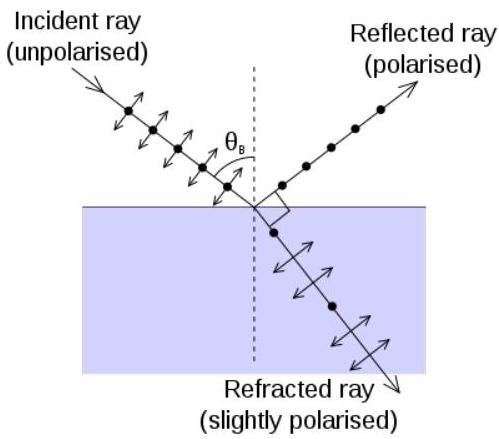
When angle of incidence is equal to the brewster's angle, the reflected and refracted rays are perpendicular to each other. Show it mathematically.
Solution:
Brewster's angle is an angle of incidence at which light with a particular polarization is perfectly transmitted through a transparent dielectric surface, with no reflection. When unpolarized light is incident at this angle, the light that is reflected from the surface is therefore perfectly polarized.
While Snell's law and the law of reflection tell us something about the direction in which reflected and
refracted light propagate, it does not say anything about how much light goes where. When light strikes the interface between two materials with different indices of refraction, a fraction of the light is reflected (R) and a fraction is transmitted (T). The values of R and T may be calculated using Fresnel's equations.
Light is an electromagnetic wave, of which fundamental characteristics can be described in terms of the electric field intensity.
For E-Field perpendicular to the plane of incidence:
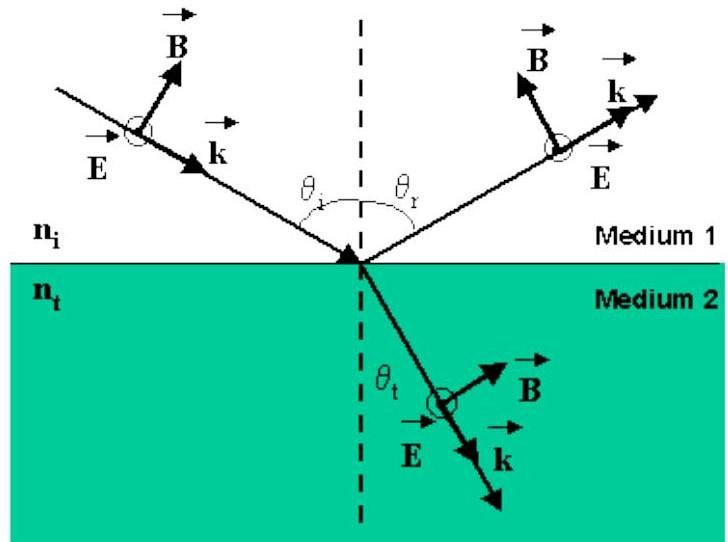 i⊥r⊥=r⊥=nicosθi+ntcosθtnicosθi−ntcosθt=−sin(θi+θt)sin(θi−θt)
where r is an amplitude reflection coefficient, ratio of reflected to incident electric field amplitudes.
i⊥t⊥=t⊥=nicosθi+ntcosθt2nicosθi=sin(θi+θt)2sinθtcosθi
Where t is an amplitude transmission coefficient, ratio of transmitted to incident electric field amplitudes.
For E-field parallel to the plane of incidence:
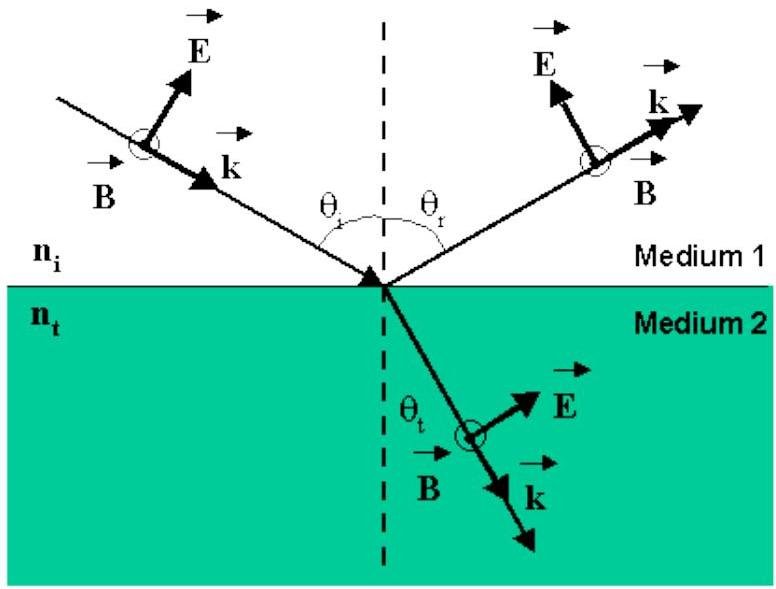 Ei∣∣Er∣∣=r∣∣=nicosθt+ntcosθintcosθi−nicosθt=tan(θi+θt)tan(θi−θt)Ei∣∣Et∣∣=t∣∣=nicosθt+ntcosθi2nicosθi=sin(θi+θt)cos(θi−θt)2sinθtcosθi
Consider now the case in which light is traveling from a medium of lower to higher index of refraction (say, an air/glass interface). Since in this case, θi>θt,r⊥ is never zero.
However, the r∣∣=0 when (θi+θt)=2π in which case the denominator becomes infinite.
r∣∣=tan(2π)tan(θi−θt)=0
At this point, all incident light which is polarized in the plane tangent to the plane of incidence is transmitted.



