Answer on Question #39082, Physics, Optics
Show that all Fresnel half-period zones have the same area.
Solution.
Let the light source S extends monochromatic spherical wave, P - the point of observation. Through the point O passes spherical wave surface. It is symmetric with respect to the line SP .
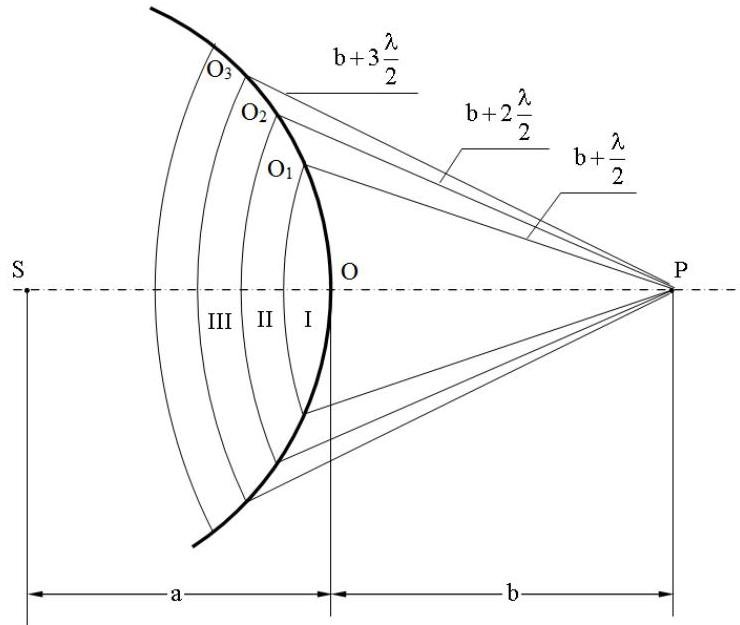
To determine the resultant effect at P , Fresnel subdivided the wavefront into a number of circular zones I, II, III etc. Let PO=b . The radii of zones equal b+2λ,b+22λ,b+23λ ... etc. The area enclosed between O and O1 , O1 and O2 , O2 and O3 etc. are known as half period zones. Each zone differs from its neighbour by a phase difference of π or a path difference of λ/2 . The area enclosed by the first circle of radius OO1 is called the first half period zone. The area enclosed by the annular strip O1O2 is known as second half period zone and so on. Thus, the annular area between (n-1)th circle and nth is the nth half period zone.
The area of the nth zone:
Sn=πOOn2−OOn−12=π[(POn2−PO2)−(POn−12−PO2)]=π[POn2−POn−12]==π[(b+2nλ)2−(b+2(n−1)λ)2]==π[b2+4n2λ2+bnλ−b2−4(n−1)2λ2−bλ(n−1)]==π[bλ+4λ2(n2−n2−1+2n)]=π[bλ+4λ2(2n−1)]b≫λ so λ2 term is negligible.
Thus,
Sn≈πbλ.
The area of each half period zone (πbλ) is approximately same and independent of the order of zone.



