Question #164512

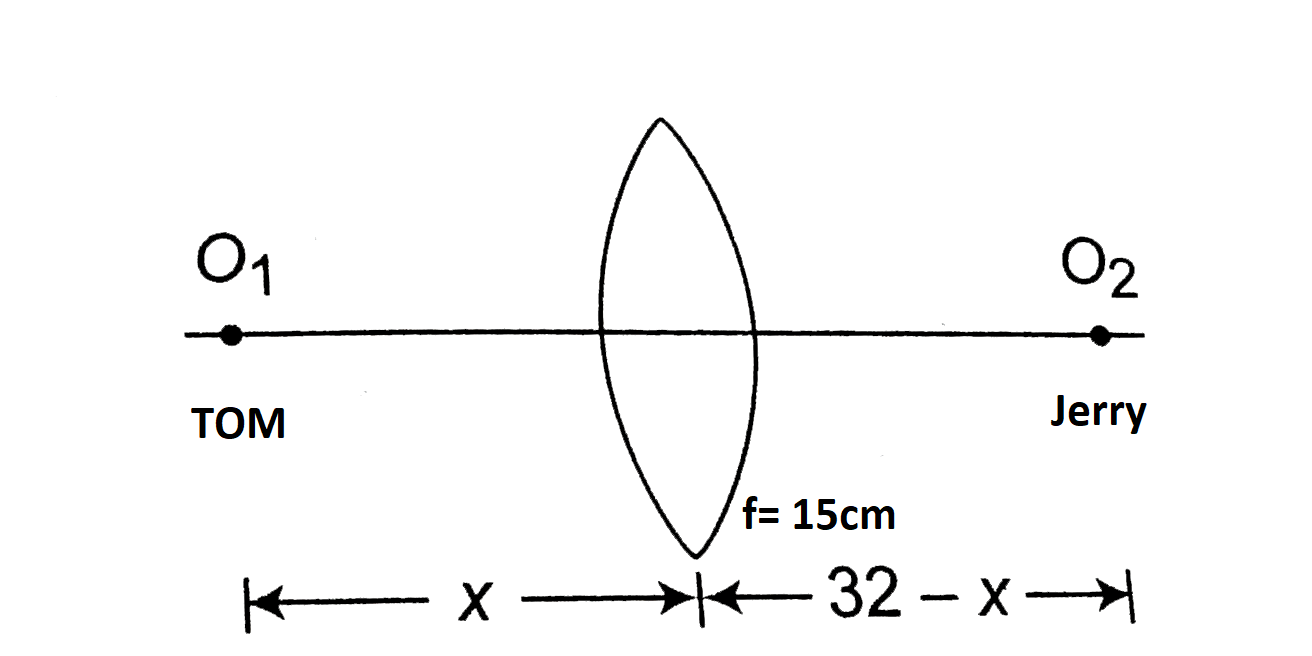
Tom and Jerry are placed at a distance of 32 cm. Between them a convex lens is placed having a focal length of 15 cm in such a way that images of both Tom and Jerry way are formed at same place. What can be the possible distance of Tom from lens?


Expert's answer


Since both images are formed at the same place, one image will real and another will be virtual.

Let image of Tom is real.

Image of O1(Tom): 1v1−1−x=115⇒1v1=115−1x\dfrac{1}{v_1}-\dfrac{1}{-x}=\dfrac{1}{15}\Rightarrow \dfrac{1}{v_1}=\dfrac{1}{15}- \dfrac{1}{x}

Image of O2(Jerry):1v2−1−(32−x)=115⇒1v2=115−1(32−x)\dfrac{1}{v_2}-\dfrac{1}{-(32-x)}=\dfrac{1}{15}\Rightarrow\dfrac{1}{v_2}=\dfrac{1}{15}-\dfrac{1}{(32-x)}


v1v_1 is positive and v2v_2 is negative

v1=−v2v_1=-v_2


1v1=−1v2\dfrac{1}{v_1}= - \dfrac{1}{v_2}


⇒115−1x=−[115−1(32−x)]\Rightarrow \dfrac{1}{15}-\dfrac{1}{x}= -[\dfrac{1}{15}-\dfrac{1}{(32-x)}]


⇒115+132−x=215⇒32x(32−x)=215\Rightarrow \dfrac{1}{15}+\dfrac{1}{32-x}=\dfrac{2}{15}\Rightarrow \dfrac{32}{x(32-x)}= \dfrac{2}{15}


⇒16x(32−x)=115\Rightarrow \dfrac{16}{x(32-x)}= \dfrac{1}{15}


⇒240=32x−x2\Rightarrow 240= 32x- x^2

⇒x2−32x+240=0\Rightarrow x^2-32x+240=0

⇒(x−20)(x−12)=0\Rightarrow(x-20)(x-12)=0

⇒x=20cm,12cm\Rightarrow x= 20cm, 12cm

Hence, the distance of Tom from lens is either 20cm or 12cm.



LATEST TUTORIALS
APPROVED BY CLIENTS
