Answer on Question #61172-Physics-Molecular Physics | Thermodynamics
What is a Gibbs paradox? How did it arise?
Answer
Consider an ideal gas of N particles in a container with a volume V . A partition separates the container into two sections with volumes V1 and V2 , respectively, such that V2+V2=V . Also, there are N1 particles in the volume V1 and N2 particles in the volume V2 . It is assumed that the number density is the same throughout the system
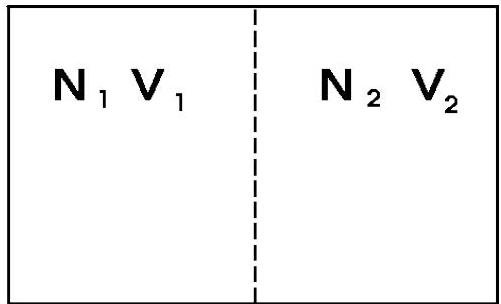
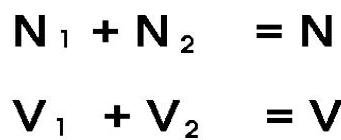
If the partition is now removed, what should happen to the total entropy? Since the particles are identical, the total entropy should not increase as the partition is removed because the two states cannot be differentiated due to the indistinguishability of the particles. Let us analyze this thought experiment using the classical expression entropy derived above (i.e., we leave off the lnN term).
The entropies S1 and S2 before the partition is removed are
S1∼N1klnV1+23N1kS2∼N2klnV2+23N2k
And the total entropy is
S=S1+S2
After the partition is removed, the total entropy is
S∼(N1+N2)kln(V1+V2)+23(N1+N2)k
Thus, the difference
ΔS=Sa f t e r−Sb e f o r eΔS=(N1+N2)kln(V1+V2)−N1klnV1−N2klnV2=N1kln(V/V1)+N2kln(V/V2)>0
This contradicts our predicted result that ΔS=0. Therefore, the classical expression must not be quite right.
Let us now restore the lnN!. Using the Stirling approximation
lnN!=NlnN−N
the entropy can be written as
S=Nk[Nh3V(β2πm)3/2]+25Nk
which is known as the Sackur-Tetrode equation. Using this expression for the entropy, the difference now becomes
ΔS=(N1+N2)kln(N1+N2V1+V2)−N1kln(V1/N1)−N2kln(V2/N2)=N1kln(V/V1)+N2kln(V/V2)−N1kln(N/N1)−N2kln(N/N2)=N1kln(NVV1N1)+N2kln(NVV2N2)
However, since the density
ρ=N1/V1=N2/V2=N/V
is constant, the terms appearing in the log are all 1 and, therefore, vanish. Hence, the change in entropy, ΔS=0 as expected. Thus, it seems that the 1/N! term is absolutely necessary to resolve the paradox. This means that only a correct quantum mechanical treatment of the ideal gas gives rise to a consistent entropy.
http://www.AssignmentExpert.com



 #339914 on Dec 2023