Answer on Question #56526-Physics-Molecular Physics-Thermodynamics
A father pushes horizontally on his daughter's sled to move it up a snowy incline, as illustrated in the figure, with h=3.5 m and θ=10∘ . The total mass of the sled and the girl is 35 kg and the coefficient of kinetic friction between the sled runners and the snow is 0.20. If the sled moves up the hill with a constant velocity, how much work is done by the father in moving it from the bottom to the top of the hill?
Solution
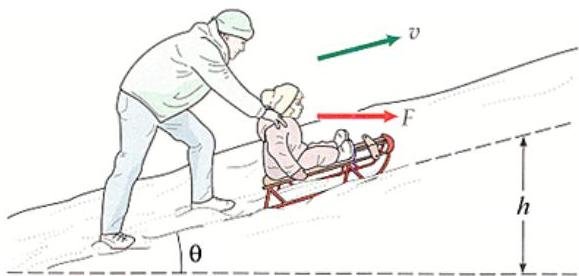
For "constant velocity", the sum of projections of all forces on any axis is zero.
For the direction perpendicular to the snowy incline:
N−Wcosθ−Fsinθ=0→N=Wcosθ+Fsinθ
For the direction parallel to the snowy incline:
Fcosθ−Wsinθ−Ffr=0→Fcosθ=Wsinθ+Ffr.
Then the friction force is
Ffr=μN=μ(Wcosθ+Fsinθ).
Thus,
Fcosθ=Wsinθ+μ(Wcosθ+Fsinθ)→F(cosθ−μsinθ)=W(μcosθ+sinθ).F=Wcosθ−μsinθμcosθ+sinθ=mgcosθ−μsinθμcosθ+sinθ.
The work done by the force is
Work=Fˉ⋅dˉ=Fdcosθ=Fsinθhcosθ=Fhcotθ=mghcosθ−μsinθμcosθ+sinθcotθ=35⋅9.8⋅3.5cos10∘−0.20sin10∘0.20cos10∘+sin10∘cot10∘=2.7kJ.
Answer: 2.7 kJ.
https://www.AssignmentExpert.com



 #340153 on Dec 2023