The Brayton cycle (or Joule cycle) represents the operation of a gas turbine engine. The cycle consists of four processes, as shown in Figure 1 along side a sketch of an engine:
- a - b Adiabatic, quasi-static (or reversible) compression in the inlet and compressor;
- b - c Constant pressure fuel combustion (idealized as constant pressure heat addition);
- c - d Adiabatic, quasi-static (or reversible) expansion in the turbine and exhaust nozzle, with which we
1. take some work out of the air and use it to drive the compressor, and
2. take the remaining work out and use it to accelerate fluid for jet propulsion, or to turn a generator for electrical power generation;
- d - a Cool the air at constant pressure back to its initial condition.
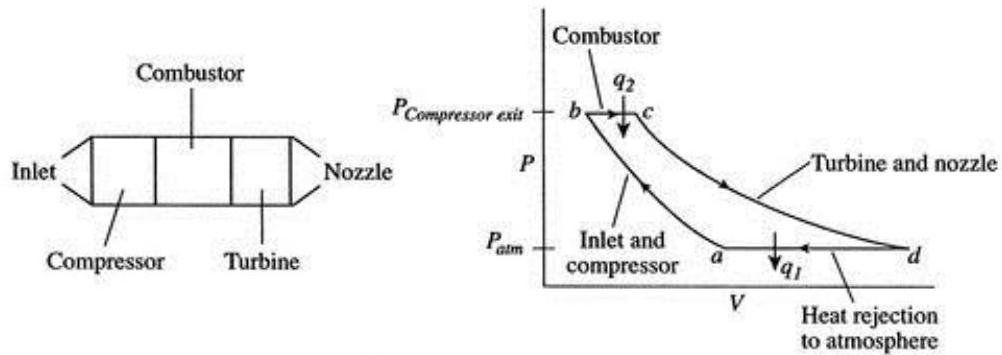
Figure 1: Sketch of the jet engine components and corresponding thermodynamic states
The objective now is to find the work done, the heat absorbed, and the thermal efficiency of the cycle. Tracing the path shown around the cycle from a−b−c−d and back to a , the first law gives (writing the equation in terms of a unit mass),
Δua−b−c−d−a=0=q2+q1−w.
Here Δu is zero because u is a function of state, and any cycle returns the system to its starting state. The net work done is therefore
w=q2+q1,
where q1 , q2 are defined as heat received by the system ( q1 is negative). We thus need to evaluate the heat transferred in processes b−c and d−a .
For a constant pressure, quasi-static process the heat exchange per unit mass is
dh=cpdT=dq,or[dq]constantP=dh.
We can see this by writing the first law in terms of enthalpy or by remembering the definition of cp .
The heat exchange can be expressed in terms of enthalpy differences between the relevant states. Treating the working fluid as a perfect gas with constant specific heats, for the heat addition from the combustor,
q2=hc−hb=cp(Tc−Tb).
The heat rejected is, similarly,
q1=ha−hd=cp(Ta−Td).
The net work per unit mass is given by
Net work per unit mass=q1+q2=cp[(Tc−Tb)+(Ta−Td)].
The thermal efficiency of the Brayton cycle can now be expressed in terms of the temperatures:
η=Heat inNet work=cp[Tc−Tb]cp[(Tc−Tb)−(Td−Ta)]=1−(Tc−Tb)(Td−Ta)=1−Tb(Tc/Tb−1)Ta(Td/Ta−1)
Eq 1
To proceed further, we need to examine the relationships between the different temperatures. We know that points a and d are on a constant pressure process as are points b and c ,
and Pa=Pd and Pb=Pc . The other two legs of the cycle are adiabatic and reversible, so
PcPd=PbPa⇒(TcTd)γ/(γ−1)=(TbTa)γ/(γ−1).Td/Tc=Ta/TbTd/Ta=Tc/Tb
Therefore, or, finally, . Using this relation in the expression for thermal efficiency, Eq. (1) yields an expression for the thermal efficiency of a Brayton cycle:
Ideal Brayton cycle efficiency: ηB=1−TbTa=1−Tcompressor exitTatmospheric.η=1−TbTa=1−(PbPa)γγ−1,γ=CvCp


