Question #41155

two identical containers are connected by very narrow tube. if one container is filled with ideal gas at tempTand pressureP and other one is evacuated .when tube connecting is opened then temperature of gas donot change. why???

Expert's answer

Answer on Question #41155 - Physics - Molecular Physics | Thermodynamics

Question.

Two identical containers are connected by very narrow tube. If one container is filled with ideal gas at temp T and pressure P and other one is evacuated. When tube connecting is opened then temperature of gas does not change. Why?

Proof.
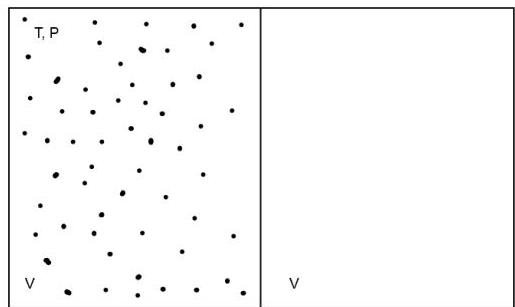

Start
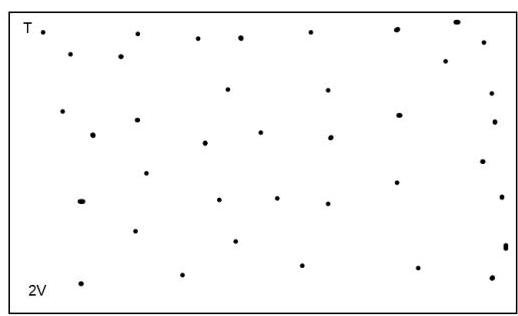


End

In this process energy doesn't change. So,


Estart=EenddU=0E _ {s t a r t} = E _ {e n d} \rightarrow d U = 0


First law of thermodynamics:


dU=TdSPdVd U = T d S - P d V


In our case:


dU=TdSPdV=0(1)d U = T d S - P d V = 0 \quad (1)


Entropy SS is the function of temperature and volume:


S=S(T,V)S = S(T, V)


Therefore:


dS=(ST)VdT+(SV)TdVdS = \left(\frac{\partial S}{\partial T}\right)_V dT + \left(\frac{\partial S}{\partial V}\right)_T dV


Substitute in equation (1):


dU=T(ST)VdT+T(SV)TdVPdVdU = T \left(\frac{\partial S}{\partial T}\right)_V dT + T \left(\frac{\partial S}{\partial V}\right)_T dV - P dV

CV=T(ST)VC_V = T\left(\frac{\partial S}{\partial T}\right)_V - heat capacity

By definition the differential of enthalpy is:


dH=TdS+VdPdH = T dS + V dP


Using the properties of the first and second derivatives we obtain:


(SV)T=(PT)V\left(\frac{\partial S}{\partial V}\right)_T = \left(\frac{\partial P}{\partial T}\right)_V


Substitute in equation for dUdU:


dU=T(ST)VdT+T(SV)TdVPdV=CVdT+[T(PT)VP]dVdU = T \left(\frac{\partial S}{\partial T}\right)_V dT + T \left(\frac{\partial S}{\partial V}\right)_T dV - P dV = C_V dT + \left[T \left(\frac{\partial P}{\partial T}\right)_V - P\right] dVdU=0CVdT+[T(PT)VP]dV=0dU = 0 \rightarrow C_V dT + \left[T \left(\frac{\partial P}{\partial T}\right)_V - P\right] dV = 0


And finally we get the temperature change with a change in volume:


(TV)E=1CV[PT(PT)V]\left(\frac{\partial T}{\partial V}\right)_E = \frac{1}{C_V} \left[ P - T \left(\frac{\partial P}{\partial T}\right)_V \right]


All this we have done for any gas. But now let us remember that we have the ideal gas.

Ideal gas law (for 1 mol):


PV=RTP=RTVPV = RT \rightarrow P = \frac{RT}{V}


Therefore:


(PT)V=RV\left(\frac{\partial P}{\partial T}\right)_V = \frac{R}{V}


Substitute this in our final equation:


(TV)E=1CV[PT(PT)V]=1CV[PTRV]=1CV[PP]=0\left(\frac {\partial T}{\partial V}\right) _ {E} = \frac {1}{C _ {V}} \left[ P - T \left(\frac {\partial P}{\partial T}\right) _ {V} \right] = \frac {1}{C _ {V}} \left[ P - T \frac {R}{V} \right] = \frac {1}{C _ {V}} [ P - P ] = 0


Thus, dT=0dT = 0 , i.e. temperature of gas doesn't change.

Notation. But this is true only for ideal gas. Common formula is:


(TV)E=1CV[PT(PT)V]\left(\frac {\partial T}{\partial V}\right) _ {E} = \frac {1}{C _ {V}} \left[ P - T \left(\frac {\partial P}{\partial T}\right) _ {V} \right]


http://www.AssignmentExpert.com/


Need a fast expert's response?

Submit order

and get a quick answer at the best price

for any assignment or question with DETAILED EXPLANATIONS!

LATEST TUTORIALS
APPROVED BY CLIENTS

