A water at a gauge pressure of 3.8 atm at street flows into an office building at a speed of 0.60 m/s through a pipe 50 mm in diameter. The pipe tapers down to 2.6 cm in diameter by the top floor, 18m above the street, where a faucet has been left open. Calculate the flow velocity and the gauge pressure in such a pipe at the top floor.
Solution.
P1=3.8atm,v1=0.60sm,d1=50mm=50⋅10−3m,d2=2.6cm=2.6⋅10−2m,h=18m,g=9.8s2m,ρ=1000m3kg;v2−?P2−?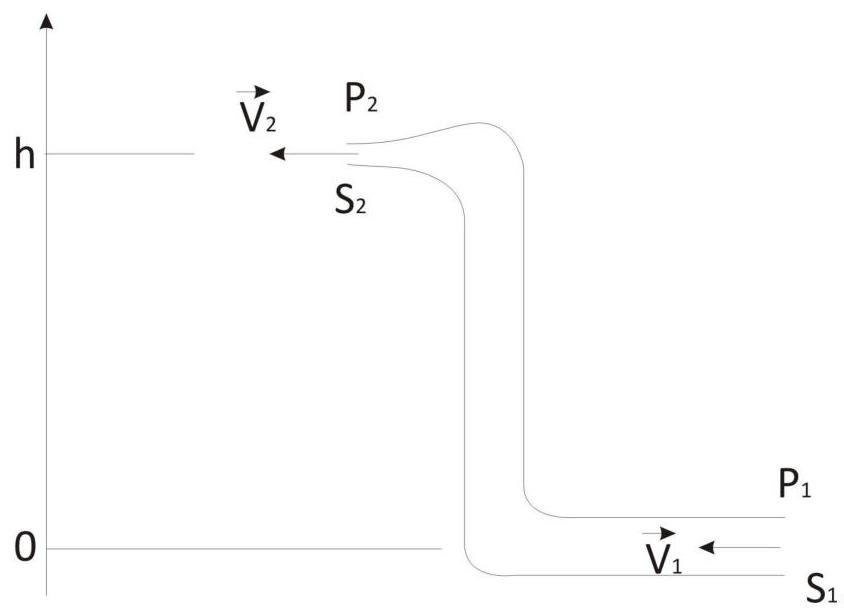
For the water in the pipe:
v1S1=v2S2;S1 - the sectional area of the pipe at the street;
S2 - the sectional area of the pipe by the top floor;
v1 - the flow velocity at the street;
v2 - the flow velocity by the top floor.
S1=π4d12;S2=π4d22.v1π4d12=v2π4d22;v1d12=v2d22;
The flow velocity by the top floor:
v2=v1d22d12.v2=0.60sm⋅(2.6⋅10−2m)2(50⋅10−3m)2=2.22sm.
By Bernoulli's principle:
2ρv12+ρgh1+P1=2ρv22+ρgh2+P2;ρ - the density of the water;
g - the acceleration due to gravity;
h1 - the elevation of the pipe at the street
h2 - the elevation of the pipe by the top floor
P1 - the gauge pressure at the street;
P2 - the gauge pressure by the top floor.
h1=0;h2=h.2ρv12+P1=2ρv22+ρgh+P2;P2=P1+2ρ(v12−v22)−ρgh.
Converting the gauge pressure to Pa:
P2=3.8 atm⋅(1.01⋅105atmPa)=3.838⋅105Pa.
The gauge pressure by the top floor:
P2=3.838⋅105Pa+21000m3kg((0.60sm)2−(2.22sm)2)−1000m3kg⋅9.8s2m⋅18m==205115.8Pa.
Converting the gauge pressure to atm:
P2=(1.01⋅105atmPa)205115.8Pa=2.03 atm.
Answer:
The flow velocity in such a pipe at the top floor is v2=2.22sm.
The gauge pressure in such a pipe at the top floor is P2=2.03atm.



 #340153 on Dec 2023