Answer on Question #74484, Physics / Mechanics | Relativity
A Particle of mass m rests on a plane with no friction. The plane is raised to an inclination angle θ with a constant rate α(θ(t=0)=0) , causing the particle to slide down the plane. Determine the motion of the particle.
Solution:
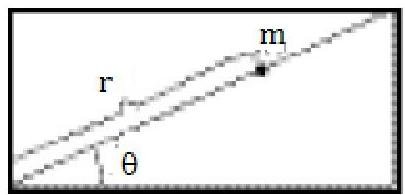
This problem is an example of a problem with a velocity-dependent constraint. However, if we can easily incorporate the constraint into the Lagrangian, we do not need to worry about constraint functions. In this example, we use our knowledge of the constraint immediately in our expression of the kinetic and the potential energy. Putting the origin of our coordinate system at the bottom of the plane we find
L=T+U=21m(r˙2+r2θ˙2)−mgrsinθ
where
θ=αt;θ≐α
So,
L=21m(r˙2+α2r2)−mgrsinαt
Lagrange's equation for r gives
mr¨=mα2r−mgsinαt
or
r¨−α2r=−gsinαt
The general solution is of the form r=rh+rn where rh is the general solution of the homogeneous r¨−α2r=−0 and rn is a particular solution. So
rh=Aeαt+Be−αt
For rn , try a solution of the form rp=Csinαt . Then r¨p=−Cα2sinαt
Substituting into above equation gives
−Cα2sinαt−−Cα2sinαt=−gsinαtC=2α2g
So,
r(t)=Aeαt+Be−αt+2α2gsinαt
We can determine A and B from the initial conditions:
r(0)=r0r˙(0)=0
So,
r0=A+B0=A−B+2α2g
Solving for A and B gives:
A=21[r0−2α2g]B=21[r0+2α2g]
So, the analytic solution to this problem is
r(t)=21[r0−2α2g]eαt+21[r0+2α2g]e−αt+2α2gsinαt
or
r(t)=r0cosh(αt)+2α2g(sinαt−sinh(αt))
Answer: r(t)=r0cosh(αt)+2α2g(sinαt−sinh(αt)).
Answer provided by https://www.AssignmentExpert.com



 #340153 on Dec 2023