Question #59308

A pipe contains a gradually tapering section where the diameter decreases from 400 mm to 250 mm. The pipe contains an incompressible fluid of density 1000 kgm−3 and runs full. If the flow velocity is 2 ms−1 in the smaller diameter, determine:
a) the velocity in the larger diameter
b) the volume flow rate
c) the mass flow rate.
1

Expert's answer

2016-04-19T09:16:05-0400

Answer on Question 59308, Physics, Mechanics, Relativity

Question:

A pipe contains a gradually tapering section where the diameter decreases from 400mm400 \, \text{mm} to 250mm250 \, \text{mm} . The pipe contains an incompressible fluid of density 1000kgm31000 \, \text{kgm}^{-3} and runs full. If the flow velocity is 2ms12 \, \text{ms}^{-1} in the smaller diameter, determine:

a) the velocity in the larger diameter

b) the volume flow rate

c) the mass flow rate

Solution:

Here's the sketch of our task:
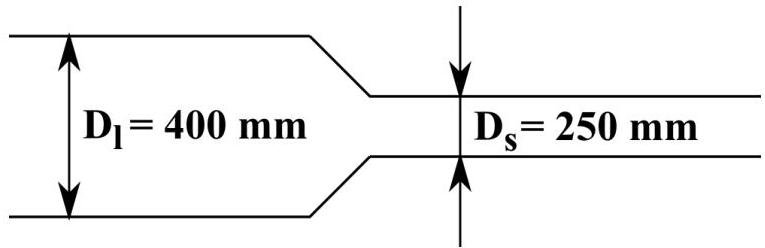


a) We can find the velocity of the fluid from the Law of Continuity:


Alvl=Asvs,A _ {l} v _ {l} = A _ {s} v _ {s},


here, Al=πrl2A_{l} = \pi r_{l}^{2} , As=πrs2A_{s} = \pi r_{s}^{2} are the large and small cross-sectional areas of the pipe, respectively; rl,rsr_{l}, r_{s} are the large and small radii of the pipe, respectively; vlv_{l} is the velocity of the fluid in the larger diameter, vsv_{s} is the velocity of the fluid in the smaller diameter.

Then, from this formula we can calculate the velocity of the fluid in the larger diameter:


vl=AsvsAl=vsπrs2πrl2=2ms1π(125103m)2π(200103m)2=0.78ms1.v _ {l} = \frac {A _ {s} v _ {s}}{A _ {l}} = v _ {s} \cdot \frac {\pi r _ {s} ^ {2}}{\pi r _ {l} ^ {2}} = 2 m s ^ {- 1} \cdot \frac {\pi \cdot (1 2 5 \cdot 1 0 ^ {- 3} m) ^ {2}}{\pi \cdot (2 0 0 \cdot 1 0 ^ {- 3} m) ^ {2}} = 0. 7 8 m s ^ {- 1}.


b) Let us determine the volume flow rate – the rate of flow through the volume VV per unit time tt :


V=vtA,V = v t A,ΔVΔt=Alvl=πDl24vl=3.144(400103m)20.78ms=0.098m3s.\frac {\Delta V}{\Delta t} = A _ {l} v _ {l} = \frac {\pi D _ {l} ^ {2}}{4} v _ {l} = \frac {3.14}{4} (400 \cdot 10^{-3} \, \text{m}) ^ {2} \cdot 0.78 \, \frac {\text{m}}{\text{s}} = 0.098 \, \frac {\text{m} ^ {3}}{\text{s}}.


c) As we know the volume flow rate, we can calculate the mass flow rate:


mρ=vts,\frac {m}{\rho} = v t s,ΔmΔt=ρΔVΔt=ρvlAl=1000kgm30.098m3s=98kgs.\frac {\Delta m}{\Delta t} = \rho \frac {\Delta V}{\Delta t} = \rho v _ {l} A _ {l} = 1000 \, \frac {\text{kg}}{\text{m} ^ {3}} \cdot 0.098 \, \frac {\text{m} ^ {3}}{\text{s}} = 98 \, \frac {\text{kg}}{\text{s}}.


Answer:

a) vl=0.78ms1v_{l} = 0.78 \, \text{ms}^{-1}.

b) ΔVΔt=0.098m3s\frac{\Delta V}{\Delta t} = 0.098 \, \frac{\text{m}^3}{\text{s}}.

c) ΔmΔt=98kgs\frac{\Delta m}{\Delta t} = 98 \, \frac{\text{kg}}{\text{s}}.

https://www.AssignmentExpert.com

Need a fast expert's response?

Submit order

and get a quick answer at the best price

for any assignment or question with DETAILED EXPLANATIONS!

Comments

No comments. Be the first!
LATEST TUTORIALS
APPROVED BY CLIENTS

