Question #57685

You attach a meter stick to an oak tree, such that the top of the meter stick is 1.47 meters above the ground. Later, an acorn falls from somewhere higher up in the tree. If the acorn takes 0.311 seconds to pass the length of the meter stick, how high above the ground was the acorn before it fell (assuming that the acorn didn\'t run into any branches or leaves on the way down)?
1

Expert's answer

2016-02-12T00:01:01-0500

Answer on Question #57701, Physics / Mechanics | Relativity

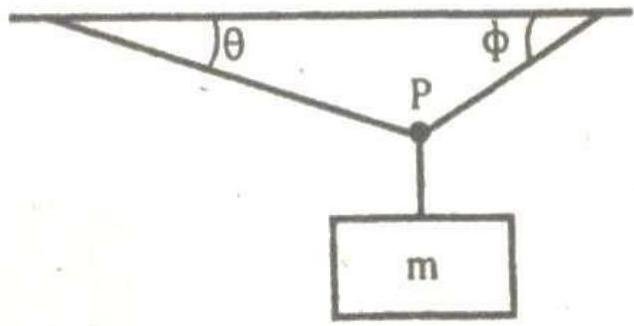
A rope is hung at both ends from a horizontal beam, and a weight mm is suspended from it. The left part of the rope exerts a force GG at PP, while the right part of the rope exerts a force HH. Find the indicated quantities from the given data.


m=50kgm = 50 \, \text{kg}θ(theta)=17\theta \, (\text{theta}) = 17{}^\circ=6\varnothing = 6{}^\circG=?|G| = ?H=?|H| = ?


Solution:


All the forces that are acting are drawn in figure:
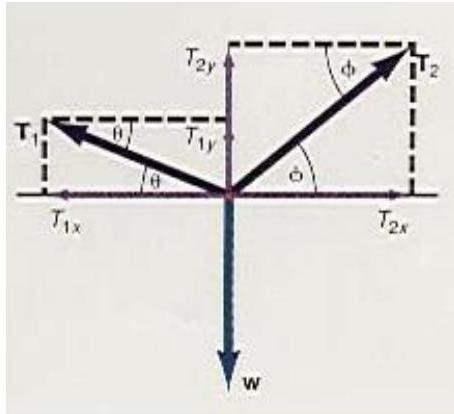


The weight is


w=mg=509.8=490Nw = mg = 50 \cdot 9.8 = 490 \, \text{N}


The forces are resolved into their components, as shown in figure, where


T1x=GcosθT_{1x} = G \cos \thetaT1y=GsinθT_{1y} = G \sin \thetaT2x=HcosϕT_{2x} = H \cos \phiT2y=HsinϕT_{2y} = H \sin \phi


The first condition of equilibrium must hold. Setting the forces in the xx-direction to zero


Fx=0\sum F_x = 0


gives


T2xT1x=0T_{2x} - T_{1x} = 0Hcosϕ=GcosθH \cos \phi = G \cos \theta


Taking all the forces in the y-direction and setting them equal to zero,


Fy=0\sum F_y = 0T1y+T2yw=0T_{1y} + T_{2y} - w = 0


Using equations for the components, this becomes


Gsinθ+Hsinϕ=wG \sin \theta + H \sin \phi = w


From equation (1)


G=HcosϕcosθG = \frac{H \cos \phi}{\cos \theta}


If we substitute this equation for G into equation (2)


Hcosϕcosθsinθ+Hsinϕ=w\frac{H \cos \phi}{\cos \theta} \sin \theta + H \sin \phi = wH(cosϕtanθ+sinϕ)=wH (\cos \phi \cdot \tan \theta + \sin \phi) = w


Hence,


H=wcosϕtanθ+sinϕ=490 Ncos6tan17+sin6=1199 NH = \frac{w}{\cos \phi \cdot \tan \theta + \sin \phi} = \frac{490\ \mathrm{N}}{\cos 6{}^\circ \cdot \tan 17{}^\circ + \sin 6{}^\circ} = 1199\ \mathrm{N}G=Hcosϕcosθ=1199cos6cos17=1247 NG = \frac{H \cos \phi}{\cos \theta} = \frac{1199 \cdot \cos 6{}^\circ}{\cos 17{}^\circ} = 1247\ \mathrm{N}


Answer: G=1247 N|\mathrm{G}| = 1247\ \mathrm{N}; H=1199 N|\mathrm{H}| = 1199\ \mathrm{N}.

https://www.AssignmentExpert.com

Need a fast expert's response?

Submit order

and get a quick answer at the best price

for any assignment or question with DETAILED EXPLANATIONS!

Comments

No comments. Be the first!
LATEST TUTORIALS
APPROVED BY CLIENTS