Answer on Question #56953, Physics / Mechanics | Relativity
A ladder of mass M and length 4 m rests against a frictionless wall at an angle of 50 degrees to the horizontal. The coefficient of static friction between the ladder and the floor is 0.65. What is the maximum distance along the ladder a person of mass 15M can climb before the ladder starts to slip?
Solution:
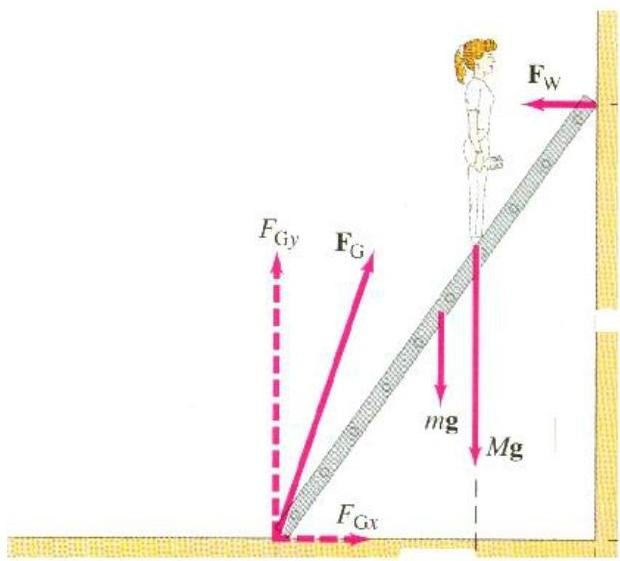
We know at the point of slipping that FGx (See diagram above) is just equal to the friction force, where the normal force is FGy (The upward force exerted by the ground on the ladder - see diagram above.)
So, applying the formula for friction:
Ffr=msFn (at the point of slipping)
where ms is the coefficient of static friction between the ladder and the floor
FGx=msFGy
Vertical Force:
Ladder weight: −Mg (down)
Person weight: −15Mg (down)
Ground pushing up: +FGy (up)
Equilibrium:
FGy−Mg−15Mg=0FGy−16Mg=0
Thus,
FGy=16Mg
Horizontal Force:
Force exerted by the wall: −FW (left)
Force exerted by the ground horizontally: +FGx (right)
Equilibrium:
FGx−FW=0FGx=FW=0.65⋅16Mg=10.4Mg
And finally torque:
We then have the following torques about the bottom of the ladder:
The ground: torque = 0 (r = 0)
The weight of the ladder: Mg N at an angle of 50∘ at a distance of 4/2=2 m from the bottom of the ladder. Torque1=(2.0m)(MgN)cos(50∘) (CW)
The weight of the person on the ladder: 15Mg N at an angle of 50∘ at a distance of x m from the bottom of the ladder. Torque2=x⋅15Mg⋅cos(50∘) (CW)
The wall pushing to the left: FW acting at a distance of 4.0m from the bottom, at an angle of 50∘ with the ladder.
Torque3=−(4.0m)FWsin(50∘)(ACW)
Equilibrium:
Torque1+Torque2+Torque32Mgcos(50∘)+15xMgcos(50∘)−4⋅10.4Mgsin(50∘)2cos(50∘)+15xcos(50∘)−41.6sin(50∘)x=0=0=0=15cos(50∘)41.6sin(50∘)−2cos(50∘)=1.311m
Answer: 1.311 m
https://www.AssignmentExpert.com



 #340153 on Dec 2023
Comments