Answer on Question#56544 - Physics - Mechanics - Relativity
practice Exercise 5.5
(i) A solid wooden door 1m wide and 2m high is hinged along one side and has a total mass of 50kg . Initially open and at rest, the door is struck at its centre by a handful of sticky mud of mass 0.5kg . Travelling 12m/s just before impact. Find the final angular velocity of the door.
[103r1md/s]
(ii) A thin uniform square plate with side l and mass M can rotate freely about a stationary vertical axis omitting with one of its sides. A small ball of mass m flying with velocity v at right angles to the plate strikes elastically the centre of it. Find the velocity of the ball v′ after the impact and the horizontal component of the force which the axis will exert on the plate after the impact.
[ms−103v′−1Mv]
(iii) A small disc of mass m slides down a smooth hill of height h without initial velocity and gets also a plank of mass M lying on the horizontal edge on the base of the hill as shown in Figure 1. Find the fixation between the disc and
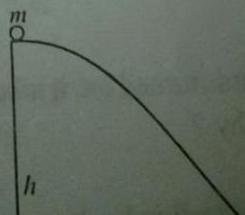
Solution:
(i) The angular momentum of the mud is
L=mvr,
Where v=12sm , m=0.5kg and r=21m - is the distance from the axis of rotation to the door's centre.
The moment of inertia of the door is
Id=31Ml2,
Where M=50kg and l=1m .
The moment of inertia of the mud (about the axis of rotation) is
Im=mr2
Since the angular momentum is conserved the final angular momentum (Id+Im)ω must be equal to the initial L :
mvr=(Id+Im)ω
Thus
ω=Id+Immvr=31Ml2+mr2mvr=3150kg⋅(1m)2+0.5kg⋅(0.5m)20.5kg⋅12sm⋅0.5m=40372srad
(ii) According to the law of conservation of angular momentum
31Ml2ω+mv′2l=mv2l
According to the law of conservation of energy
231Ml2ω2+2mv′2=2mv2
(1):
v−v′=32mMlω(v−v′)2=(32mMlω)2
(2):
v2−v′2=31mMl2ω2
Dividing (3) by (4) we obtain
v2−v′2(v−v′)2=31mMl2ω2(32mMlω)2v+v′v−v′=34mMv′=4M+3m3m−4Mv
Thus the angular velocity ω is
ω=2M3ml1(v−v′)=lv4M+3m12m
The horizontal component of the force acting on the axis is given by the centrifugal force of the plate which is (integral over all vertical stripes of width dr at distance r from the axis of revolution)
F=∫0lMω2lrdr=21Mω2l=21M(lv4M+3m12m)2l=72Mlv2(4M+3m)2m2
Answer:
(i) 403s72rad
(ii) v′=4M+3m3m−4Mv
F=72Mlv2(4M+3m)2m2
https://www.AssignmentExpert.com



 #340153 on Dec 2023
Comments