Answer on Question #51386-Physics-Mechanics-Kinematics-Dynamics
The moment of inertia of a annular disc of mass M , the inner diameter R1 and outer diameter is R2 about a perpendicular axis through its center is
Solution
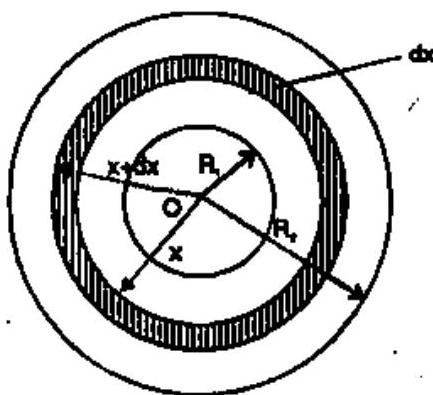
An annular disc is just a circular disc from which a smaller, concentric disc has been removed, leaving a hole in its place as shown in the figure.
Let O be the center of annular disc. Then, clearly, face area of the disc is π(R22−R12) and, therefore,
mass per unit area of the disk =π(R22−R12)M
Now, consider a coaxial ring of radius x and width dx shown in the figure. We clearly have,
face area of the ring =2πxdx and, therefore, it mass =π(R22−R12)M2πxdx=(R22−R12)M2xdx.
Hence, the moment of inertia of this ring about an axis through O and perpendicular to its plane is
(R22−R12)M2xdx⋅x2=(R22−R12)M2x3dx.
The moment of inertia of the whole annular disk about an axis through O and perpendicular to its plane is thus easily obtained by integrating the above expression for the moment of inertia of this ring, between the limits x=R1 and x=R2 , so that, we have
I=∫R1R2(R22−R12)M2x3dx=(R22−R12)2M∫R1R2x3dx=(R22−R12)2M[4x4]R1R2=(R22−R12)2M[4(R24−R14)]=2M(R22+R12).
Answer: 2M(R22+R12) .
http://www.AssignmentExpert.com/



 #340153 on Dec 2023
Comments