Answer on Question#49931 – Physics – Mechanics | Kinematics | Dynamics
θ=21asin(V275g)≈18.88∘
Stone will go up of the buckle.
Solution
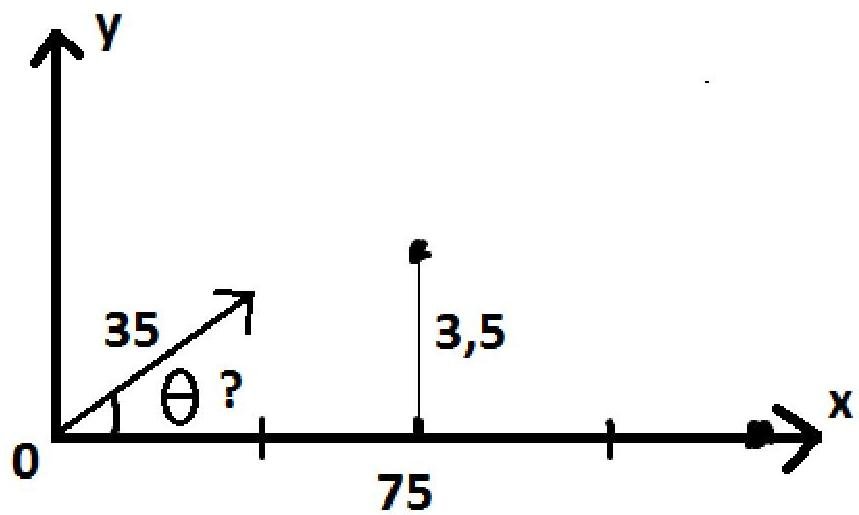
Equations of motion:
mdtd2x=0mdt2d2y=−mg
Initial conditions:
x=0;Vx(0)=Vcos(θ);y(0)=0;Vy(0)=Vsin(θ);
Explicit solutions of the equations above:
x=C1+C2ty=−2gt2+C3t+C4
Use initial conditions:
x(0)=C1+C2(0)=C1=0Vx(0)=dtdx(0)=C2=Vcos(θ)y(0)=−2g(0)2+C3(0)+C4=C4=0Vy(0)=dtdy(0)=−g(0)+C3=C3=Vsin(θ)
Thus, we have:
x(t)=Vcos(θ)ty(t)=Vsin(θ)t−2gt2
We know that at some time t1:
x(t1)=Vcos(θ)t1=75y(t1)=Vsin(θ)t1−2gt12=0
Solve last equation for t1:
Vsin(θ)t1−2gt12=0t1(Vsin(θ)−2gt1)=0t11=0t12=g2Vsin(θ)
Obviously, we need second solution to use. Put it into equation x(t1) to determine angle θ:
Vcos(θ)t1=75gVcos(θ)2Vsin(θ)=752sin(θ)cos(θ)=sin(2θ)gV2sin(2θ)=752θ=asin(V275g)θ=21asin(V275g)
Substitute
V=35;g=10;θ=21asin(35275⋅10)≈18.88∘
As soon as velocity along x – constant, stone pass middle point at time 2t1. Calculate y(2t1):
y(2t1)=Vsin(θ)2t1−8gt12=2(Vsin(θ)t1−2gt12)+8gt12
Recall that
Vsin(θ)t1−2gt12=0
Then
y(2t1)=8gt12=8g(g2Vsin(θ))2=8gg24V2sin2(21asin(V275g))=2gV2sin2(21asin(V275g))
Substitute
V=35;g=5;y(t1)≈6.41>3
http://www.AssignmentExpert.com/



 #339914 on Dec 2023
Comments