Answer Question #45653, Physics, Mechanics | Kinematics | Dynamics
The father of a 20kg child stands at the summit of a conical hill as he spins a 2.0m long rope. The sides of the hill are inclined at 20 degrees. He again keeps the rope parallel to the ground and friction is negligible. What rope tension will allow the cart to spin the same 14rpm it had?
Solution:
We can consider the figure of our task to construct the equation of the forces acting on the system.
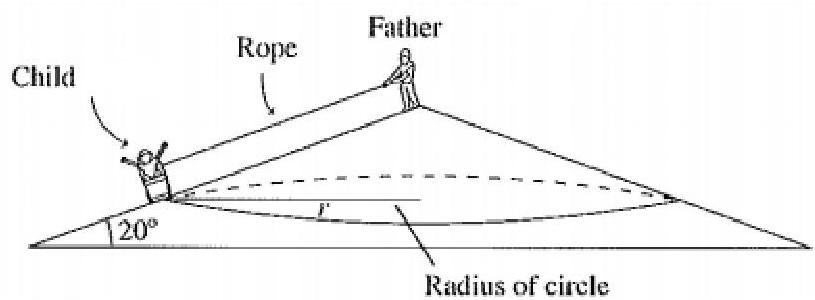
We need to all the forces acting on the system. According to the condition of the task the system has a total mass which is equal to 20kg. Then we can note the forces acting on the system. We have weight Mg which acts along the vertical, tension FT along the rope, FT making an angle of 20∘ with the horizontal and normal force FN perpendicular to the incline, with FN making an angle of 20∘ with the vertical.
We use a normal 2 dimensional coordinate system with the x-axis along the horizontal, y-axis along the vertical. The system rotates along the side of the hill; it describes a horizontal circle parallel to our x-axis and lying below the summit of the hill. Because of the circular motion, application of Newton's second law gives (we assume that 20∘ is measured relative to the horizontal).
FTcos(20∘)−FNsin(20∘)=Rmv2
(above equation holds true at the instant the (child) is on the right side of the hill with (+) force toward center of circular motion, (-) force away from center of circular motion).
Along the x-axis, v is the velocity (speed) of circular motion and R is the radius of circular motion lying along the horizontal circle below the summit, so that R equal to
R=Lcos(20∘),L=2.0m.
Along the vertical (y-axis) we get
FTsin(20∘)+FNcos(20∘)−Mg=0 (no motion along vertical).
From where we can find the value of the normal force FN.
FNcos(20∘)=Mg−FTsin(20∘)
Finally we can note the formula for normal force FN.
FN=cos(20∘)Mg−FTsin(20∘)
Now we substitute the value of FN into the first equation:
FTcos(20∘)−(cos(20∘)Mg−FTsin(20∘))sin(20∘)=Lcos(20∘)mv2
We know that cos(20∘)sin(20∘) equal to tan(20∘), so we can substitute this value into the formula noted above.
FTcos(20∘)−(Mg−FTsin(20∘))tan(20∘)=Lcos(20∘)mv2
Then we solve equation for FT:
FTcos(20∘)−Mgtan(20∘)+FTsin(20∘)tan(20∘)=Lcos(20∘)mv2
Simplify by taking out of the brackets the tension FT, we obtained the following result:
FT(cos(20∘)+sin(20∘)tan(20∘))=Mgtan(20∘)+Lcos(20∘)mv2
Rewrite the equation:
FT(cos(20∘)+sin(20∘)cos(20∘)sin(20∘))=Mgcos(20∘)sin(20∘)+Lcos(20∘)mv2cos(20∘)FT(cos(20∘)cos(20∘)+sin(20∘)sin(20∘))=cos(20∘)Mgsin(20∘)+Lmv2
Then we cos(20∘) cancels out and obtained the following result:
FT=Mgsin(20∘)+Lmv2
Now we need to find v before we get FT. To do that, we use the given 14 rpm. Now 14 rpm corresponds to 14 rev in a time of 60 s. Since increasing the elapsed time for a given period (time for one full turn) also increases the number of rev, we can use the following ratio and proportion. We can note
((elapsed time of one period P)1 rev)=(60 sec14 rev)
We can find the time of period, which is equal to
P=14 rev1 rev⋅60 sec=1460 sec=4.3 sec
Also we know that the distance traveled is one circumference C of a circle, which determined by the following formula:
vP=2πR=2πLcos(20∘)
From where we can find the value of v.
v=P2πLcos(20∘)=0.467πLcos(20∘)
Also we have to find the fraction Lv2, which will be equal to
Lv2=(0.467)2π2cos2(20∘)
Finally we can find the value of FT, we substitute the find values in the noted formula for determination tension force.
FT=(20⋅9.8⋅0.342)+20⋅2.0⋅(0.467)2(3.14)2(0.939692)2
Simplify the expression by opening the parenthesis.
FT=67.032+75.949=142.981 N
The rope tension will allow the cart to spin the same 14rpm with tension force equal to approximately 143 N.
https://www.AssignmentExpert.com



