Answer on Question #45285, Physics, Mechanics | Kinematics | Dynamics
A canon fires successively two shells with a velocity 240m/s . The first at angle of 55 degree and second at 40 degree with respect to horizon. Find the time interval between two fires such that two shells can collide in mid year.
Solution:
Given:
0=240m/s,θ1=55∘,θ2=40∘,t=?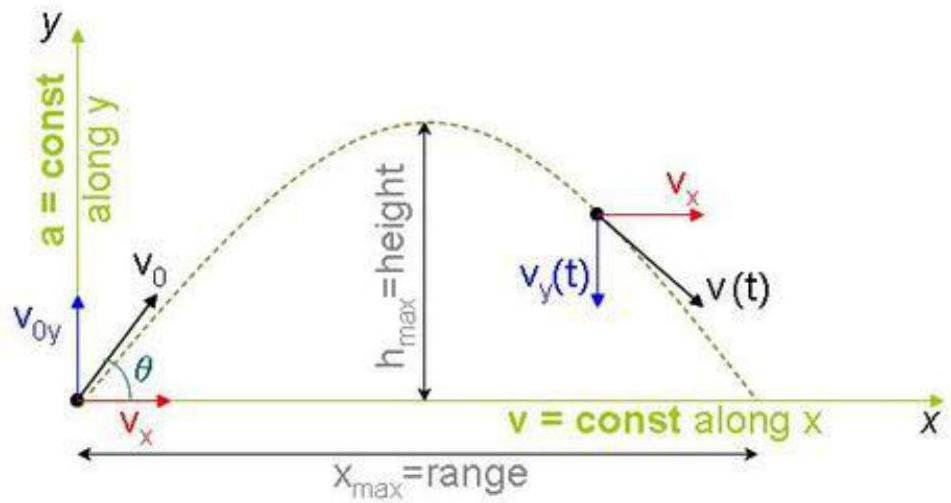
Projectile motion is a form of motion in which an object or particle (called a projectile) is thrown near the earth's surface, and it moves along a curved path under the action of gravity only.
In projectile motion, the horizontal motion and the vertical motion are independent of each other; that is, neither motion affects the other.
The horizontal component of the velocity of the object remains unchanged throughout the motion. The vertical component of the velocity increases linearly, because the acceleration due to gravity is constant (g=9.81m/s2).
Equations related to trajectory motion are given by
Horizontal distance,x=0xtVertical distance,y=y0+0yt−21gt2
Let t2 is time of flight of second shell, t is time interval between two fires.
Equations of motion of the first shell are given by
x=1x(t+t2)y=1y(t+t2)−21gt2
Equations of motion of the second shell are given by
x=2xt2y=2yt2−21gt2x=0cosθ=240⋅cos55∘=137.7m/sy=0sinθ=240⋅sin55∘=196.6m/s2x=0cosθ2=240⋅cos40∘=183.9m/s2y=0sinθ2=240⋅sin40∘=154.3m/s
We obtain system of two equations
x(t+t2)=2xt2y(t+t2)−21g(t+t2)2=2yt2−21gt22137.7(t+t2)=183.9t2196.6(t+t2)−4.9(t+t2)2=154.3t2−4.9t22
From first equation
t+t2=137.7183.9t2
Substituting to second equation
196.6137.7183.9t2−4.9(137.7183.9t2)2=154.3t2−4.9t22262.56−8.74t2=154.3−4.9t2
Thus,
t2=8.74−4.9256.56−154.3=3.84s
So,
t=(137.7183.9−1)t2=0.336t2=0.336⋅3.84=1.29s≈1.3s
Answer: t=1.29s≈1.3s.
http://www.AssignmentExpert.com/



 #340153 on Dec 2023