Question #43152

A particle is dropped vertically from rest, from a height. Find the time taken by
it to fall through successive distances of 1m each.

Expert's answer

Answer on Question #43152, Physics, Mechanics | Kinematics | Dynamics

A particle is dropped vertically from rest, from a height. Find the time taken by it to fall through successive distances of 1m each.
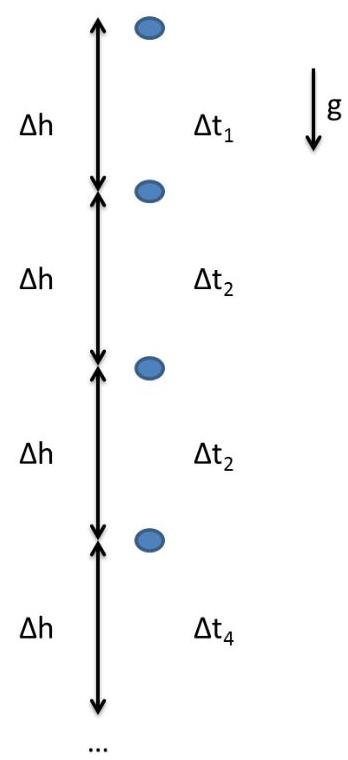


Solution.

From relations of uniformly accelerated motion:


l=V0t+at22l = V _ {0} t + \frac {a t ^ {2}}{2}


We have V0=0V_{0} = 0 , as the particle initially was at the state of rest. So for the first segment we have:


Δh=gΔt122Δt1=2Δhg\Delta h = \frac {g \Delta t _ {1} ^ {2}}{2} \Rightarrow \Delta t _ {1} = \sqrt {\frac {2 \Delta h}{g}}


For the first and second segments together:


2Δh=g(Δt1+Δt2)22Δt2=22ΔhgΔt1=4Δhg2Δhg=2Δhg(21)\begin{array}{l} 2 \Delta h = \frac {g (\Delta t _ {1} + \Delta t _ {2}) ^ {2}}{2} \Rightarrow \Delta t _ {2} = \sqrt {\frac {2 * 2 \Delta h}{g}} - \Delta t _ {1} = \sqrt {\frac {4 \Delta h}{g}} - \sqrt {\frac {2 \Delta h}{g}} \\ = \sqrt {\frac {2 \Delta h}{g}} \left(\sqrt {2} - 1\right) \\ \end{array}


For the first three segments together:


3Δh=g(Δt1+Δt2+Δt3)22Δt3=23ΔhgΔt2Δt1=4Δhg2Δhg(21)2Δhg=2Δhg(32)\begin{array}{l} 3 \Delta h = \frac {g \left(\Delta t _ {1} + \Delta t _ {2} + \Delta t _ {3}\right) ^ {2}}{2} \Rightarrow \Delta t _ {3} = \sqrt {\frac {2 * 3 \Delta h}{g}} - \Delta t _ {2} - \Delta t _ {1} \\ = \sqrt {\frac {4 \Delta h}{g}} - \sqrt {\frac {2 \Delta h}{g}} (\sqrt {2} - 1) - \sqrt {\frac {2 \Delta h}{g}} = \sqrt {\frac {2 \Delta h}{g}} (\sqrt {3} - \sqrt {2}) \end{array}


And so on. As one can see from relations for Δt1\Delta t_1 , Δt2\Delta t_2 and Δt3\Delta t_3 the relation for interval number ii will be next:


Δti=2Δhg(ii1)\Delta t _ {i} = \sqrt {\frac {2 \Delta h}{g}} \left(\sqrt {i} - \sqrt {i - 1}\right)


Numerically:


Δt1=2Δhg=21m10ms2=15s0.45s\Delta t _ {1} = \sqrt {\frac {2 \Delta h}{g}} = \sqrt {\frac {2 \cdot 1 m}{1 0 \frac {m}{s ^ {2}}}} = \sqrt {\frac {1}{5}} s \approx 0. 4 5 sΔt2=2Δhg(21)=21m10ms2(21)0.19s\Delta t _ {2} = \sqrt {\frac {2 \Delta h}{g}} (\sqrt {2} - 1) = \sqrt {\frac {2 \cdot 1 m}{1 0 \frac {m}{s ^ {2}}}} (\sqrt {2} - 1) \approx 0. 1 9 sΔt3=2Δhg(32)=21m10ms2(32)0.14s\Delta t _ {3} = \sqrt {\frac {2 \Delta h}{g}} (\sqrt {3} - \sqrt {2}) = \sqrt {\frac {2 \cdot 1 m}{1 0 \frac {m}{s ^ {2}}}} (\sqrt {3} - \sqrt {2}) \approx 0. 1 4 sΔti=2Δhg(ii1)=21m10ms2(ii1)0.45(ii1)s\Delta t _ {i} = \sqrt {\frac {2 \Delta h}{g}} \left(\sqrt {i} - \sqrt {i - 1}\right) = \sqrt {\frac {2 \cdot 1 m}{1 0 \frac {m}{s ^ {2}}}} \left(\sqrt {i} - \sqrt {i - 1}\right) \approx 0. 4 5 \left(\sqrt {i} - \sqrt {i - 1}\right) s


Answer: Δti0.45(ii1)s\Delta t_{i} \approx 0.45\left(\sqrt{i} - \sqrt{i - 1}\right)s

http://www.AssignmentExpert.com/


Need a fast expert's response?

Submit order

and get a quick answer at the best price

for any assignment or question with DETAILED EXPLANATIONS!

LATEST TUTORIALS
APPROVED BY CLIENTS

