Question #40140

8. a) A particle of mass 4.0 kg, initially moving with a velocity of 5 . 0 ms with a particle of mass 6.0 kg, initially moving with a velocity of 5.0ms− 1 collides elastically -8.0 ms-1. What are the velocities of the two particles before and after the collision in the centre of mass frame of reference? What are the velocities of the two particles after the collision in the laboratory frame?

b) A 30.0 kg girl stands at the rim of a merry-go-round that has a moment of inertia of 2 500 kg m and a radius of 3.00 m. The merry-go-round is initially at rest. The woman then starts walking around the rim clockwise at a constant speed of 2 . 0 ms-1 ,i) In what direction and with what angular speed does the merry-go-round rotate? ii) How much work does the girl do to set herself and the merry-go-round into motion

Expert's answer

Answer on Question #40140, Physics, Mechanics | Kinematics | Dynamics

a) A particle of mass 4.0kg4.0\mathrm{kg} , initially moving with a velocity of 5.0ms5.0\mathrm{ms} with a particle of mass 6.0kg6.0\mathrm{kg} , initially moving with a velocity of 5.0ms15.0\mathrm{ms}-1 collides elastically 8.0ms1-8.0\mathrm{ms}-1 . What are the velocities of the two particles before and after the collision in the center of mass frame of reference? What are the velocities of the two particles after the collision in the laboratory frame?

b) A 30.0kg30.0\mathrm{kg} girl stands at the rim of a merry-go-round that has a moment of inertia of 2500kgm2500\mathrm{kgm} and a radius of 3.00m3.00\mathrm{m} . The merry-go-round is initially at rest. The woman then starts walking around the rim clockwise at a constant speed of 2.0 ms-1, i) In what direction and with what angular speed does the merry-go-round rotate? ii) How much work does the girl do to set herself and the merry-go-round into motion.

Solution

a)
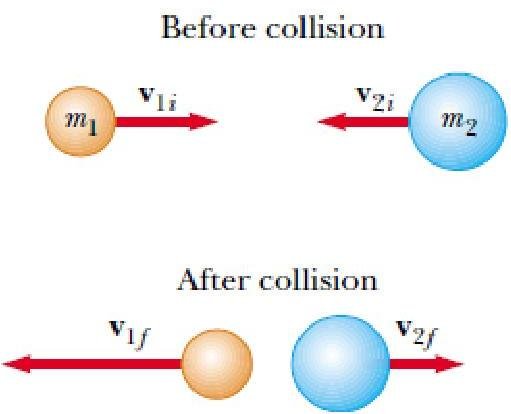

1) The laboratory frame.

Given:


m1=4.0kg,m2=6.0kg,v1i=5.0ms,v2i=5.0ms.m _ {1} = 4. 0 k g, m _ {2} = 6. 0 k g, v _ {1 i} = 5. 0 \frac {m}{s}, v _ {2 i} = - 5. 0 \frac {m}{s}.


Collision is elastic - both the momentum and kinetic energy of the system are conserved.


m2v2i+m1v1i=m1v1f+m2v2f.m _ {2} v _ {2 i} + m _ {1} v _ {1 i} = m _ {1} v _ {1 f} + m _ {2} v _ {2 f}.m2v2i22+m1v1i22=m1v1f22+m2v2f22.\frac {m _ {2} v _ {2 i} ^ {2}}{2} + \frac {m _ {1} v _ {1 i} ^ {2}}{2} = \frac {m _ {1} v _ {1 f} ^ {2}}{2} + \frac {m _ {2} v _ {2 f} ^ {2}}{2}.m2v2i+m1v1i=m1v1f+m2v2fm1(v1iv1f)=m2(v2fv2i).m _ {2} v _ {2 i} + m _ {1} v _ {1 i} = m _ {1} v _ {1 f} + m _ {2} v _ {2 f} \rightarrow m _ {1} \left(v _ {1 i} - v _ {1 f}\right) = m _ {2} \left(v _ {2 f} - v _ {2 i}\right).m2v2i22+m1v1i22=m1v1f22+m2v2f22m1(v1i2v1f2)=m2(v2f2v2i2).\frac {m _ {2} v _ {2 i} ^ {2}}{2} + \frac {m _ {1} v _ {1 i} ^ {2}}{2} = \frac {m _ {1} v _ {1 f} ^ {2}}{2} + \frac {m _ {2} v _ {2 f} ^ {2}}{2} \rightarrow m _ {1} \left(v _ {1 i} ^ {2} - v _ {1 f} ^ {2}\right) = m _ {2} \left(v _ {2 f} ^ {2} - v _ {2 i} ^ {2}\right).m1(v1i2v1f2)=m2(v2f2v2i2)m1(v1iv1f)(v1i+v1f)=m2(v2fv2i)(v2f+v2i).m _ {1} \left(v _ {1 i} ^ {2} - v _ {1 f} ^ {2}\right) = m _ {2} \left(v _ {2 f} ^ {2} - v _ {2 i} ^ {2}\right)\rightarrow m _ {1} \left(v _ {1 i} - v _ {1 f}\right)\left(v _ {1 i} + v _ {1 f}\right) = m _ {2} \left(v _ {2 f} - v _ {2 i}\right)\left(v _ {2 f} + v _ {2 i}\right).


To obtain our final result, we divide equation m1(v1iv1f)(v1i+v1f)=m2(v2fv2i)(v2f+v2i)m_{1}\big(v_{1i} - v_{1f}\big)\big(v_{1i} + v_{1f}\big) = m_{2}\big(v_{2f} - v_{2i}\big)\big(v_{2f} + v_{2i}\big) by equation m1(v1iv1f)=m2(v2fv2i)m_{1}\big(v_{1i} - v_{1f}\big) = m_{2}\big(v_{2f} - v_{2i}\big) and obtain


(v1i+v1f)=(v2f+v2i)(v1iv2i)=(v1fv2f).\left(v _ {1 i} + v _ {1 f}\right) = \left(v _ {2 f} + v _ {2 i}\right)\rightarrow \left(v _ {1 i} - v _ {2 i}\right) = - \left(v _ {1 f} - v _ {2 f}\right).


This equation, in combination with equation m2v2i+m1v1i=m1v1f+m2v2fm_2 v_{2i} + m_1 v_{1i} = m_1 v_{1f} + m_2 v_{2f} give us the final velocities:


v1f=m1m2m1+m2v1i+2m2m1+m2v2i=4.06.04.0+6.05.0+26.04.0+6.0(5.0)=7.0ms.v _ {1 f} = \frac {m _ {1} - m _ {2}}{m _ {1} + m _ {2}} v _ {1 i} + \frac {2 m _ {2}}{m _ {1} + m _ {2}} v _ {2 i} = \frac {4 . 0 - 6 . 0}{4 . 0 + 6 . 0} 5. 0 + \frac {2 \cdot 6 . 0}{4 . 0 + 6 . 0} (- 5. 0) = - 7. 0 \frac {m}{s}.v2f=2m1m1+m2v1i+m2m1m1+m2v2i=24.04.0+6.05.0+6.04.04.0+6.0(5.0)=3.0ms.v _ {2 f} = \frac {2 m _ {1}}{m _ {1} + m _ {2}} v _ {1 i} + \frac {m _ {2} - m _ {1}}{m _ {1} + m _ {2}} v _ {2 i} = \frac {2 \cdot 4 . 0}{4 . 0 + 6 . 0} 5. 0 + \frac {6 . 0 - 4 . 0}{4 . 0 + 6 . 0} (- 5. 0) = 3. 0 \frac {m}{s}.


The center of mass frame of reference.

Before the collision:


u1i=v1ivcm=v1im2v2i+m1v1im1+m2=5.06.0(5.0)+4.05.04.0+6.0=6.0ms.u _ {1 i} = v _ {1 i} - v _ {c m} = v _ {1 i} - \frac {m _ {2} v _ {2 i} + m _ {1} v _ {1 i}}{m _ {1} + m _ {2}} = 5. 0 - \frac {6 . 0 \cdot (- 5 . 0) + 4 . 0 \cdot 5 . 0}{4 . 0 + 6 . 0} = 6. 0 \frac {m}{s}.u2i=v2ivcm=v2im2v2i+m1v1im1+m2=5.06.0(5.0)+4.05.04.0+6.0=4.0ms.u _ {2 i} = v _ {2 i} - v _ {c m} = v _ {2 i} - \frac {m _ {2} v _ {2 i} + m _ {1} v _ {1 i}}{m _ {1} + m _ {2}} = - 5. 0 - \frac {6 . 0 \cdot (- 5 . 0) + 4 . 0 \cdot 5 . 0}{4 . 0 + 6 . 0} = - 4. 0 \frac {m}{s}.


After the collision:


u1f=u1i=6.0ms.u _ {1 f} = - u _ {1 i} = - 6. 0 \frac {m}{s}.u2f=u2i=4.0ms.u _ {2 f} = - u _ {2 i} = 4. 0 \frac {m}{s}.


b) i) If no external agent exerts a torque about the vertical axis through the center of the merry-go-round, the total angular momentum of the system (girl plus merry-go-round) about this axis remains constant. When the girl is at rest on the stationary merry-go-round, the total angular momentum of the system is zero (Li=0L_{i} = 0). As the girl starts walking around the axis, merry-go-round must develop a counterclockwise angular momentum whose magnitude equals of the girl's clockwise angular momentum. These two contributions to the total angular momentum will then cancel each other.

Treating the girl as the point object on the rim of merry-go-round (which r=3.00mr = 3.00 \, m from the axis), her moment of inertia about the central axis is Ig=mgr2I_g = m_g r^2. Taking counterclockwise angular momentum as positive the girl's clockwise angular momentum as she walks at constant speed vv relative to the Earth is


Lg=Igωg=(mgr2)(vr)=mgrv.L _ {g} = - I _ {g} \omega_ {g} = - \left(m _ {g} r ^ {2}\right) \left(\frac {v}{r}\right) = - m _ {g} r v.


The angular momentum of merry-go-round is Lm=ImωmL_{m} = I_{m}\omega_{m} and conservation of angular momentum requires that


Lfinal=Lm+Lg=Li=0 or Imωmmgrv=0.L _ {f i n a l} = L _ {m} + L _ {g} = L _ {i} = 0 \text{ or } I _ {m} \omega_ {m} - m _ {g} r v = 0.


Thus


ωm=mgrvIm=30.0kg3.00m2.0ms2500kgm=0.072rads counterclockwise.\omega_ {m} = \frac {m _ {g} r v}{I _ {m}} = \frac {3 0 . 0 \mathrm {k g} \cdot 3 . 0 0 \mathrm {m} \cdot 2 . 0 \frac {\mathrm {m}}{\mathrm {s}}}{2 5 0 0 \mathrm {k g} \cdot \mathrm {m}} = 0. 0 7 2 \frac {r a d}{s} \text{ counterclockwise}.


ii) The work-energy theorem gives the work done by the girl to set this system in motion as


Wnet=KEfKEi=(12Imωm2+12mgv2)0.W _ {n e t} = K E _ {f} - K E _ {i} = \left(\frac {1}{2} I _ {m} \omega_ {m} ^ {2} + \frac {1}{2} m _ {g} v ^ {2}\right) - 0.Wnet=12(2500kgm)(0.072rads)2+12(30.0kg)(2.0ms)2=66.5J.W _ {n e t} = \frac {1}{2} (2 5 0 0 \mathrm {k g} \cdot \mathrm {m}) \left(0. 0 7 2 \frac {r a d}{s}\right) ^ {2} + \frac {1}{2} (3 0. 0 \mathrm {k g}) \left(2. 0 \frac {\mathrm {m}}{\mathrm {s}}\right) ^ {2} = 6 6. 5 J.

Need a fast expert's response?

Submit order

and get a quick answer at the best price

for any assignment or question with DETAILED EXPLANATIONS!

LATEST TUTORIALS
APPROVED BY CLIENTS

