A truck on a straight road starts from rest and accelerates at 2.0m/s2 until it reaches a speed of 20m/s. Then the truck travels for 20 s at a constant speed until the brakes are applied, stopping the car in a uniform manner in an additional 5.0 s. How long is the truck in motion and what is its average velocity during the motion?
Solution
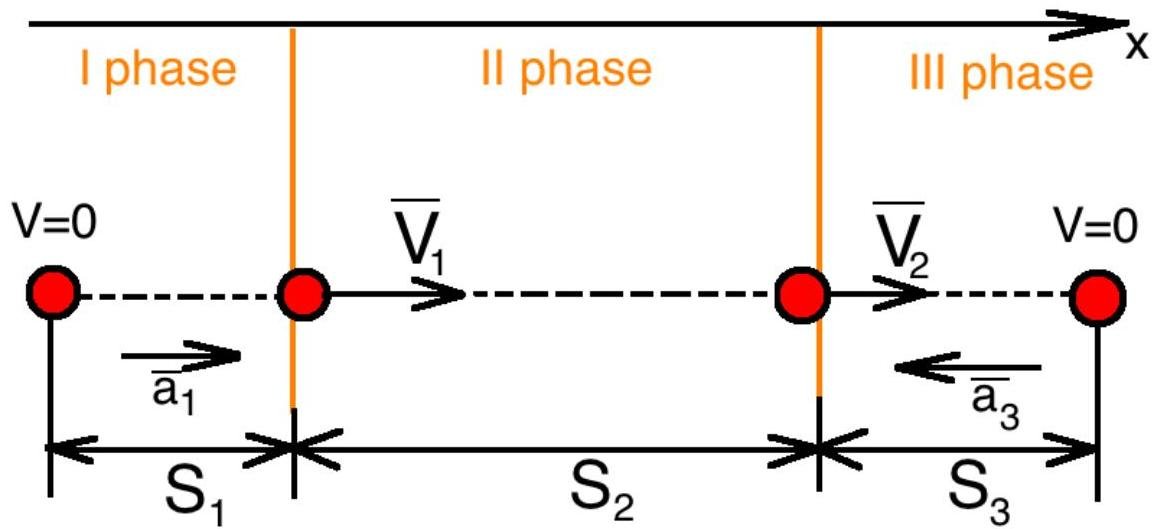
Assumption: to find the average speed we can break all path up into three phases: accelerating → coasting → decelerating.
First phase (accelerating)
Rate equation for the acceleration phase:
V1=a1t1t1=a1V1=2.0s2m20sm=10s
It means that accelerating will stop after 10 seconds because then the truck will reach velocity 20m/s.
Equation of motion for the acceleration phase:
S1=2a1t12=22.0s2m⋅(10s)2=100mSecond phase (coasting):
Truck travels path at 20m/s for 20 s:
S2=V2t2=20sm⋅20s=400mThird phase (decelerating):
Rate equation for the acceleration phase:
0=V2−a3t3a3=t3V2=5s20sm=4s2m
It means that accelerating will stop after 10 seconds because then the truck will reach velocity 20m/s.
Equation of motion for the deceleration phase:
S3=2a3t32=24s2m⋅(5s)2=50mAverage velocity=all timeall distance=t1+t2+t3S1+S2+S3=10s+20s+5s100m+400m+50m==15.7sm
Time of the travel is T=10s+20s+5s=35s.
Answer: average velocity during the motion is 15.7sm, truck was in motion during 35s.



 #339914 on Dec 2023