Question #36693

A sphere of radius 20 cm,has a total charge of 3.14 micro coulomb distributed on its surface.Calculate the electric potential at points, 5 cm, 10cm, 15 cm,20 cm,..............50 cm.what will be the possible graph?

Expert's answer

A sphere of radius 20cm20\mathrm{cm} , has a total charge of 3.14 micro coulomb distributed on its surface. Calculate the electric potential at points, 5cm5\mathrm{cm} , 10cm10\mathrm{cm} , 15cm15\mathrm{cm} , 20cm20\mathrm{cm} , ..., 50cm50\mathrm{cm} . what will be the possible graph?

Solution:

q=3.14×10⁶Ccharge of the sphere;q = 3.14 \times 10^{-6} C - \text{charge of the sphere};

R=20 cm=0.2 m\mathrm{R} = 20 \mathrm{~cm} = 0.2 \mathrm{~m} - radius of the sphere;

r - distance to the center of the sphere;
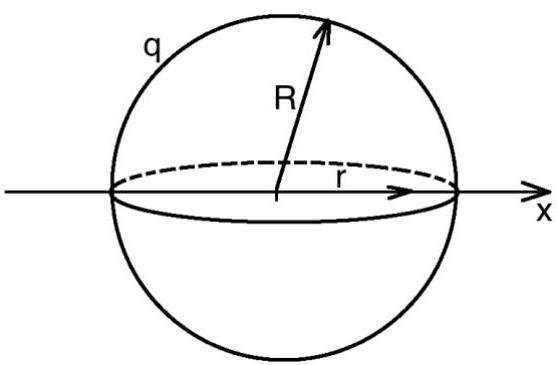


Formula for the electric potential of the sphere :


φ={qkr, if rRqkR, if r<R, where k=14πε0\varphi = \left\{ \begin{array}{l} \frac {\mathrm {q k}}{\mathrm {r}}, \text { if } \mathrm {r} \geq \mathrm {R} \\ \frac {\mathrm {q k}}{\mathrm {R}}, \text { if } \mathrm {r} < \mathrm {R} \end{array} , \text { where } \mathrm {k} = \frac {1}{4 \pi \varepsilon_ {0}} \right.=9×10⁹Nm2C2= 9 \times 1 0 ^ {9} \frac {\mathrm {N} \cdot \mathrm {m} ^ {2}}{\mathrm {C} ^ {2}}


Electric potential for the radius which is smaller than the sphere radius (r=5cm,10cm,15cm)(\mathrm{r} = 5\mathrm{cm},10\mathrm{cm},15\mathrm{cm})

φ5cm=φ10cm=φ15cm=φ20cm=qkR=\varphi_ {5 \mathrm {c m}} = \varphi_ {1 0 \mathrm {c m}} = \varphi_ {1 5 \mathrm {c m}} = \varphi_ {2 0 \mathrm {c m}} = \frac {\mathrm {q k}}{\mathrm {R}} ==3.14×10⁶C9×109Nm2C20.2m=141×103V= \frac {3 . 1 4 \times 1 0 ^ {- 6} \mathrm {C} \cdot 9 \times 1 0 ^ {9} \frac {\mathrm {N} \cdot \mathrm {m} ^ {2}}{\mathrm {C} ^ {2}}}{0 . 2 \mathrm {m}} = 1 4 1 \times 1 0 ^ {3} \mathrm {V}


Electric potential for the radius which is bigger than the sphere radius (r=20cm,25cm,30cm,35cm,40cm,45cm,50cm)(\mathrm{r} = 20\mathrm{cm},25\mathrm{cm},30\mathrm{cm},35\mathrm{cm},40\mathrm{cm},45\mathrm{cm},50\mathrm{cm})

φ25cm=qkr=3.14×10⁶C9×109Nm2C20.25m=113×103V\varphi_ {2 5 \mathrm {c m}} = \frac {\mathrm {q k}}{\mathrm {r}} = \frac {3 . 1 4 \times 1 0 ^ {- 6} \mathrm {C} \cdot 9 \times 1 0 ^ {9} \frac {\mathrm {N} \cdot \mathrm {m} ^ {2}}{\mathrm {C} ^ {2}}}{0 . 2 5 \mathrm {m}} = 1 1 3 \times 1 0 ^ {3} \mathrm {V}φ30cm=qkr=3.14×10⁶C9×109Nm2C20.3m=94×103V\varphi_ {3 0 \mathrm {c m}} = \frac {\mathrm {q k}}{\mathrm {r}} = \frac {3 . 1 4 \times 1 0 ^ {- 6} \mathrm {C} \cdot 9 \times 1 0 ^ {9} \frac {\mathrm {N} \cdot \mathrm {m} ^ {2}}{\mathrm {C} ^ {2}}}{0 . 3 \mathrm {m}} = 9 4 \times 1 0 ^ {3} \mathrm {V}φ35cm=qkr=3.14×10⁶C9×109Nm2C20.35m=81×103V\varphi_ {3 5 \mathrm {c m}} = \frac {\mathrm {q k}}{\mathrm {r}} = \frac {3 . 1 4 \times 1 0 ^ {- 6} \mathrm {C} \cdot 9 \times 1 0 ^ {9} \frac {\mathrm {N} \cdot \mathrm {m} ^ {2}}{\mathrm {C} ^ {2}}}{0 . 3 5 \mathrm {m}} = 8 1 \times 1 0 ^ {3} \mathrm {V}φ40cm=qkr=3.14×10⁶C9×109Nm2C20.4m=71×103V\varphi_ {4 0 \mathrm {c m}} = \frac {\mathrm {q k}}{\mathrm {r}} = \frac {3 . 1 4 \times 1 0 ^ {- 6} \mathrm {C} \cdot 9 \times 1 0 ^ {9} \frac {\mathrm {N} \cdot \mathrm {m} ^ {2}}{\mathrm {C} ^ {2}}}{0 . 4 \mathrm {m}} = 7 1 \times 1 0 ^ {3} \mathrm {V}φ45cm=qkr=3.14×10⁶C9×109Nm2C20.45m=63×103V\varphi_ {4 5 \mathrm {c m}} = \frac {\mathrm {q k}}{\mathrm {r}} = \frac {3 . 1 4 \times 1 0 ^ {- 6} \mathrm {C} \cdot 9 \times 1 0 ^ {9} \frac {\mathrm {N} \cdot \mathrm {m} ^ {2}}{\mathrm {C} ^ {2}}}{0 . 4 5 \mathrm {m}} = 6 3 \times 1 0 ^ {3} \mathrm {V}φ50cm=qkr=3.14×10⁶C9×109Nm2C20.5m=57×103V\varphi_ {5 0 \mathrm {c m}} = \frac {\mathrm {q k}}{\mathrm {r}} = \frac {3 . 1 4 \times 1 0 ^ {- 6} \mathrm {C} \cdot 9 \times 1 0 ^ {9} \frac {\mathrm {N} \cdot \mathrm {m} ^ {2}}{\mathrm {C} ^ {2}}}{0 . 5 \mathrm {m}} = 5 7 \times 1 0 ^ {3} \mathrm {V}


Possible graph for the electric potential:
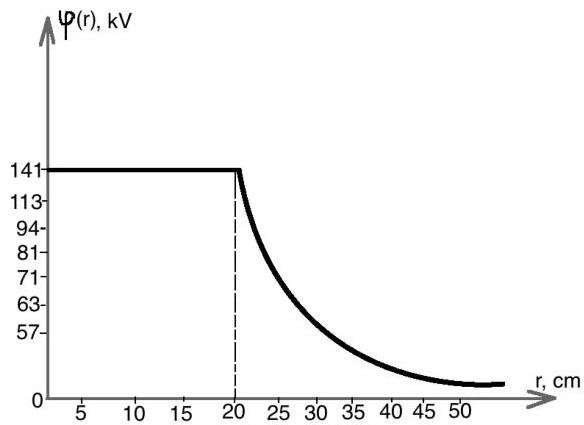


Answer: φ5cm=φ10cm=φ15cm=φ20cm=qkR=141×103 V\varphi_{5\mathrm{cm}} = \varphi_{10\mathrm{cm}} = \varphi_{15\mathrm{cm}} = \varphi_{20\mathrm{cm}} = \frac{\mathrm{qk}}{\mathrm{R}} = 141 \times 10^{3} \mathrm{~V}

φ25cm=113×103V\varphi_ {2 5 \mathrm {c m}} = 1 1 3 \times 1 0 ^ {3} \mathrm {V}φ30cm=94×103V\varphi_ {3 0 \mathrm {c m}} = 9 4 \times 1 0 ^ {3} \mathrm {V}φ35cm=81×103V\varphi_ {3 5 \mathrm {c m}} = 8 1 \times 1 0 ^ {3} \mathrm {V}φ40cm=71×103V\varphi_ {4 0 \mathrm {c m}} = 7 1 \times 1 0 ^ {3} \mathrm {V}φ45cm=63×103V\varphi_ {4 5 \mathrm {c m}} = 6 3 \times 1 0 ^ {3} \mathrm {V}φ50cm=57×103V\varphi_ {5 0 \mathrm {c m}} = 5 7 \times 1 0 ^ {3} \mathrm {V}

Need a fast expert's response?

Submit order

and get a quick answer at the best price

for any assignment or question with DETAILED EXPLANATIONS!

LATEST TUTORIALS
APPROVED BY CLIENTS

