Question #36415

An indestructible bullet 2.00 cm long is fired straight through a board that is 10.0 cm thick. The bullet strikes the board with a speed of 460 m/s and emerges with a speed of 300 m/s. (To simplify, assume that the bullet accelerates only while the front tip is in contact with the wood.)

a) what is the average acceleration of the bullet through the board? answer m/s^2
b) What is is the total time that the bullet is in contact with the board? answer s
c)What thickness of board (calculated to 0.1 cm) would it take to stop the bullet, assuming that the acceleration through all boards is the same? answer cm
Expert's answer

An indestructible bullet 2.00cm2.00 \, \text{cm} long is fired straight through a board that is 10.0cm10.0 \, \text{cm} thick. The bullet strikes the board with a speed of 460m/s460 \, \text{m/s} and emerges with a speed of 300m/s300 \, \text{m/s}. (To simplify, assume that the bullet accelerates only while the front tip is in contact with the wood.)

a) what is the average acceleration of the bullet through the board? answer m/s^2

b) What is the total time that the bullet is in contact with the board? answer s

c) What thickness of board (calculated to 0.1 cm) would it take to stop the bullet, assuming that the acceleration through all boards is the same? answer cm


Solution:

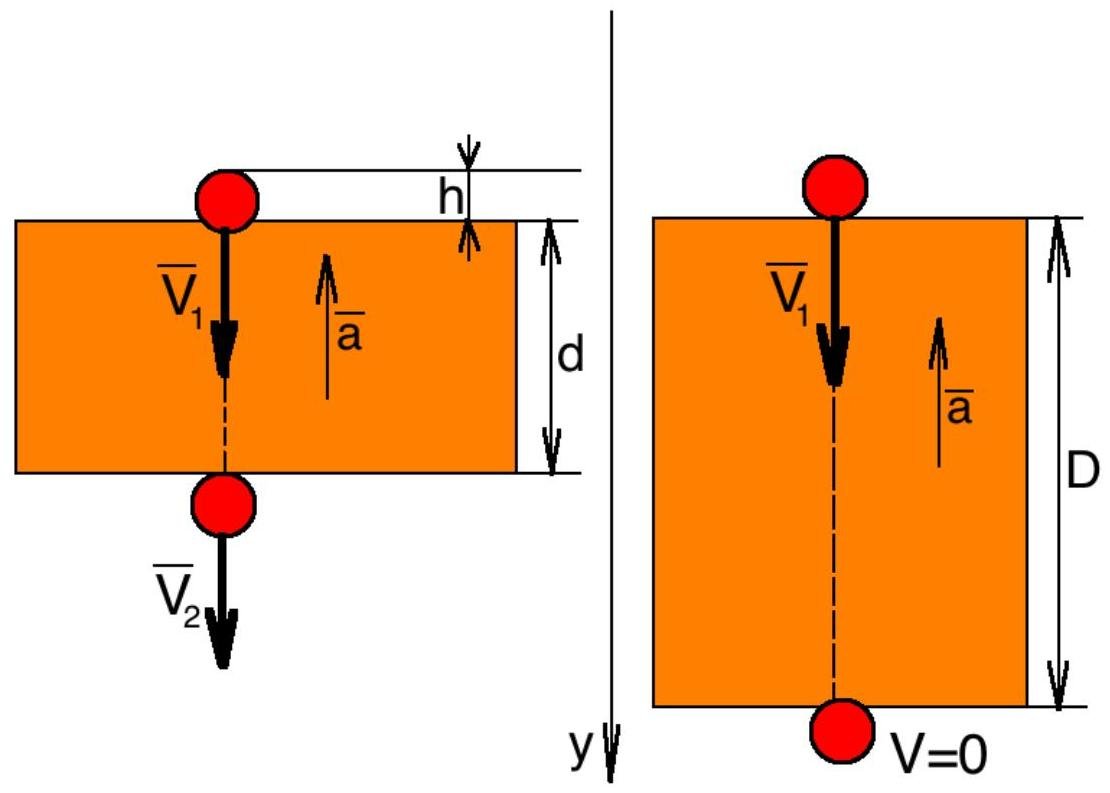
V1=460ms\mathrm{V}_{1} = 460\frac{\mathrm{m}}{\mathrm{s}} – the initial velocity of the bullet;

V2=300ms\mathrm{V}_{2} = 300\frac{\mathrm{m}}{\mathrm{s}} – final velocity of the bullet;

h=0.02m\mathrm{h} = 0.02\mathrm{m} – length of the bullet;

d=10cm=0.1m\mathrm{d} = 10\mathrm{cm} = 0.1\mathrm{m} – thickness of the board;

D\mathrm{D} – thickness of the board that stops the bullet;

a\mathrm{a} – acceleration inside the board.

t\mathrm{t} – total time that the bullet is in contact with the board

Assuming constant acceleration we can use the rate equation and motion equation to find the acceleration inside the board. Rate equation along the Y axis:


V2=V1atV _ {2} = V _ {1} - a tt=V1V2at = \frac {V _ {1} - V _ {2}}{a}


Motion equation along the Y axis:


d+h=V1tat22d + h = V _ {1} t - \frac {a t ^ {2}}{2}


(1) in (2):


d+h=V1(V1V2a)a(V1V2a)22d + h = V _ {1} \left(\frac {V _ {1} - V _ {2}}{a}\right) - \frac {a \left(\frac {V _ {1} - V _ {2}}{a}\right) ^ {2}}{2}2a(d+h)=2V1V2+2V12V12+2V1V2+V222 a (d + h) = - 2 V _ {1} V _ {2} + 2 V _ {1} ^ {2} - V _ {1} ^ {2} + 2 V _ {1} V _ {2} + V _ {2} ^ {2}2a(d+h)=V12+V222 a (d + h) = V _ {1} ^ {2} + V _ {2} ^ {2}a=V12+V222(d+h)=(460ms)2+(300ms)22(0.1m+0.02m)=18×103ms2a = \frac {V _ {1} ^ {2} + V _ {2} ^ {2}}{2 (d + h)} = \frac {\left(460 \frac {m}{s}\right) ^ {2} + \left(300 \frac {m}{s}\right) ^ {2}}{2 (0.1 m + 0.02 m)} = 18 \times 10 ^ {3} \frac {m}{s ^ {2}}


To find the total time that the bullet is in contact with the board we can use formula (1):


t=V1V2a=460ms300ms18×103ms2=8.9×10³st = \frac {V _ {1} - V _ {2}}{a} = \frac {460 \frac {m}{s} - 300 \frac {m}{s}}{18 \times 10 ^ {3} \frac {m}{s ^ {2}}} = 8.9 \times 10 ^ {- 3} s


If the thickness of the board will be DD, bullet will have the velocity V=0V = 0 after passing through the board, hence, the formula (1) will change to:


t2=V1V2a=V10a=V1at _ {2} = \frac {V _ {1} - V _ {2} ^ {\prime}}{a} = \frac {V _ {1} - 0}{a} = \frac {V _ {1}}{a}


Equation of the motion in this instance will change to:


D+h=V1tat22D + h = V _ {1} t - \frac {a t ^ {2}}{2}


(3) in (4):


D+h=V1(V1a)a(V1a)22D + h = V _ {1} \left(\frac {V _ {1}}{a}\right) - \frac {a \left(\frac {V _ {1}}{a}\right) ^ {2}}{2}D+h=V12aV122aD + h = \frac {V _ {1} ^ {2}}{a} - \frac {V _ {1} ^ {2}}{2 a}D+h=V122aD + h = \frac {V _ {1} ^ {2}}{2 a}D=V122ah=(460ms)2218×103ms20.02m=585.8cmD = \frac {V _ {1} ^ {2}}{2 a} - h = \frac {\left(460 \frac {m}{s}\right) ^ {2}}{2 \cdot 18 \times 10 ^ {3} \frac {m}{s ^ {2}}} - 0.02 m = 585.8 cm


Answer: a) 18×103ms218 \times 10^{3} \frac{m}{s^{2}}

b) 8.9×10³s8.9 \times 10^{-3} s

c) 585.8 cm

Need a fast expert's response?

Submit order

and get a quick answer at the best price

for any assignment or question with DETAILED EXPLANATIONS!

LATEST TUTORIALS
APPROVED BY CLIENTS

