Question #35579

if a disc of radius 5m is such that its density varies from its centre proportional to the sqr of distance ..
density at deistance 1 is 2kg/msqr then determine its MI about an axis through centre and perpendicular the plane

Expert's answer

if a disc of radius 5m5\mathrm{m} is such that its density varies from its centre proportional to the sqr of distance ..

density at distance 1 is 2kg/msqr2\mathrm{kg} / \mathrm{msqr} then determine its MI about an axis through centre and perpendicular the plane

Solution:

Density at distance 1m:


ρ1=αr12=2kgm2=α(1m)2α=2kgm4\rho_ {1} = \alpha r _ {1} ^ {2} = 2 \frac {k g}{m ^ {2}} = \alpha (1 m) ^ {2} \Rightarrow \alpha = 2 \frac {\mathrm {k g}}{m ^ {4}}

ρ=αr2\rho = \alpha r^2 - density of the disc;

R=5m\mathrm{R} = 5\mathrm{m} - radius of the disk.

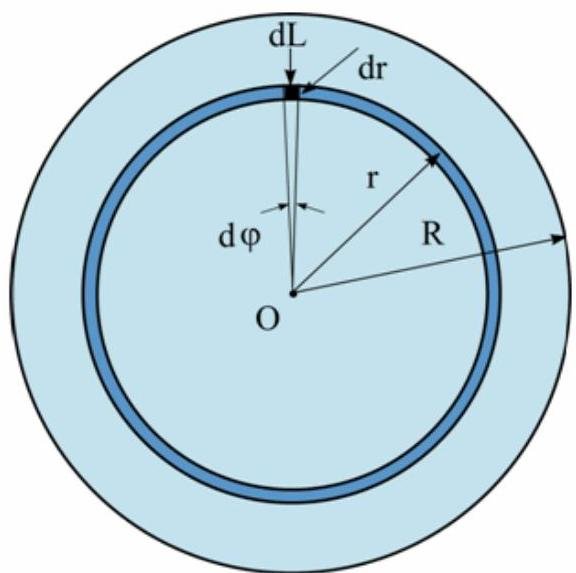
Let's take any element of the disc, which is located at a distance rr (see figure) and find the mass this element. For the point located at a distance rr , ρ=αr2\rho = \alpha r^2 . Mass of an element is equal to the product of area and area density:


dL=rdφ;\mathrm {d L} = \mathrm {r} \mathrm {d} \varphi ;dm=αr2dS=αr2drdL=αr2rdrdφ=αr3drdφ\mathrm {d m} = \alpha \mathrm {r} ^ {2} \cdot \mathrm {d S} = \alpha \mathrm {r} ^ {2} \cdot \mathrm {d r} \mathrm {d L} = \alpha \mathrm {r} ^ {2} \cdot \mathrm {r} \mathrm {d r} \mathrm {d} \varphi = \alpha \mathrm {r} ^ {3} \mathrm {d r} \mathrm {d} \varphi


Moment of inertia of the element relative to the selected axis through centre and perpendicular to the plane:


dJ=dmr2=αr3drdφr2=αr5drdφ\mathrm {d J} = \mathrm {d m} \mathrm {r} ^ {2} = \alpha \mathrm {r} ^ {3} \mathrm {d r} \mathrm {d} \varphi \mathrm {r} ^ {2} = \alpha \mathrm {r} ^ {5} \mathrm {d r} \mathrm {d} \varphi


To find the moment of inertia of the disk, we need to sum the moment of inertia of the element over the entire disk, so we need to take the integral of the ring, which elementary part is our element dJ\mathrm{dJ} ( 0rR,0φ2π0 \leq r \leq R, 0 \leq \varphi \leq 2\pi ):


J=02π0RdJ;J=02π0Rαr5drdφ=α02πdφ0Rr5dr=απr60R=απR6=3.142kgm4(5m)6=9.8×10⁴kgm2\begin{array}{l} J = \int_ {0} ^ {2 \pi} \int_ {0} ^ {R} d J; \\ J = \int_ {0} ^ {2 \pi} \int_ {0} ^ {R} \alpha r ^ {5} d r d \varphi = \alpha \int_ {0} ^ {2 \pi} d \varphi \int_ {0} ^ {R} r ^ {5} d r = \alpha \pi r ^ {6} \int_ {0} ^ {R} = \alpha \pi R ^ {6} \\ = 3. 1 4 \cdot 2 \frac {\mathrm {k g}}{\mathrm {m} ^ {4}} \cdot (5 \mathrm {m}) ^ {6} = 9. 8 \times 1 0 ^ {4} \mathrm {k g} \cdot \mathrm {m} ^ {2} \\ \end{array}


Answer: Moment of inertia of the disc is 9.8×10⁴kgm29.8 \times 10^{4} \, \mathrm{kg} \cdot \mathrm{m}^{2} .


Need a fast expert's response?

Submit order

and get a quick answer at the best price

for any assignment or question with DETAILED EXPLANATIONS!

LATEST TUTORIALS
APPROVED BY CLIENTS