Question #23614

A baseball is thrown at 25 m/sec at an angle of 30 degrees above the horizontal.
a) How far away does the ball land?
b) What is the minimum height reached?

- A football is kicked at an angle 45 degrees above the horizontal. What is its initial speed if it covers 150 ft?

-A golf ball leaves a tee at 60 m/sec. and at an angle of 50 degrees above the horizontal. Find:
a) The total time of flight
b) The maximum height reached
c) The horizontal distance covered.

Expert's answer

Task:

1. A baseball is thrown at 25 m/sec at an angle of 30 degrees above the horizontal.

a) How far away does the ball land?

b) What is the maximum height reached?

2. A football is kicked at an angle 45 degrees above the horizontal. What is its initial speed if it covers 150 ft?

3. A golf ball leaves a tee at 60 m/sec. and at an angle of 50 degrees above the horizontal. Find:

a) The total time of flight

b) The maximum height reached

c) The horizontal distance covered.

Solution:

1.
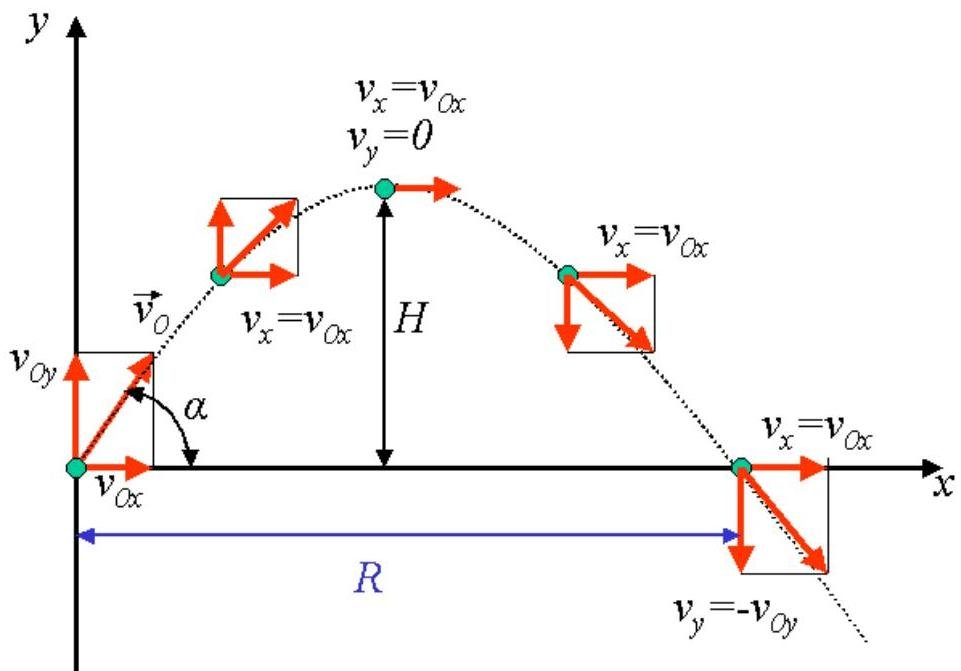

v0=25msv _ {0} = 2 5 \frac {m}{s}α=30\alpha = 3 0 {}^ {\circ}R=v0cosαtR = v _ {0} \cos \alpha \cdot tH=v0sinαt2g(t2)22=v02sin2α2gH = v _ {0} \sin \alpha \cdot \frac {t}{2} - g \cdot \frac {\left(\frac {t}{2}\right) ^ {2}}{2} = \frac {v _ {0} ^ {2} \sin^ {2} \alpha}{2 g}t=Rv0cosαt = \frac {R}{v _ {0} \cos \alpha}v0sinα(Rv0cosα)2g(Rv0cosα2)22=v02sin2α2gv _ {0} \sin \alpha \cdot \frac {\left(\frac {R}{v _ {0} \cos \alpha}\right)}{2} - g \cdot \frac {\left(\frac {R}{\frac {v _ {0} \cos \alpha}{2}}\right) ^ {2}}{2} = \frac {v _ {0} ^ {2} \sin^ {2} \alpha}{2 g}R=55.175mR = 55.175 \, \text{m}H=v02sin2α2g=7.964mH = \frac {v _ {0} ^ {2} \sin^ {2} \alpha}{2 g} = 7.964 \, \text{m}


2.


α=45\alpha = 45{}^{\circ}R=150ftR = 150 \, \text{ft}R=v0cosαtR = v _ {0} \cos \alpha \cdot tH=v0sinαt2g(t2)22=v02sin2α2gH = v _ {0} \sin \alpha \cdot \frac {t}{2} - g \cdot \frac {\left(\frac {t}{2}\right) ^ {2}}{2} = \frac {v _ {0} ^ {2} \sin^ {2} \alpha}{2 g}t=Rv0cosαt = \frac {R}{v _ {0} \cos \alpha}v0sinα(Rv0cosα)2g(Rv0cosα2)22=v02sin2α2gv _ {0} \sin \alpha \cdot \frac {\left(\frac {R}{v _ {0} \cos \alpha}\right)}{2} - g \cdot \frac {\left(\frac {R}{\frac {v _ {0} \cos \alpha}{2}}\right) ^ {2}}{2} = \frac {v _ {0} ^ {2} \sin^ {2} \alpha}{2 g}v0=69.444ft/sv _ {0} = 69.444 \, \text{ft/s}


3.


v0=60m/sv _ {0} = 60 \, \text{m/s}α=50\alpha = 50{}^{\circ}R=v0cosαtR = v _ {0} \cos \alpha \cdot tH=v0sinαt2g(t2)22=v02sin2α2gH = v _ {0} \sin \alpha \cdot \frac {t}{2} - g \cdot \frac {\left(\frac {t}{2}\right) ^ {2}}{2} = \frac {v _ {0} ^ {2} \sin^ {2} \alpha}{2 g}t=Rv0cosαt = \frac {R}{v _ {0} \cos \alpha}v0sinα(Rv0cosα)2g(Rv0cosα2)22=v02sin2α2gv _ {0} \sin \alpha \cdot \frac {\left(\frac {R}{v _ {0} \cos \alpha}\right)}{2} - g \cdot \frac {\left(\frac {\frac {R}{v _ {0} \cos \alpha}}{2}\right) ^ {2}}{2} = \frac {v _ {0} ^ {2} \sin^ {2} \alpha}{2 g}R=361.397mR = 361.397 \, \text{m}H=v02sin2α2g=107.674mH = \frac {v _ {0} ^ {2} \sin^ {2} \alpha}{2 g} = 107.674 \, \text{m}t=Rv0cosα=9.371st = \frac {R}{v _ {0} \cos \alpha} = 9.371 \, \text{s}


**Answer:**

1. a) R=55.175mR = 55.175 \, \text{m}

b) H=v02sin2α2g=7.964mH = \frac{v_0^2 \sin^2 \alpha}{2g} = 7.964 \, \text{m}

2. v0=69.444ftsv_{0} = 69.444 \frac{ft}{s}

3. a) t=Rv0cosα=9.371st = \frac{R}{v_0 \cos \alpha} = 9.371 \, \text{s}

b) H=v02sin2α2g=107.674mH = \frac{v_0^2 \sin^2 \alpha}{2g} = 107.674 \, \text{m}

c) R=361.397mR = 361.397 \, \text{m}

Need a fast expert's response?

Submit order

and get a quick answer at the best price

for any assignment or question with DETAILED EXPLANATIONS!

LATEST TUTORIALS
APPROVED BY CLIENTS

