Question #21725

a light ladder is supported on a rough floor and leans against a rough wall.how far up the ladder can a man climb without slipping taking place?

Expert's answer

A light ladder is supported on a rough floor and leans against a rough wall. How far up the ladder can a man climb without slipping taking place?

Solution.
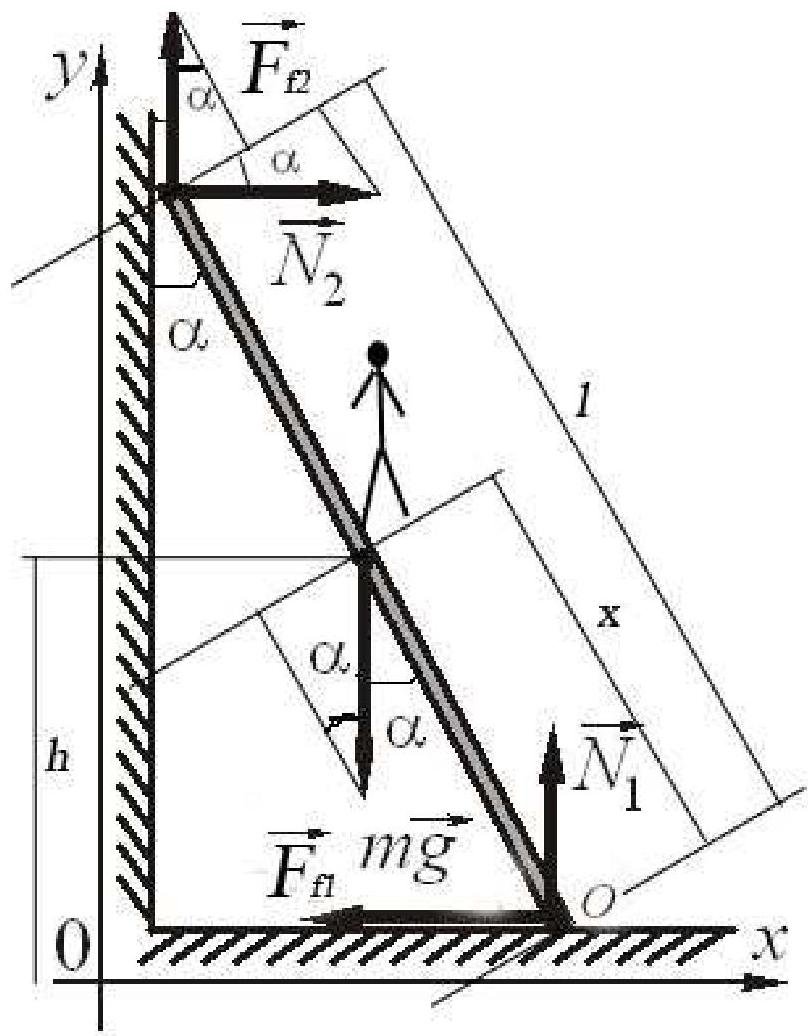

The necessary conditions for mechanical equilibrium for a system of particles.

The vector sum of all external forces is zero:

Projection on OX:


Ff1=N2;F _ {f 1} = N _ {2};


Projection on OY:


mg=N1+Ff2;m g = N _ {1} + F _ {f 2};


The forces of friction:


Ff1=μ1N1;F _ {f 1} = \mu_ {1} N _ {1};Ff2=μ2N2;F _ {f 2} = \mu_ {2} N _ {2};

μ1\mu_{1} is the coefficient of friction between the ladder and the floor;

μ2\mu_{2} is the coefficient of friction between the ladder and the wall.


μ1N1=N2;\mu_ {1} N _ {1} = N _ {2};N1=N2μ1;N _ {1} = \frac {N _ {2}}{\mu_ {1}};mg=N1+μ2N2;m g = N _ {1} + \mu_ {2} N _ {2};mg=N2μ1+μ2N2;m g = \frac {N _ {2}}{\mu_ {1}} + \mu_ {2} N _ {2};N2=μ1mg1+μ1μ2.N _ {2} = \frac {\mu_ {1} m g}{1 + \mu_ {1} \mu_ {2}}.


The sum of the moments of all external forces about line O is zero:


N2cosαl+Ff2sinαlmgcosαx=0;N _ {2} \cos \alpha l + F _ {f 2} \sin \alpha l - m g \cos \alpha x = 0;mgcosαx=N2cosαl+Ff2sinαl;m g \cos \alpha x = N _ {2} \cos \alpha l + F _ {f 2} \sin \alpha l;mgcosαx=N2cosαl+μ2N2sinαl;m g \cos \alpha x = N _ {2} \cos \alpha l + \mu_ {2} N _ {2} \sin \alpha l;mgcosαx=N2l(cosα+μ2sinα);m g \cos \alpha x = N _ {2} l (\cos \alpha + \mu_ {2} \sin \alpha);mgcosαx=μ1mgl1+μ1μ2(cosα+μ2sinα);m g \cos \alpha x = \frac {\mu_ {1} m g l}{1 + \mu_ {1} \mu_ {2}} (\cos \alpha + \mu_ {2} \sin \alpha);x=μ1mgl1+μ1μ2(cosα+μ2sinα)mgcosα;x = \frac {\mu_ {1} m g l}{1 + \mu_ {1} \mu_ {2}} \cdot \frac {(c o s \alpha + \mu_ {2} s i n \alpha)}{m g c o s \alpha};x=μ1l1+μ1μ2(cosα+μ2sinα)cosα;x = \frac {\mu_ {1} l}{1 + \mu_ {1} \mu_ {2}} \cdot \frac {(c o s \alpha + \mu_ {2} s i n \alpha)}{c o s \alpha};h=xcosα;h = x \cos \alpha ;h=μ1l1+μ1μ2(cosα+μ2sinα)cosαcosα;h = \frac {\mu_ {1} l}{1 + \mu_ {1} \mu_ {2}} \cdot \frac {(c o s \alpha + \mu_ {2} s i n \alpha)}{c o s \alpha} c o s \alpha ;h=μ1l(cosα+μ2sinα)1+μ1μ2.h = \frac {\mu_ {1} l (c o s \alpha + \mu_ {2} s i n \alpha)}{1 + \mu_ {1} \mu_ {2}}.


Answer:


h=μ1l(cosα+μ2sinα)1+μ1μ2.h = \frac {\mu_ {1} l (c o s \alpha + \mu_ {2} s i n \alpha)}{1 + \mu_ {1} \mu_ {2}}.

Need a fast expert's response?

Submit order

and get a quick answer at the best price

for any assignment or question with DETAILED EXPLANATIONS!

LATEST TUTORIALS
APPROVED BY CLIENTS

