Question #21711

an archer fires an arrow with an initial velocity of 4m/sec
atan elevation of 45 degrees.
calculate:
a) the max height attained
b) the time of flight
c) the max range of the arrow

Expert's answer

An archer fires an arrow with an initial velocity of 4m/sec4\mathrm{m / sec} at an elevation of 45 degrees. Calculate:

a) the max height attained;

b) the time of flight;

c) the max range of the arrow.

Solution.
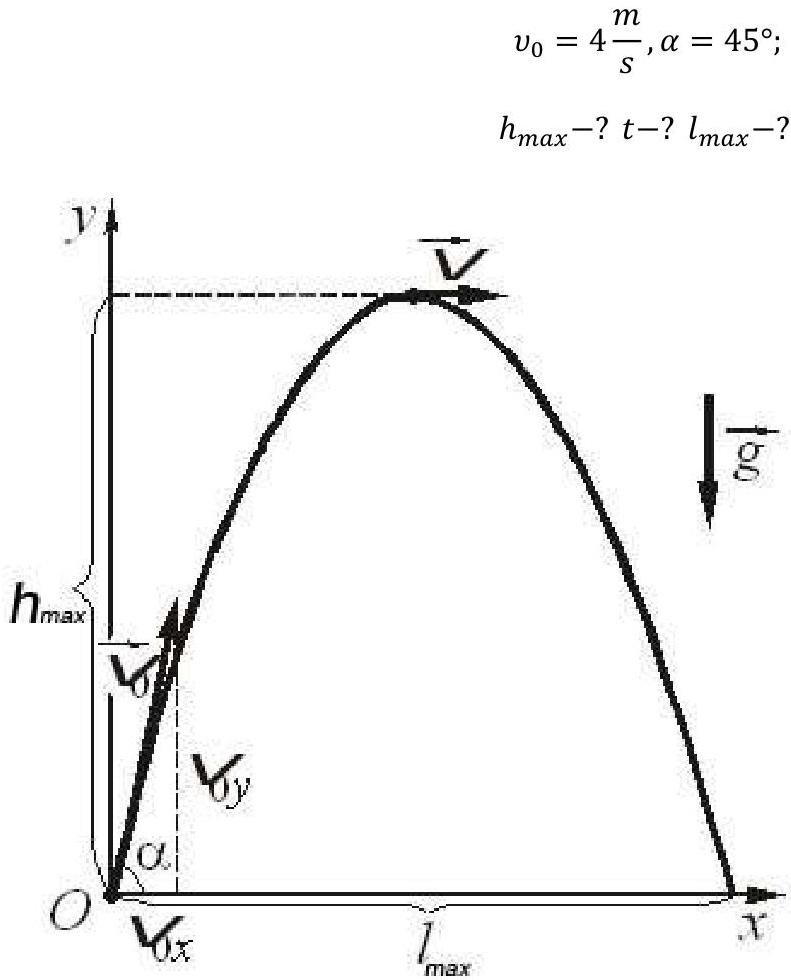
vx=v0cosα;v_{x} = v_{0}\cos \alpha ;

vy=v0sinα.v_{y} = v_{0}\sin \alpha .

a) the max height attained.

hmax=vy2v0y22g.h_{max} = \frac{v_y^2 - v_{0y}^2}{-2g}.

At the max height vy=0v_{y} = 0 :

hmax=v0y22g;h_{max} = \frac{-v_{0y}^2}{-2g};

hmax=v022g;h_{max} = \frac{v_0^2}{2g};

hmax=v02sin2α2g.h_{max} = \frac{v_0^2\sin^2\alpha}{2g}.

hmax=42sin24529.8=0.4(m).h_{max} = \frac{4^2 \cdot \sin^2 45{}^\circ}{2 \cdot 9.8} = 0.4(m).


b) the time of flight.


h=v0ytgt22;h = v_{0y} t - \frac{g t^2}{2};h=v0sinαtgt22.h = v_0 \sin \alpha t - \frac{g t^2}{2}.


At the end of the flight h=0h = 0:


0=v0sinαtgt22;0 = v_0 \sin \alpha t - \frac{g t^2}{2};v0sinαt=gt22;v_0 \sin \alpha t = \frac{g t^2}{2};v0sinα=gt2;v_0 \sin \alpha = \frac{g t}{2};t=2v0sinαg.t = \frac{2 v_0 \sin \alpha}{g}.t=24sin459.8=0.58(s);t = \frac{2 \cdot 4 \cdot \sin 45{}^\circ}{9.8} = 0.58(s);


c) the max range of the arrow.


lmax=v0xt;l_{max} = v_{0x} t;lmax=v0cosαt;l_{max} = v_0 \cos \alpha t;lmax=2v02sinαcosαg.l_{max} = \frac{2 v_0^2 \sin \alpha \cos \alpha}{g}.lmax=242sin45cos459.8=1.63(m).l_{max} = \frac{2 \cdot 4^2 \cdot \sin 45{}^\circ \cdot \cos 45{}^\circ}{9.8} = 1.63(m).


Answer:

a) the max height attained: hmax=0.4mh_{max} = 0.4m.

b) the time of flight: t=0.58st = 0.58s.

c) the max range of the arrow: lmax=1.63ml_{max} = 1.63m.


Need a fast expert's response?

Submit order

and get a quick answer at the best price

for any assignment or question with DETAILED EXPLANATIONS!

LATEST TUTORIALS
APPROVED BY CLIENTS

