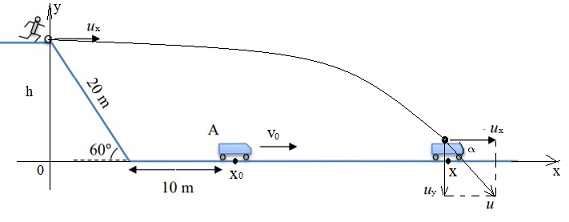
By the condition of the problem
V 0 = 5 m / s V_0=5m/s V 0 = 5 m / s a = 1.5 m / s 2 a=1.5 m/s^2 a = 1.5 m / s 2
During the fall of the ball from a height h h h The car will move to a point x x x
From the equation h = g ⋅ t 2 2 h=\frac{g \cdot t^2}{2} h = 2 g ⋅ t 2
Determine the time
t = 2 h g = 2 ⋅ 20 ⋅ sin ( 6 0 0 ) 9.81 = 1.879 s t=\sqrt{\frac{2h}{g}}=\sqrt{\frac{2 \cdot 20 \cdot \sin(60^0)}{9.81}}=1.879 s t = g 2 h = 9.81 2 ⋅ 20 ⋅ s i n ( 6 0 0 ) = 1.879 s
We write the value of the coordinate x x x for ball and car
x = u x ⋅ t x=u_x \cdot t x = u x ⋅ t
x = x 0 + V 0 ⋅ t + a ⋅ t 2 2 x=x_0+V_0 \cdot t +\frac{a \cdot t^2}{2} x = x 0 + V 0 ⋅ t + 2 a ⋅ t 2
we equate these equations
u x ⋅ t = x 0 + V 0 ⋅ t + a ⋅ t 2 2 u_x \cdot t=x_0+V_0 \cdot t +\frac{a \cdot t^2}{2} u x ⋅ t = x 0 + V 0 ⋅ t + 2 a ⋅ t 2
a)Where will we write (initial ball speed)
u x = x 0 t + V 0 + a ⋅ t 2 u_x =\frac{x_0}{t}+V_0 +\frac{a \cdot t}{2} u x = t x 0 + V 0 + 2 a ⋅ t
u x = 20 ⋅ cos 6 0 0 + 10 1.879 + 5 + 1.5 ⋅ 1.879 2 = 17.053 m / s u_x =\frac{20 \cdot \cos{60^0+10}}{1.879}+5 +\frac{1.5 \cdot 1.879}{2}=17.053m/s u x = 1.879 20 ⋅ c o s 6 0 0 + 10 + 5 + 2 1.5 ⋅ 1.879 = 17.053 m / s
Next we write
u y = g ⋅ t = 9.81 ⋅ 1.879 = 18.433 m / s u_y=g \cdot t=9.81 \cdot 1.879=18.433m/s u y = g ⋅ t = 9.81 ⋅ 1.879 = 18.433 m / s
Ball speed before hitting a car
u = u x 2 + u y 2 = 17.05 3 2 + 18.43 3 2 = 25.111 m / s u=\sqrt{u_x^2+u_y^2}=\sqrt{17.053^2+18.433^2}=25.111m/s u = u x 2 + u y 2 = 17.05 3 2 + 18.43 3 2 = 25.111 m / s
The angle with the x axis is
α = arccos u x u = arccos 17.053 25.111 = 47.22 6 0 \alpha=\arccos{\frac{u_x}{u}}=\arccos{\frac{17.053}{25.111}}=47.226^0 α = arccos u u x = arccos 25.111 17.053 = 47.22 6 0
Comments

