Answer on Question #43573 – Physics - Electric Circuits
a uniform wire of resistance 15ohms is cut into three pieces in ratio 1:2:3 and the three pieces are connected to form a triangle. a cell of 10V potential with internal resistance 1ohm is connected across the highest of three resistors. calculate the current through each part of the circuit.
Solution:
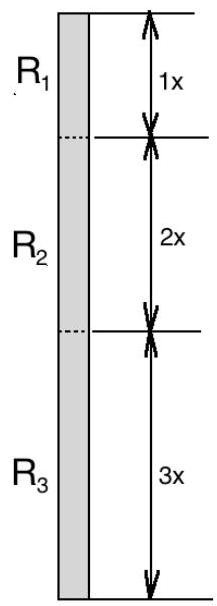
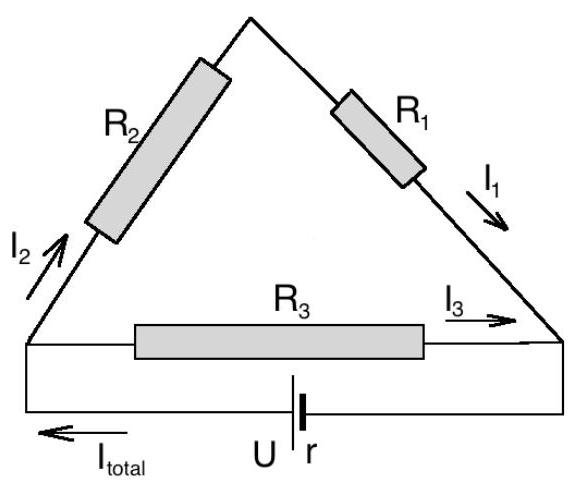
R=15Ohm - resistance of the uniform wire;
1x:2x:3x− ratio of the three pieces;
U=10 V - potential of the cell;
r=1Ohm - internal resistance of the cell;
Since the resistance is linearly proportional to the length of the wire (R=ρSL,L−length) , the ratio of the three resistances of the pieces is equal to the ratio of the lengths of the pieces:
R1:R2:R3=1:2:3R3=3R1R2=2R1
The sum of these resistances is equal to the resistance of the uniform ware. We have an equation:
R=R1+R2+R3R=R1+2R1+3R1R=6R1R1=6R;R2=62R;R3=63R=2R
In a series configuration, the current through all of the resistors is the same, and resultant resistance is equal to the sum of the resistances:
R12=R1+R2=6R+62R=63R=2R
Formula for the resultant resistance for the parallel configuration:
Rtotal1=R31+R121Rtotal=R3+R12R3R12=R3+R12R3R12=2R+2R2R⋅2R=R4R2=4R
Formula for the total current through the circuit (Ohm's law):
Itotal=Rtotal+rU=4R+rU=415 Ohm+1 Ohm10V=2.1 A
Resistors R3=2R and R12=2R in a parallel configuration are each subject to the same potential difference (voltage), however the currents through them add, since R3=R12⇒I3=I2=2Itotal=22.105 A=1.05 A (current is halved).
In a series configuration (resistors R1 and R2), the current through all of the resistors is the same:
I1=I2=1.05 A
Answer: I1=I2=I3=1.05 A;
Itotal=2.1 A
http://www.AssignmentExpert.com/



 #340153 on Dec 2023