The resistance of 500 ohm and 3000 ohm are placed in series with a 60V supply. What will be the reading on a voltmeter of internal resistance of 2000 ohm when placed across-
1) 500 ohm resistors;
2) 3000 ohm resistors.
Solution.
R1=500Ohm,R2=3000Ohm,V=60V,RV=2000Ohm;V1−?V2−?
1)
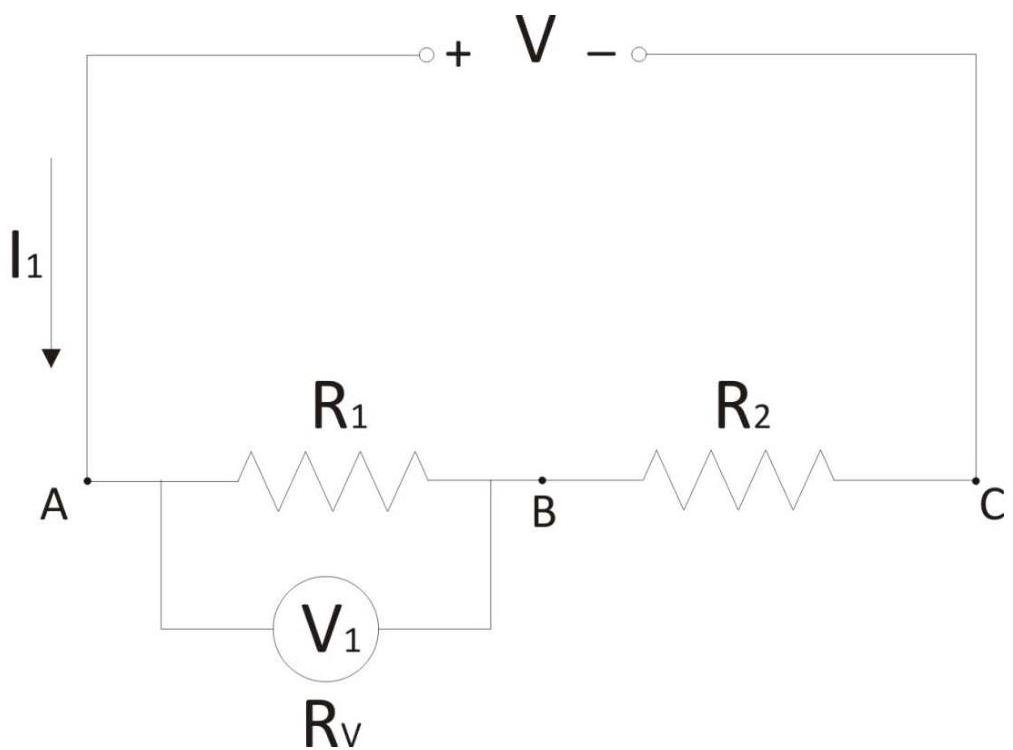
The resistance between the points A and B :
RAB1=R11+RV1;RV - the internal resistance of the voltmeter.
RAB=R1+RVR1RV.
The resistance between the points A and C :
RAC=RAB+R2;RAC=R1+RVR1RV+R2;RAC=R1+RVR1RV+R1R2+RVR2.
By Ohm's law the amperage I1 is:
I1=RACV;I1=R1RV+R1R2+RVR2V(R1+RV).
The voltage across resistance R1 is the same as the voltage across voltmeter and the same as the voltage across the points A and B then:
V1=I1RAB;V1=R1RV+R1R2+RVR2V(R1+RV)⋅R1+RVR1RV;V1=R1RV+R1R2+RVR2VR1RV.V1=500⋅2000+500⋅3000+2000⋅300060⋅500⋅2000=7.06(V).
2)
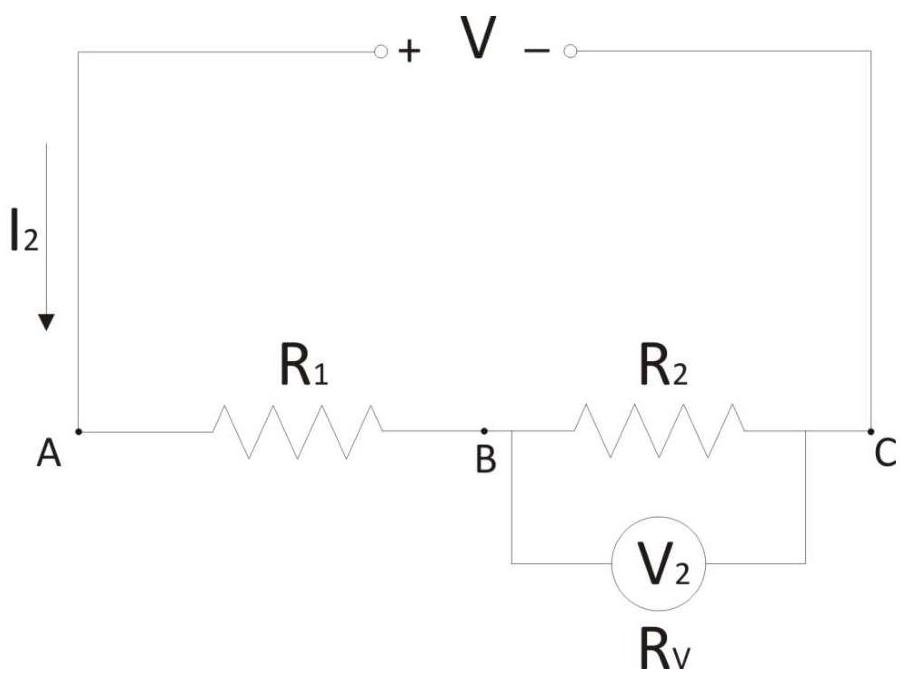
The resistance between the points B and C :
RBC1=R21+RV1;RV - the internal resistance of the voltmeter.
RBC=R2+RVR2RV.
The resistance between the points A and C :
RAC=R1+RBC;RAC=R1+R2+RVR2RV;RAC=R2+RVR1R2+R1RV+R2RV.
By Ohm's law the amperage I2 is:
I2=RACV;I2=R1R2+R1RV+R2RVV(R2+RV).
The voltage across resistance R2 is the same as the voltage across voltmeter and the same as the voltage across the points B and C then:
V2=I2RBC;V2=R1R2+R1RV+R2RVV(R2+RV)⋅R2+RVR2RV;V2=R1RV+R1R2+RVR2VR2RV.V2=500⋅2000+500⋅3000+2000⋅300060⋅3000⋅2000=42.35(V).
Answer:
1) V1=7.06V;
2) V2=42.35V.



