Answer on Question 58092, Physics, Astronomy, Astrophysics
Question:
The change in the value of acceleration of Earth towards Sun, when the Moon comes from the position of solar eclipse to the position on the other side of Earth in line with the Sun is? (mass of Moon is 7.36⋅1022kg , orbital radius of Moon is 3.82⋅108m )
Solution:
Let's draw, for clarity, the free-body diagrams for Earth in the two situations (solar eclipse and lunar eclipse):
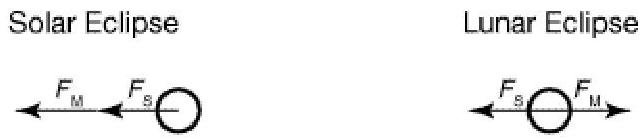
Here, FS is the magnitude of the gravitational attraction of the Sun on Earth, FM is the magnitude of the gravitational attraction of the Moon on the Earth. It is obvious, that the magnitudes of the net forces acting on the Earth are FS+FM in case of a solar eclipse and FS−FM in case of a lunar eclipse.
Let's write the forces FS and FM using the Newton's Law of Universal Gravitation:
FS=GDS2MSME,FM=GDM2MMME,
here, G is the universal gravitational constant, MS is the mass of the Sun, ME is the mass of the Earth, MM is the mass of the Moon, DS is the distance from the Earth to the Sun, DM is the distance from the Earth to the Moon.
It is obviously, that the net forces acting on the Earth in cases of the solar eclipse and the lunar eclipse are balanced by the Earth's acceleration MEa :
MEaS=∑F=FS+FM,MEaL=∑F=FS−FM,MEaS=GDS2MSME+GDM2MMME,MEaL=GDS2MSME−GDM2MMME,aS=G(DS2MS+DM2MM),aL=G(DS2MS−DM2MM),
here, aS is the acceleration of Earth in case of the solar eclipse, aL is the acceleration of Earth in case of the lunar eclipse.
Then, we can find the change in the value of acceleration of Earth towards Sun, when the Moon comes from the position of solar eclipse to the position on the other side of Earth in line with the Sun:
aS=G(DS2MS+DM2MM)=6.67⋅10−11kg2N⋅m2⋅((1.50⋅1011m)21.99⋅1030kg+(3.82⋅108m)27.36⋅1022kg)=0.00593288s2m.aL=G(DS2MS−DM2MM)=6.67⋅10−11kg2N⋅m2⋅((1.50⋅1011m)21.99⋅1030kg−(3.82⋅108m)27.36⋅1022kg)=0.0058656s2m.aS−aL=0.00593288s2m−0.0058656s2m=0.0000673s2m=6.73⋅10−5s2m.
Answer:
aS−aL=6.73⋅10−5s2m.
http://www.AssignmentExpert.com/



 #340153 on Dec 2023