Solve by Factoring
1. x2−x−20=0
2. x(14x−15)=9
**Solution:**
A quadratic equation is a polynomial that looks like ax2+bx+c, where a,b, and c are numbers. For the easy case of factoring, we will find two numbers that will not only multiply to equal the constant term c, but also add up to equal b, the coefficient on the x-term.
This equation is already in the form quadratic equals zero: x2−x−20=0.
We need to find factors of −20 that add up to 1. Since −20 can be written as the product of -4 and 5, and since 5+(−4)=1, then we will use -4 and 5. From multiplying polynomials that this quadratic is formed from multiplying two factors of the form (x+m)(x+n), for some numbers m and n. We will write in the two numbers that we found above:
(x+4)(x−5)=0
Solve each factor: (x+4)=0,x=−4;(x−5)=0,x=5.
The solutions to x2−x−20=0 are x=5,−4
Checking x=5 in x2−x−20=0
(5)2−5−20=025−5−20=020−20=00=0
Checking x=−4 in x2−x−20=0
(−4)2−(−4)−20=016+4−20=020−20=00=0
We check both solutions of quadratic equation.
**Another variant to solve equation**
To solve this problem we multiplying a and c (a=1,c=−20). We get (1)(−20)=−20.

We can subtract the pairs to find the differences. If there is a pair of factors with a difference of 1, then we can factor the quadratic. Now that we have factor pair (with the larger number having the "minus" sign), factor the quadratic:

Subtract into quadratic equation x2−x−20=x2+4x−5x−20=x(x+4)−5(x+4)=(x−5)(x+4)=0
The solutions to x2−x−20=0 are x=5,−4 .
2. x(14x−15)=9
Compare our equation to the standard form, ax2+bx+c : 14x2−15x−9=0
Identify values a,b and c . ( a=14,b=−15 and c=−9 ). Find a pair of factors of a×c=14×(−9)=−126 , whose sum is b=−15 .
We note the possibilities in a table:
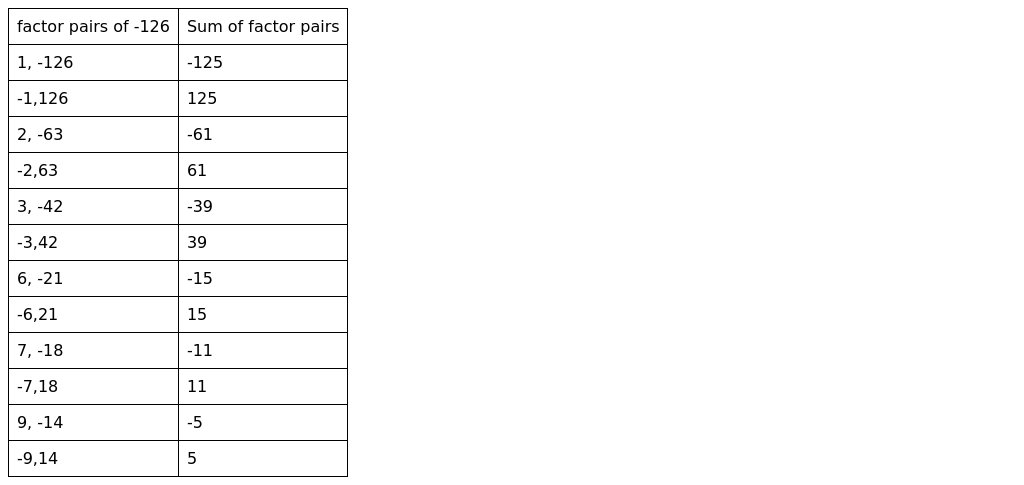
Using the factor pairs [6, -21], which get sum b equal =−15 . Rewrite our equation replacing the term −15x with 6x and −21x .
Subtract into equation 14x2−15x−9=14x2+6x−21x−9=0
14x2+6x−21x−9=0
Group the first two terms and the last two terms on the left side:
(14x2+6x)+(−21x−9)=0
Factor common factors:
2x(7x+3)−3(7x+3)=0
The two quantities in parentheses are the same. We have common quantity (7x+3), so we can factor it out:
(7x+3)(2x−3)=0
Solve each factor: (7x+3)=0,7x=−3,x=−73;(2x−3)=0,2x=3,x=23.
The solutions to x2−x−20=0 are x=−73,23
Checking x=−73 in 14x2−15x−9=0
14⋅(−73)2−15⋅(−73)−9=0(14⋅499)+745−9=0718+745−9=0763−9=09−9=0
Checking x=23 in 14x2−15x−9=0
14⋅(23)2−15⋅23−9=014⋅49−245−9=0263−245−9=0218−9=09−9=0
The solutions to 14x2−15x−9=0 are x=23,x=−73.



 #340153 on Dec 2023